Where can you make maple syrup?
The maple belt
Core sugaring regions
- Connecticut~Feb 12
- Illinois
- Indiana~Feb 10
- Iowa
- Kentucky
- Maine~Mar 4
- Massachusetts~Feb 24
- Michigan~Mar 5
- Minnesota~Mar 6
- Missouri
- New Brunswick
- New Hampshire~Feb 28
- New York~Feb 28
- Nova Scotia
- Ohio~Feb 18
- Ontario
- Pennsylvania~Feb 25
- Quebec~Mar 14
- Vermont~Mar 2
- West Virginia~Feb 4
- Wisconsin~Mar 15
Beyond the belt
More US states
Alabama
MarginalMarginal: Alabama Extension's native-tree key lists sugar, red, silver, chalk and Florida maple plus boxelder, so the trees exist (mostly in the north), but freeze-thaw runs are brief and no Alabama producer, festival or extension sugaring program was found.
Alaska
NoNo for maple — Alaska has no native tappable maple (only shrubby Douglas maple in the southeast and a few planted yard maples) — but yes for birch: Alaska is home to the world's largest birch-syrup producer (Kahiltna Birchworks, Talkeetna), UAF Extension publishes tapping guidance, and the Interior and Mat-Su run a 2–3-week sap season from about mid-April.
Arkansas
In partsYes in the Ozark highlands: native sugar maples are 'best suited to northwest Arkansas', a Newton County family has boiled syrup for generations, and Searcy County hobbyists tap every winter — the Delta and south have only red, silver and boxelder with too few freeze-thaw days.
California
MarginalMarginal: bigleaf maple grows from the North Coast through the Sierra foothills, and a 2025 Humboldt State study tapped 24 trees for six weeks — but sap flow fell as temperatures rose, the authors judged the species' southern range 'not suitable for large-scale commercial expansion' though possible for hobbyists, and no California producer was found.
Colorado
MarginalMarginal: Colorado has native boxelder in every river bottom, planted silver and Norway maples in every Front Range town, and the freeze-thaw swings are there — but no Colorado producer, festival or extension sugaring program was found; the only regional record is Colorado Plateau hobbyists tapping box elder.
Delaware
MarginalMarginal: all the eastern tappable maples grow in Delaware and the Delaware Nature Society taps sugar maples for an annual March festival in the Piedmont corner (Hockessin), but the state is small, low and coastal, the freeze-thaw window is short, and no Delaware producer or extension program was found.
Georgia
MarginalMarginal: sugar and silver maple reach only the far-north Georgia mountains, red maple and Florida maple grow statewide but the freeze-thaw window is short and unreliable, and no Georgia producer, festival or extension program could be found in this session's searches.
Idaho
In partsYes in eastern Idaho's bigtooth maple hills and in town: the USFS estimates 2.1 million tappable bigtooth maples, University of Idaho Extension (Franklin County) is a partner in the USU-led USDA syrup project, a UI educator's bigtooth syrup matched eastern sugar content, and 'Idaho's Sugar Bush' sells bigtooth and boxelder syrup — but sap volume is about half of Vermont's and trees are small.
Kansas
In partsYes in the eastern third and along northern river towns: sugar maple reaches eastern Kansas, silver maple and boxelder line every creek and street, and a small-town crew in Republic County has boiled syrup commercially since about 2013 — but trees are scattered and the season is short.
Maryland
In partsYes in western Maryland: Garrett County has made syrup commercially since at least 1908 and the state park service has boiled sap at Cunningham Falls for 50+ years; the Piedmont and Eastern Shore have red and silver maple but a shorter, less reliable freeze-thaw window.
Montana
In partsYes in western Montana's valley towns: Missoula's Montana MapleWorks is the state's only licensed producer (planted Norway, silver and sugar maples plus native boxelder), MSU Extension runs tapping workshops, and ASHS-published trials measured 9–30 L of sap per tree per season — but the window is short, urban trees are stressed by hot summers, and east of the Divide the only natives are boxelder and birch.
Nebraska
In partsYes at hobby scale in the east: silver maple and boxelder are the native tappable trees along every Nebraska river and in every town, and the Nebraska Forest Service has written about prairie sugaring — but sugar maple is not native, the freeze-thaw window is variable, and no Nebraska producer was found; the one Nebraska-specific article could not be opened, so this entry leans on neighbouring Plains extension sources.
New Jersey
YesYes: sugar maple is native in the north and centre and 'many small farms tap trees for syrup'; in South Jersey, where sugar maple is nearly absent, Stockton University's USDA-funded Maple Project has shown red maple can be sugared with vacuum and reverse osmosis.
North Carolina
In partsYes in the high mountains: sugar maple reaches its southern native limit in the northwestern NC mountains, where two commercial producers (Ashe and Yancey counties) run 450–500 taps each on a ~six-week season; the Piedmont gets only brief, unreliable runs and the Coastal Plain none.
North Dakota
In partsYes with boxelder: NDSU's extension forester says 'quite a few people' make syrup from boxelder, a state park holds an annual Maple Sugaring Day, and the native boxelder lines every river bottom and shelterbelt — but there is no native sugar maple, the window is 'very narrow', and it opens in March, weeks later than the East.
Oklahoma
MarginalMarginal but under active study: five native maples grow in eastern Oklahoma and the Wichita Mountains, and Oklahoma State University holds USDA and state grants (2022–2026) to test syrup from them — but OSU itself says the industry 'currently does not exist in Oklahoma' and no producer was found.
Oregon
In partsYes in western Oregon: bigleaf maple is everywhere from the Coast Range to the Cascade foothills, OSU Extension publishes a hobbyist guide and runs a USDA-funded bigleaf project with the Oregon Maple Project and Oregon Tree Tappers, and Willamette Valley sugarmakers run 100+ taps — but sap is about half as sweet as sugar maple and some winters bring no freeze at all.
Rhode Island
YesYes: Rhode Island has a small working sugaring scene — Spring Hill Sugar House (Richmond) taps 3,000 trees and Uncle Buck's (Hopkinton) has run since 1997, the state Senate proclaims March 'Maple Syrup Month' — though sugar maple is 'uncommon' here and much of the crop comes from red, swamp and Norway maples with leaner sap.
South Carolina
MarginalMarginal: sugar and silver maple reach only the Blue Ridge escarpment of the Upstate (Oconee, Pickens, Greenville), red and Florida maple are common statewide but break bud early and the Piedmont/Lowcountry seldom get a sustained freeze-thaw run; Clemson Extension discusses tapping only in passing and no South Carolina producer was found.
South Dakota
In partsYes in eastern South Dakota towns and shelterbelts with silver maple and boxelder (SDSU Extension publishes two how-to guides and runs tapping workshops); sugar maple is rare and 'listed as rare in South Dakota where it is at the western edge of its range', and the Plains freeze-thaw window can be 'a few days to a month'.
Tennessee
In partsYes in East Tennessee's mountains and the Cumberland Plateau: a commercial farm in Greene County makes 80+ gallons a year, UT Extension launched an annual Maple School in Sullivan County in 2025, and maple sugar was 'a most important industry in early Tennessee'; Middle and West Tennessee lowlands have red, silver and boxelder but few freeze-thaw weeks.
Texas
MarginalMarginal: Texas has relict bigtooth ('Uvalde') maples in Hill Country and Trans-Pecos canyons, sugar maple at its far southwestern limit in the northeast, and boxelder and red maple across East Texas — but winters rarely string together freeze-thaw days, no Texas producer or extension sugaring guidance was found, and Texas Parks & Wildlife treats bigtooth as a fall-colour relict, not a sap tree.
Utah
In partsYes along the Wasatch Front and canyons: Utah State University leads a USDA-funded Intermountain West syrup program, publishes two Forest Facts on tapping boxelder, Norway and native bigtooth maple, and the Bigtooth Maple Project in Woodland Hills tapped over 900 trees for ~60 gallons in 2024 — but the natives are small, sap volumes are about half of eastern sugar maple, and the season is a few weeks from mid/late February.
Virginia
In partsYes in the mountains: sugar and red maple are abundant in western Virginia, Highland County has run commercial sugar camps for generations, and USDA counts maple farms in 19 counties — but the warm Piedmont and Tidewater lack the reliable freeze-thaw run and sugar maple is scarce there.
Washington
In partsYes west of the Cascades: bigleaf maple is abundant, WSU/UW/OSU run a joint research-and-extension program, and a handful of permitted commercial producers (Acme, Whatcom County) sell bigleaf syrup — but sap is only 1–1.5% sugar, the season is a winter freeze-chasing game, and east of the Cascades the only tappable natives are boxelder and small mountain maples.
Beyond the belt
More Canadian provinces
Alberta
MarginalMarginal: southern Alberta's river valleys and towns have native-to-naturalised Manitoba maple and plenty of planted silver/Norway maples, and birch is everywhere, but no Alberta maple producer, festival or extension guidance could be verified this session — Alberta's documented tree-syrup history is birch (Canada's first commercial birch syrup, Edmonton area, 1992, per an archived heritage page that would not load).
British Columbia
In partsYes on Vancouver Island and the south coast: bigleaf maple syrup is a recognised BC farm crop with a few dozen producers, a festival in Duncan since 2008 and provincial 'Qualifying Agricultural Use' status; the Interior has only boxelder/Douglas maple plus birch (Cariboo birch syrup), and bad years come from winters that are too cold or too dry.
Manitoba
YesYes — with the Manitoba maple (boxelder), not sugar maple: a cottage industry centred on McCreary (annual Manitoba Maple Syrup Festival since 2013), backyard tappers across the south, syrup made as far north as The Pas, and two birch-syrup producers in the boreal north; the trade-off is a short, late season and about a quarter to half the syrup per tap of a sugar maple.
Newfoundland and Labrador
In partsYes on the island of Newfoundland at backyard scale: red maple is native, sugar and Norway maples are common in St. John's (half the city's census trees are maples), and a documented St. John's household has tapped 15 trees a year since about 2009 with public workshops at Pippy Park — but trees are small, the season is late (late Feb–early Apr) and wind-blown, and no commercial producer was found; Labrador has only birch.
Prince Edward Island
YesYes: PEI has a small but real maple industry — the P.E.I. Maple Syrup Company taps 4,000 trees at Breadalbane, the Sugar Shack at Hazel Grove runs ~700, and CBC reports producers tapping from late February — though the province says small sugar-maple stands and scarce big trees cap its growth, and warm/snowy winters make for erratic seasons.
Saskatchewan
In partsYes at cottage scale with the Manitoba maple: it 'occurs naturally throughout Saskatchewan and Manitoba' and fills shelterbelts, federal research at Indian Head measured its sap and syrup yield, and Statistics Canada profiled Prairie tapping as a cottage industry — but syrup per tap is a quarter to half of sugar maple's and the season is a short March–April window.
Beyond the belt
Elsewhere in the world
Australia and New Zealand
MarginalAustralia: effectively no — the only locally bottled brand imports Vermont syrup and says outright it is 'not cold [enough] to produce locally', and no Australian tapping (Tasmania included) was found. New Zealand: marginal but real — a Nelson grower has tapped a planted 200-tree sugar maple grove for years, and University of Canterbury trials (Hanmer Springs, 2021–) are testing coppiced row-crop maples for a commercial industry.
Germany and central Europe
MarginalMarginal: central Europe's native sycamore, Norway and field maples carry sugary sap and were tapped historically (a late-18th-century sugar-shortage boom, GDR research in the 1960s), but the Bavarian State Forestry Institute judges them 'not sufficiently productive for commercial syrup production'; a current TU Munich project is measuring Alpine sycamore sap to test that.
Ireland
MarginalMarginal to no: Ireland is full of sycamore and planted Norway maple, but its mild oceanic winters almost never deliver the repeated hard freeze/thaw that maple sap needs, and no Irish maple or birch tapping producer could be found in this session; birch (native, with a documented March season in nearby Wales) is the only realistic sap tree.
Japan
In partsYes in a few mountain districts: Japan taps its native itaya-kaede (painted maple, Acer pictum subsp. mono) — 'the most popular maple in Hokkaido' — and small producers exist at Chichibu (Saitama), in Hokkaido and Yamagata, with Chichibu's Maple Base boiling syrup on Canadian equipment and collecting sap 'around February'; volumes are tiny and the industry is a forestry-revitalisation experiment.
South Korea
YesYes — but as gorosoe sap, not syrup: Korea taps the painted maple (Acer pictum subsp. mono) on a large, county-organised scale (Gurye alone: 12,000 ha, 270 farms, 886,000 L a year) and drinks the sap fresh as a spring health water; the mid-January-to-mid-March season peaks between the Usu and Gyeongchip solar terms, and boiling it to syrup is not the tradition.
United Kingdom
MarginalMarginal for maple, workable for birch: Britain has abundant sycamore, field and Norway maple, but a maritime climate that rarely strings together the hard-freeze/thaw days maple sap needs — so maple syrup is a garden experiment, while birch tapping has a real, researched three-week March season (EIP Wales trials) and small artisan producers.
FAQ
Common questions
- What does a tree need for syrup?
- Sap with enough sugar to be worth boiling (sugar maples average about 2 to 2.5 percent, other maples usually less) and a late-winter climate that swings between freezing nights and thawing days, which is what pushes sap out of a taphole. Where either is missing the season is short, the ratio is high, or there is no season at all.
- Can you make syrup from trees other than sugar maple?
- Yes. Red, silver, black and Norway maple, boxelder (Manitoba maple), bigleaf maple in the Pacific Northwest, birches and black walnut are all tapped; the sugar content and season differ. The pages here say which of them grow in each place and who already taps them.

LuckySap · free on iPhone & Android
Log every run. Know your season.
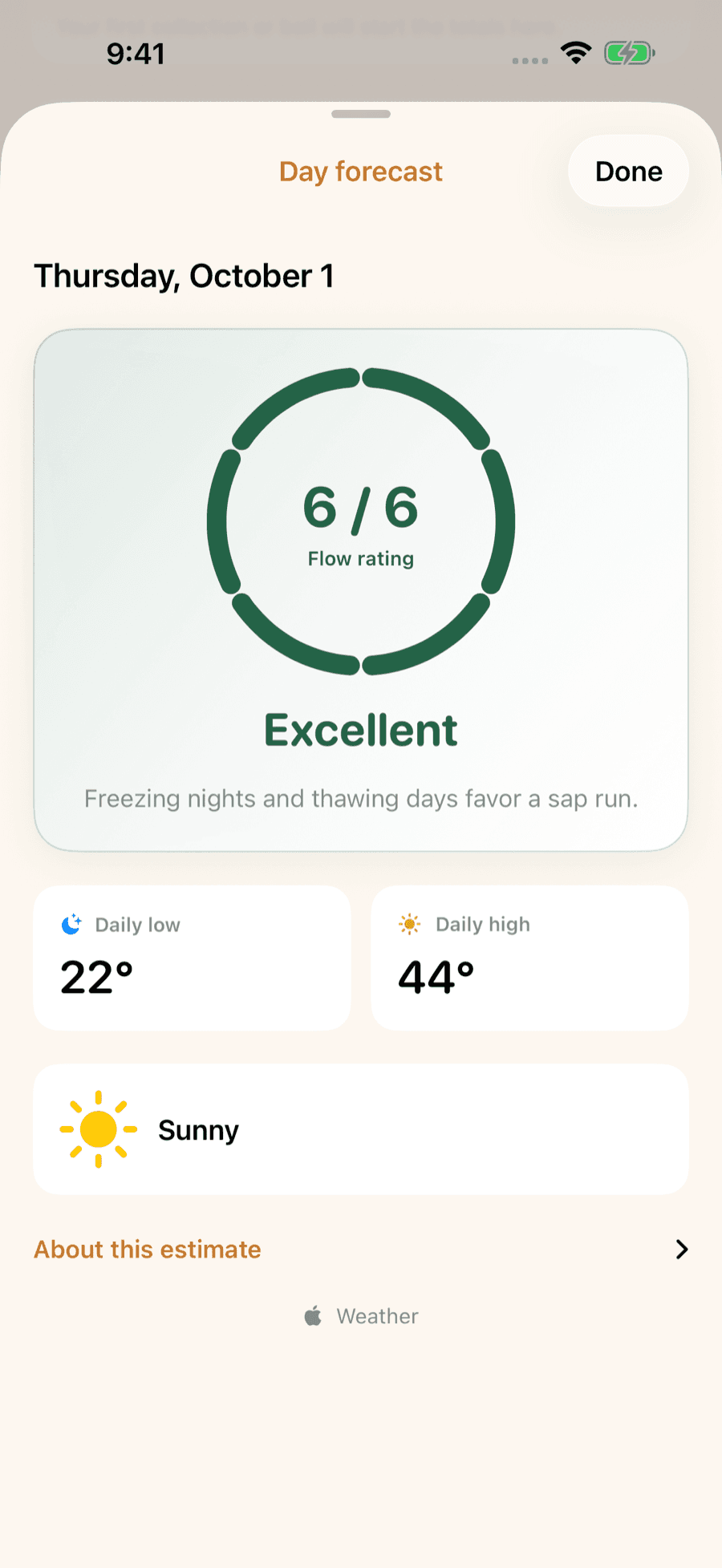
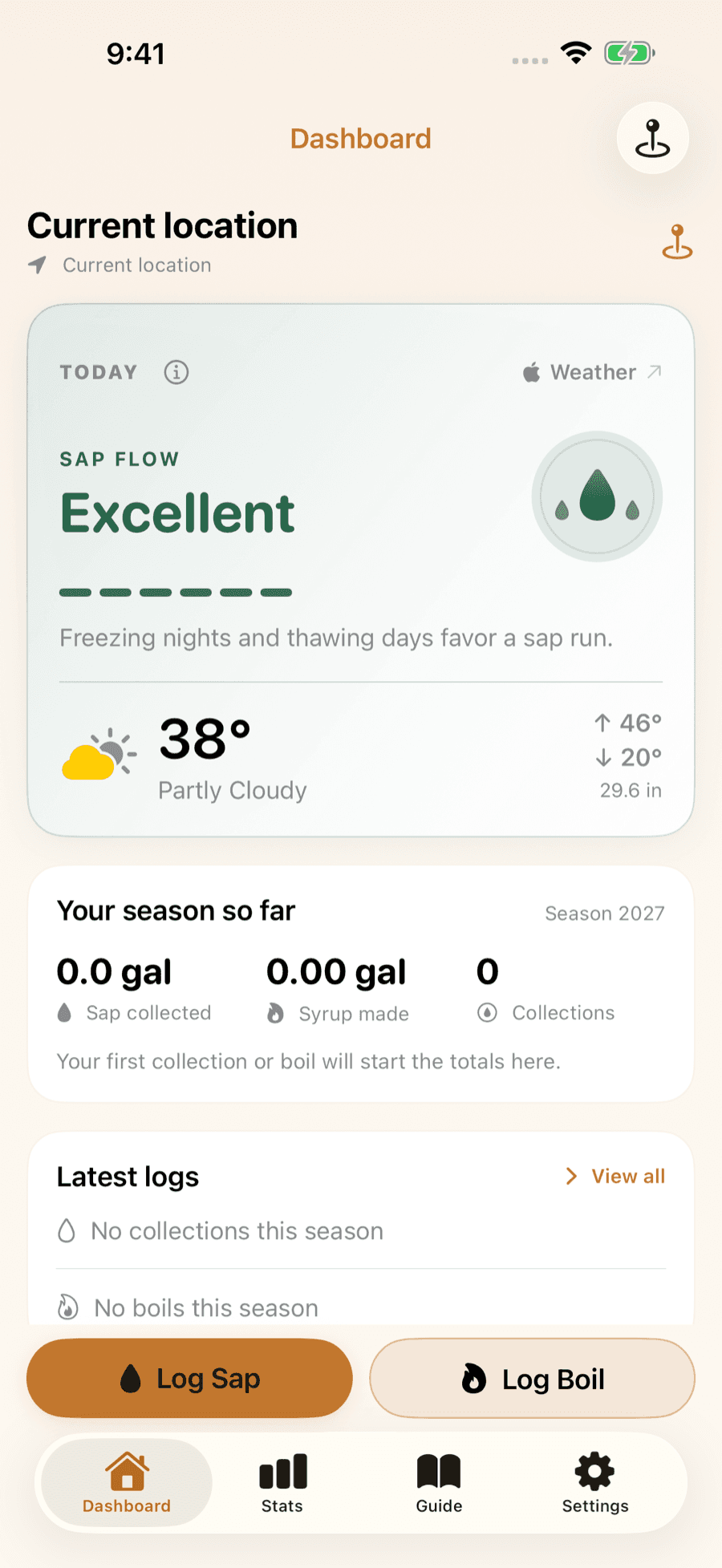
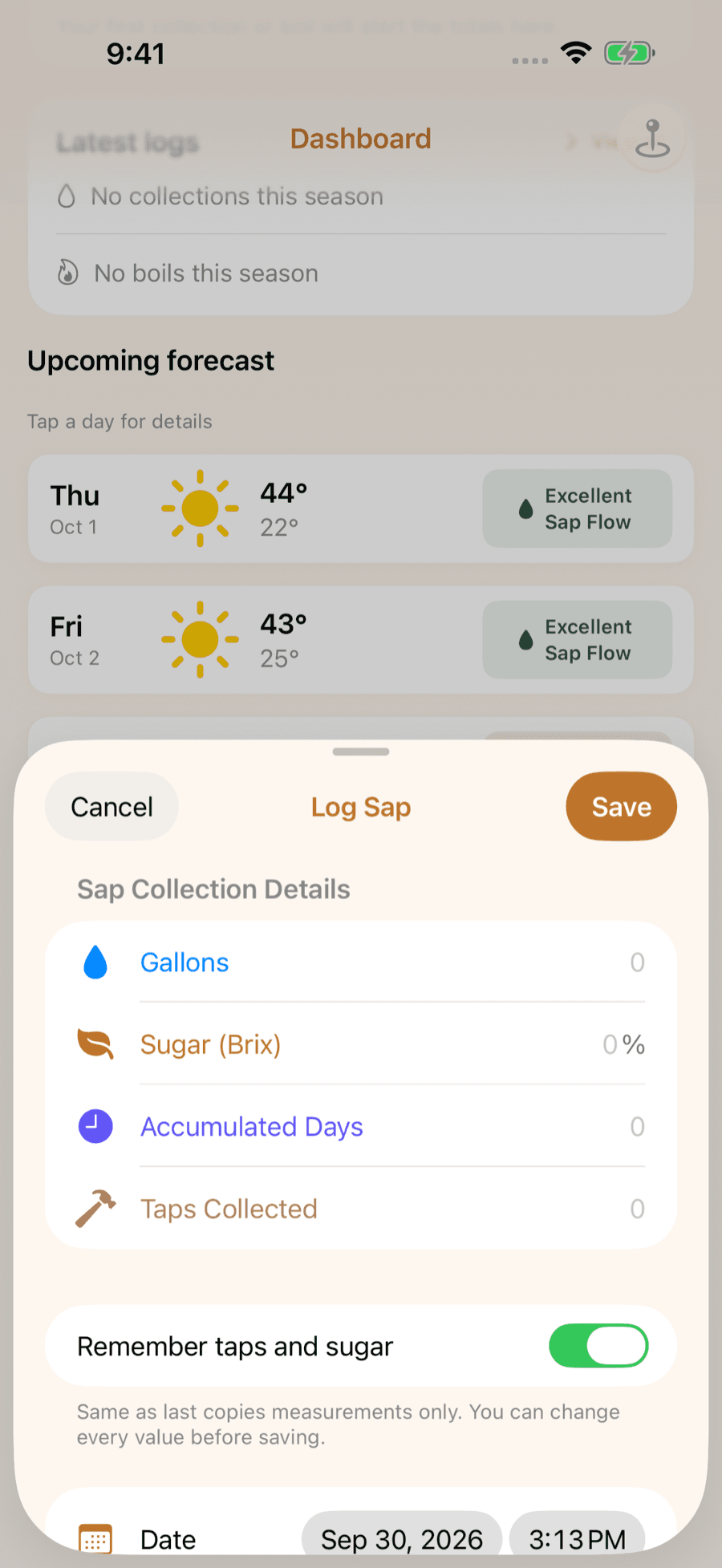
LuckySap is the maple syrup tracker for iPhone and Android: a sap-flow outlook for your trees, a quick log for every collection and boil, and season stats you can compare year to year.