Can you make maple syrup in Washington?
Local timing guidance
WSU Extension FAQ: 'In Western Washington, this is typically late November to early March, with the best sap runs occurring between late December and February.' Producer (Acme): 'Between December and early March ... McLeod must wait for a good freeze and thaw.'
Source: WSU Extension FAQ (VERIFIED); Cascadia Daily News 2025 (PRACTITIONER)
Trees
Tappable trees in Washington
| Species | Status | Where |
|---|---|---|
| Bigleaf mapleAcer macrophyllum | native | Western Washington lowlands, Puget trough, Olympic Peninsula and Cascade foothills — 'the most prevalent maple in the Pacific Northwest' (research sites at Forks, Pe Ell, Bremerton, Quilcene, Acme, Sultan, Olympia, Eatonville)USFS FEIS (WA in states list); WSU Extension forest-farming page; Cascadia Daily/WSU case study |
| BoxelderAcer negundo | native | 'naturalized in ... southeastern Washington' (FEIS); planted in towns east of the CascadesUSFS FEIS |
| Rocky Mountain / Douglas mapleAcer glabrum | native | Mountains statewide; usually too small to tapUSFS FEIS (WA in STATES list) |
| Bigtooth mapleAcer grandidentatum | native | Listed for WA in FEIS states/provinces (marginal occurrence)USFS FEIS |
| Norway mapleAcer platanoides | introduced | Street tree across the state; FEIS lists it escaped in WashingtonUSFS FEIS |
| Paper birchBetula papyrifera | native | Northern and eastern Washington (FEIS WA in list); grows with bigleaf maple at AcmeUSFS FEIS; WSU case study |
Who already does it
Sugaring in Washington, documented
WSU Extension forest-farming guidance: bigleaf 'has a lower relative sugar content (1-1.5% by volume)'; 'maples are tapped in the winter months (Dec-Feb)'; labor 'restricted to a 3-4 weeks'; 'Reverse osmosis is essential for commercial syrup production'
Washington State University Extension (Western Region Landowner Program) · VERIFIED
WSU Bigleaf Maple Syrup Toolkit FAQ — season, depth, yields ('0.5-2 gallons per day'), spoilage and RO advice for hobbyists
WSU Extension · VERIFIED
UW thesis (Braun 2022), Pack Forest near Eatonville, three seasons under high vacuum: 'seasonal sugar content of tapped stems ranged from 0.7% to 1.9%, averaging 1.3%'; multi-stem clumps >30 cm 'produced two to three times more sap per tap'; sap (L) = 0.22 × DBH (cm) + 1.04
University of Washington ResearchWorks · VERIFIED
Neil's Bigleaf Maple Syrup, Acme (Whatcom County): 200-acre forest-farming case study by USDA National Agroforestry Center; 'Only three producers in the state, including the University of Washington, have cleared the bureaucratic hurdles' (Jan 2025)
WSU case study (USDA NAC); Cascadia Daily News, 25 Jan 2025 · PRACTITIONER
Neil's produced 140 gallons in 2019 and hoped for up to 700 in 2020; 'the sugaring season for bigleaf maples runs from October to March'
Modern Farmer, 9 Feb 2020 · PRACTITIONER
Cautions
What local sources warn about
- Lean sap: 1–1.5% (WSU), 0.7–1.9% averaging 1.3% (UW) — roughly 80–100 gallons of sap per gallon of syrup; RO is 'essential' commercially. (WSU Extension; UW thesis (both VERIFIED))
- Freezes are the limiting factor, not warmth: 'The length or intensity of freezing temperatures were insufficient to cause sap flow' is WSU's first troubleshooting item; Forks (wet west coast) was the one research site without commercial-grade flow. (WSU FAQ (VERIFIED); WSU magazine via search summary (RECALL))
- Mild winters spoil sap fast — WSU: boil 'within 24-48 hours of it leaving the tree'; fridge buys 2–3 days; freezing stores it indefinitely. (WSU FAQ (VERIFIED))
- Thick furrowed bark on old trees makes tapping harder; younger smooth-barked stems and clumps tap better. (UW thesis (VERIFIED); Raven's Roots (PRACTITIONER))
Where to look
Likely sugaring country
Acme (Whatcom County)
Neil's Bigleaf Maple Syrup — the state's largest producer, Nooksack valley cold-air drainage
Eatonville (Pierce County)
UW Pack Forest research sugarbush, three seasons of sap data
Olympia / Quilcene
WSU Meyer's Point station and Olympic Peninsula research sites with commercial-grade flow
Autosuggest priority place ('when to tap maple trees in washington state'). Selling rules (WA treats syrup as non-cottage food) noted in Cascadia Daily but out of scope. KUOW/NPR 2020 and WSU Magazine 2021 fetched but not quoted; research-site list from WSU Magazine is RECALL.
FAQ
Sugaring in Washington: questions
- Can you tap maple trees in Washington?
- Yes, in parts of it. Yes west of the Cascades: bigleaf maple is abundant, WSU/UW/OSU run a joint research-and-extension program, and a handful of permitted commercial producers (Acme, Whatcom County) sell bigleaf syrup — but sap is only 1–1.5% sugar, the season is a winter freeze-chasing game, and east of the Cascades the only tappable natives are boxelder and small mountain maples.
- When do you tap maple trees in Washington?
- WSU Extension FAQ: 'In Western Washington, this is typically late November to early March, with the best sap runs occurring between late December and February.' Producer (Acme): 'Between December and early March ... McLeod must wait for a good freeze and thaw.' (WSU Extension FAQ (VERIFIED); Cascadia Daily News 2025 (PRACTITIONER))
- Which trees can you tap in Washington?
- Bigleaf maple (Acer macrophyllum, native): Western Washington lowlands, Puget trough, Olympic Peninsula and Cascade foothills — 'the most prevalent maple in the Pacific Northwest' (research sites at Forks, Pe Ell, Bremerton, Quilcene, Acme, Sultan, Olympia, Eatonville) Boxelder (Acer negundo, native): 'naturalized in ... southeastern Washington' (FEIS); planted in towns east of the Cascades Rocky Mountain / Douglas maple (Acer glabrum, native): Mountains statewide; usually too small to tap Bigtooth maple (Acer grandidentatum, native): Listed for WA in FEIS states/provinces (marginal occurrence) Norway maple (Acer platanoides, introduced): Street tree across the state; FEIS lists it escaped in Washington Paper birch (Betula papyrifera, native): Northern and eastern Washington (FEIS WA in list); grows with bigleaf maple at Acme

LuckySap · free on iPhone & Android
Try a season where you are
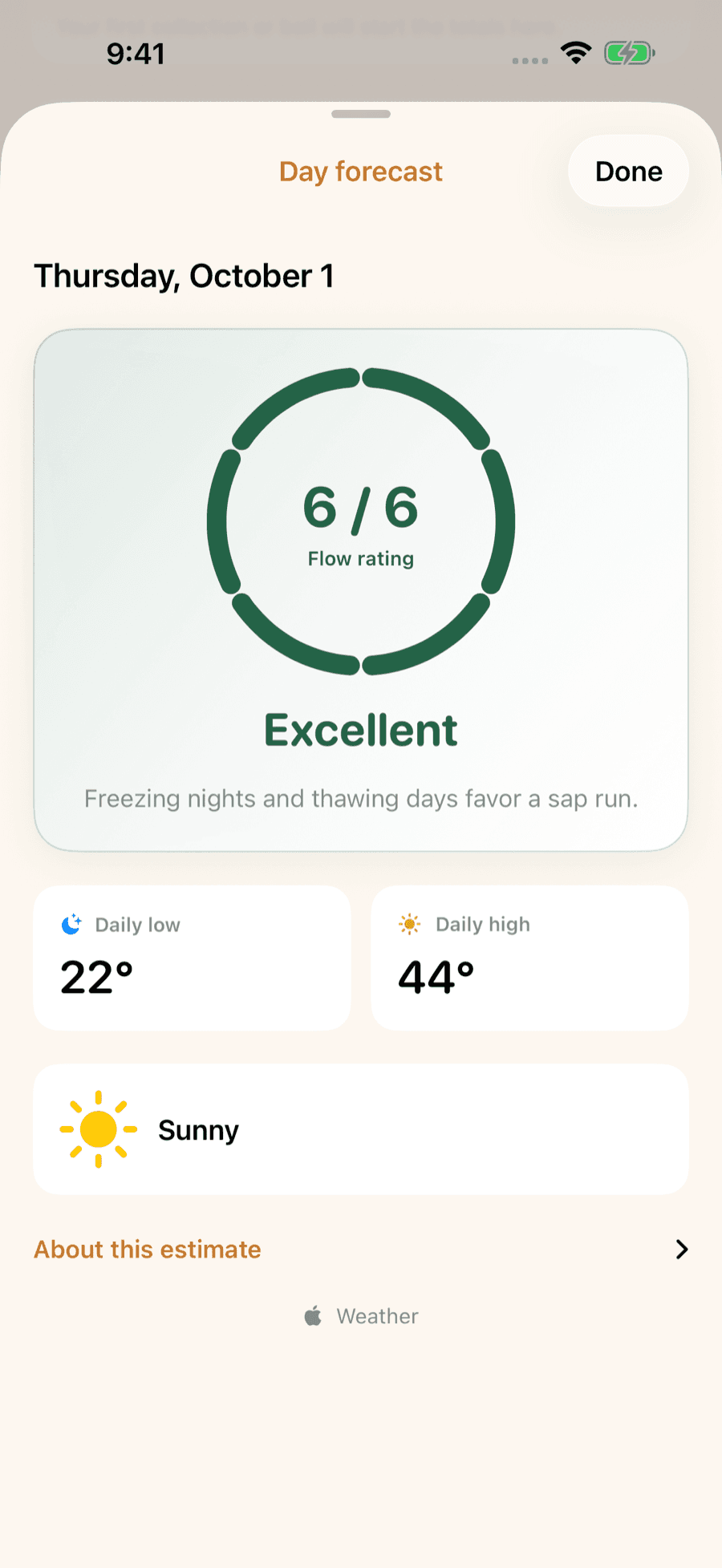
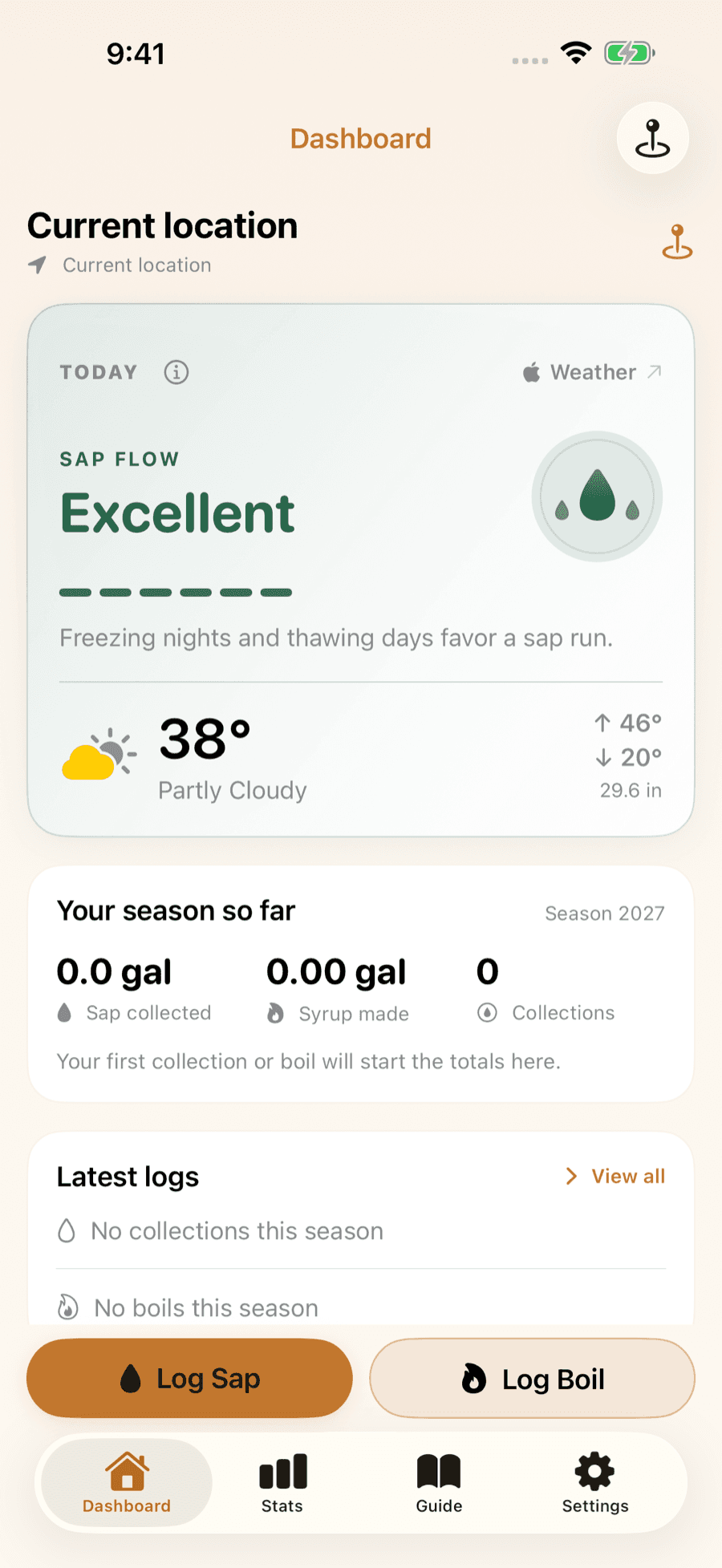
LuckySap turns the forecast for any spot into a day-by-day sap outlook and logs every collection and boil. Free on iPhone and Android.