Can you make maple syrup in North Carolina?
Local timing guidance
Ashe County producer (Wheeler Munroe): a sap run 'typically happens around here in early February, when temperatures dip into the 20s during the night and warm into the 40s during the day', with 'only about six weeks' before bud break; Food Pilgrim describes Waterfall Farm's boil as 'a six-week period from January into early March'. Piedmont hobbyist: 'The time to shoot for here is usually late January through early March.'
Source: WNC Magazine (PRACTITIONER); Food Pilgrim 2018 (PRACTITIONER); Tara Lynne Today 2023 (PRACTITIONER)
Trees
Tappable trees in North Carolina
| Species | Status | Where |
|---|---|---|
| Sugar mapleAcer saccharum | native | Blue Ridge above ~3,000 ft — Ashe, Yancey, Watauga, Avery, Mitchell; 'The northwestern North Carolina mountains are the southernmost native range of the sugar maple'USFS FEIS (NC in STATES list); Carolina Country 2012 |
| Red mapleAcer rubrum | native | Statewide, mountains to coast; tapped alongside sugar maple at Waterfall FarmUSFS FEIS; Food Pilgrim 2018 |
| Silver mapleAcer saccharinum | native | 'north through western South Carolina and western North Carolina' — Piedmont/mountain river bottoms, not the Coastal PlainUSFS FEIS |
| BoxelderAcer negundo | native | Riparian sites statewideUSFS FEIS (NC in STATES list) |
| Florida / southern sugar mapleAcer floridanum (A. saccharum ssp. floridanum) | native | Piedmont and Coastal Plain bottomlands and mesic slopes; 'Common (rare in Mountains)'; also a street tree — no tapping record foundNameThatPlant (Weakley's Flora) for the Carolinas & Georgia |
| Paper birch (minor)Betula papyrifera | native | Outlying populations in the Appalachian Mountains to western North CarolinaUSFS FEIS |
| Black walnutJuglans nigra | native | Statewide on rich soilsUSFS FEIS (NC in STATES list) |
Who already does it
Sugaring in North Carolina, documented
Waterfall Farm, Warrensville (Ashe County), 3,300–3,400 ft: Doug Munroe tapping since 2005; 450-plus taps on vacuum; 'about six weeks to sugar before the buds start to break'
WNC Magazine ('Sweet Life') and Food Pilgrim (Georgann Eubanks, 2018) · PRACTITIONER
Maple Creek Farm, Yancey County (John Swann): 'about 85 acres of woods', '500 taps in 400 trees', best season ~100 gal syrup, worst ~20; 'It takes 45 gallons of sap to make 1 gallon of syrup'
Carolina Country, March 2012 · PRACTITIONER
UVA-Wise study tapped 2 red + 5 sugar maples at Warrensville, NC (1,035 m) in 2016–17 as part of its four-species comparison
Peters et al. 2020, JAFSCD · VERIFIED
Piedmont hobbyist report: a beekeeper tapping yard maples; 'Last year it spanned about two weeks in the Piedmont'
Tara Lynne Today (Substack), Dec 2023 · PRACTITIONER
Cautions
What local sources warn about
- Warm winters erase the season: in 2013 'it got warm early and stayed warm', eating 'those few precious weeks at the end of February and beginning of March when maple syrup production in North Carolina is possible'. (WNC Magazine (PRACTITIONER))
- Sparse trees and steep ground: 'The sparseness of the trees here, along with a steep terrain that makes collecting by hand impractical, has limited the potential for large-scale production.' (Carolina Country 2012 (PRACTITIONER))
- Lower sugar than the Northeast: NC producers quote 45–55 gallons of sap per gallon of syrup, and the regional study measured 1.3–1.6 °Bx means. (Carolina Country 2012; Peters et al. 2020 (VERIFIED))
- Piedmont runs are short — about two weeks in one hobbyist's year — and collection must be daily; a mountain apiary site did worse than the Piedmont yard because it was not visited daily. (Tara Lynne Today 2023 (PRACTITIONER))
Where to look
Likely sugaring country
West Jefferson / Warrensville (Ashe County)
Waterfall Farm's sugarbush at ~3,300 ft in the Amphibolite Mountains; syrup sold at the West Jefferson farmers market
Burnsville (Yancey County)
Maple Creek Farm, 500 taps, about 80 miles southwest of Ashe County
Boone (Watauga County)
High-elevation sugar maple country between the two producers; the region's weather reference point
Autosuggest priority place ('can you tap maple trees in nc', 'when to tap ... north carolina'). Two sources each call a different farm 'the only commercial operation' (Waterfall Farm; Maple Creek Farm) — both exist, so say 'a handful'. Mountain Xpress (403) and Smoky Mountain Living (timeout) not opened. No NC State Extension maple publication located.
FAQ
Sugaring in North Carolina: questions
- Can you tap maple trees in North Carolina?
- Yes, in parts of it. Yes in the high mountains: sugar maple reaches its southern native limit in the northwestern NC mountains, where two commercial producers (Ashe and Yancey counties) run 450–500 taps each on a ~six-week season; the Piedmont gets only brief, unreliable runs and the Coastal Plain none.
- When do you tap maple trees in North Carolina?
- Ashe County producer (Wheeler Munroe): a sap run 'typically happens around here in early February, when temperatures dip into the 20s during the night and warm into the 40s during the day', with 'only about six weeks' before bud break; Food Pilgrim describes Waterfall Farm's boil as 'a six-week period from January into early March'. Piedmont hobbyist: 'The time to shoot for here is usually late January through early March.' (WNC Magazine (PRACTITIONER); Food Pilgrim 2018 (PRACTITIONER); Tara Lynne Today 2023 (PRACTITIONER))
- Which trees can you tap in North Carolina?
- Sugar maple (Acer saccharum, native): Blue Ridge above ~3,000 ft — Ashe, Yancey, Watauga, Avery, Mitchell; 'The northwestern North Carolina mountains are the southernmost native range of the sugar maple' Red maple (Acer rubrum, native): Statewide, mountains to coast; tapped alongside sugar maple at Waterfall Farm Silver maple (Acer saccharinum, native): 'north through western South Carolina and western North Carolina' — Piedmont/mountain river bottoms, not the Coastal Plain Boxelder (Acer negundo, native): Riparian sites statewide Florida / southern sugar maple (Acer floridanum (A. saccharum ssp. floridanum), native): Piedmont and Coastal Plain bottomlands and mesic slopes; 'Common (rare in Mountains)'; also a street tree — no tapping record found Paper birch (minor) (Betula papyrifera, native): Outlying populations in the Appalachian Mountains to western North Carolina Black walnut (Juglans nigra, native): Statewide on rich soils

LuckySap · free on iPhone & Android
Try a season where you are
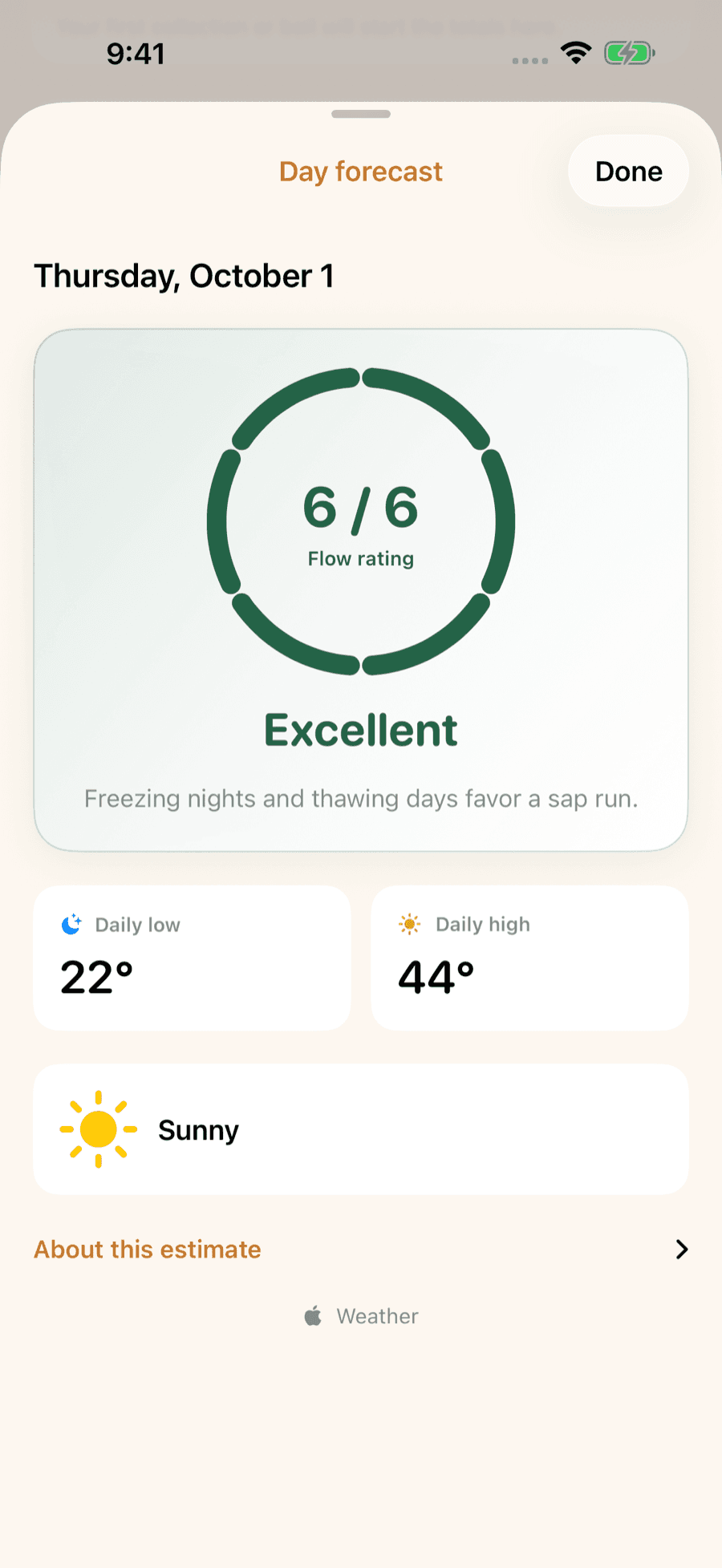
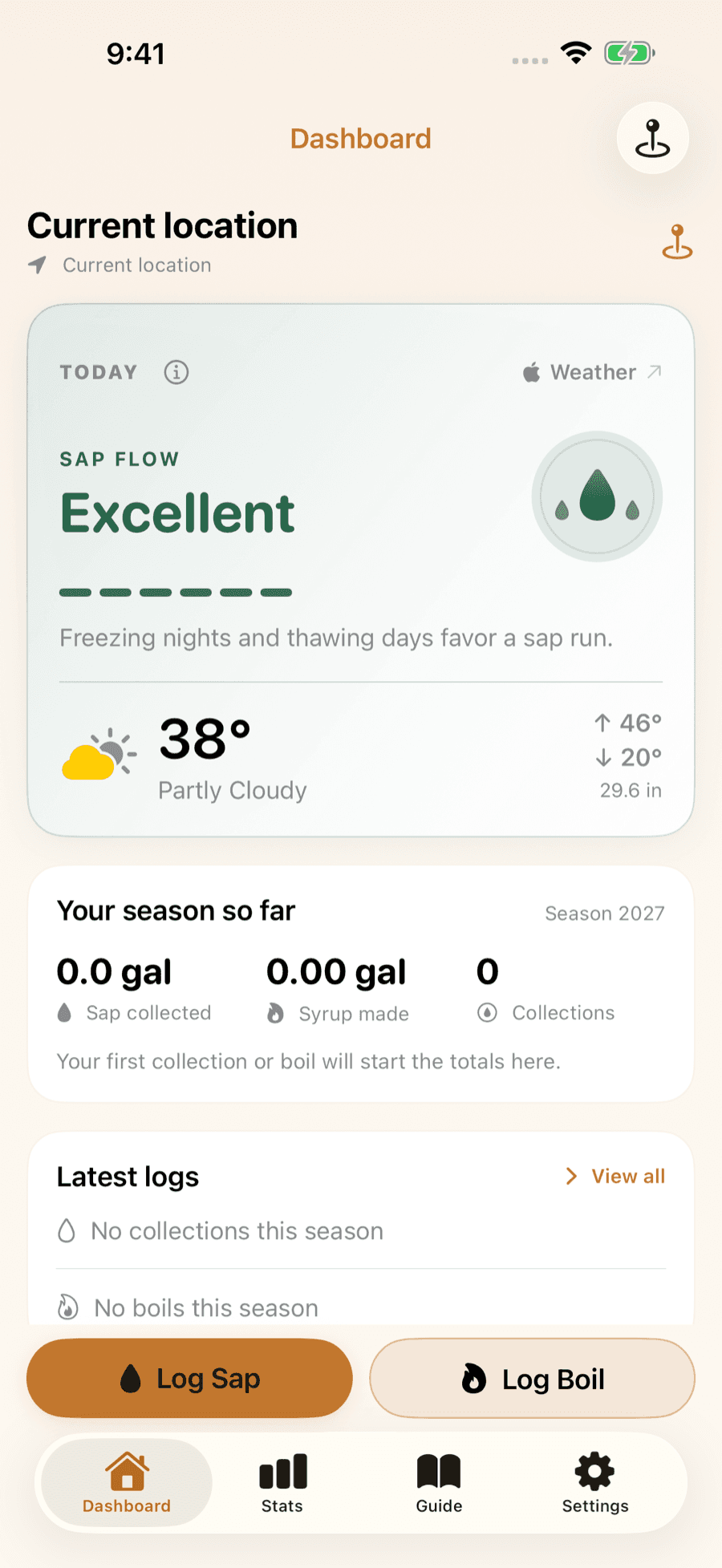
LuckySap turns the forecast for any spot into a day-by-day sap outlook and logs every collection and boil. Free on iPhone and Android.