Can you make maple syrup in Oregon?
Local timing guidance
OSU (Jones 2022): 'roughly the beginning of Dec. to the end of Feb.' OSU EM 9163: 'late fall and winter (after the leaves have dropped) through early spring prior to bud-break.' Older practitioner rule: 'January and February are the months to begin tapping.'
Source: OSU via WMSWCD 2022; Oregon State Extension EM 9163; Small Farmer's Journal 1983
Trees
Tappable trees in Oregon
| Species | Status | Where |
|---|---|---|
| Bigleaf mapleAcer macrophyllum | native | Coast Range, Willamette Valley, Klamath-Siskiyous and Cascade foothills; the US Forest Service: 'obtaining best development in southern Oregon'Source: US Forest Service range data |
| BoxelderAcer negundo | introduced | 'naturalized in ... eastern Oregon' (US Forest Service); planted in towns east of the CascadesSource: US Forest Service range data |
| Rocky Mountain / Douglas mapleAcer glabrum | native | Mountains statewide; small, rarely tappableSource: US Forest Service range data |
| Paper birchBetula papyrifera | native | Listed for Oregon by the US Forest Service (northeastern Oregon)Source: US Forest Service range data |
USDA Forest Inventory · plots measured 2015–2024
How many tappable maples?
Sugar and red maples are too scarce on the Forest Service’s Oregon plots for a reliable count, but it counts about 28 million bigleaf maples 10 inches and up on Oregon's forest land.
| Statewide | 10 in and up | 18 in and up |
|---|---|---|
| Statewide | ||
| Bigleaf maples | 10 in and up about28 million ±7.0% sampling error (26–30 million) · tallied on 560 plots | 18 in and up about6.4 million ±9.8% sampling error (5.8–7.0 million) · tallied on 226 plots |
- FIA counts trees on forest land only. Yard, street and farm trees are not counted, so true numbers are higher.
- Plots measured 2015–2024. FIA visits a different share of its plots each year, so a “current” estimate pools 10 years of visits.
- Species are listed only where the statewide sampling error is 50% or less. FIA measures bigtooth and Rocky Mountain maples at the root collar rather than at chest height, so they are not in these counts.
- Source: USDA Forest Service, Forest Inventory and Analysis (live trees on forest land, by species and trunk diameter at 4.5 ft). How FIA counts trees →
Who already does it
Sugaring in Oregon, documented
OSU Extension EM 9163 'Making bigleaf maple syrup: A hobbyist's guide' (2017): 'sap collection is done in the late fall and winter (after the leaves have dropped) through early spring prior to bud-break'; store sap at '38 °F or colder'
OSU College of Forestry bigleaf maple project (Eric T. Jones): 'The tapping season is in winter, roughly the beginning of Dec. to the end of Feb.'; 'Bigleaf has roughly half the sugar content of sugar maple ... you need 80 to 90 gallons of bigleaf sap'; producers listed on Oregon Tree Tappers; training via the nonprofit Oregon Maple Project; funded by USDA Acer Access and Development
Willamette Valley hobbyist Nolan Lynch, Champoeg area: 150 taps since 2021, sap 'about one to two percent sugar content'; OSU working with valley sugarmakers
Newsberg, 1 Apr 2024Producer or news report
Historic how-to (1983): 'In most areas of the northwest, January and February are the months to begin tapping'; warns that west of the Cascades 'We may have five to six weeks without frosts ... If so, no maple syrup for that year'
Small Farmer's Journal (Victor Morejohn, 1983; reposted)Producer or news report
Cautions
What local sources warn about
- Half the sugar: '80 to 90 gallons of bigleaf sap' per gallon of syrup; vacuum tubing and reverse osmosis are what make it pay.Source: OSU via WMSWCD 2022
- Frost-free winters can mean no crop at all west of the Cascades; season is 'longer and less predictable' than in the East and depends on elevation and microclimate.Source: Small Farmer's Journal 1983; The Astorian/Seattle Times 2020
- Old bigleaf bark is 'brown and shallowly grooved, which makes tapping more difficult'; collect daily and keep sap at 38 °F or colder.Source: Oregon State Extension EM 9163
- Most tapping and processing supplies 'have to be bought from the East' — plan lead time.Source: OSU via WMSWCD 2022
Where to look
Likely sugaring country
Corvallis (Benton County)
OSU College of Forestry bigleaf project base; mid-Willamette Valley
Newberg / Champoeg (Yamhill–Marion)
Documented Willamette Valley sugarmakers (150-tap grove)
Roseburg (Douglas County)
Southern Oregon, where the US Forest Service says bigleaf maple reaches its best development
FAQ
Sugaring in Oregon: questions
- Can you tap maple trees in Oregon?
- Yes, in parts of it. Yes in western Oregon: bigleaf maple is everywhere from the Coast Range to the Cascade foothills, OSU Extension publishes a hobbyist guide and runs a USDA-funded bigleaf project with the Oregon Maple Project and Oregon Tree Tappers, and Willamette Valley sugarmakers run 100+ taps — but sap is about half as sweet as sugar maple and some winters bring no freeze at all.
- When do you tap maple trees in Oregon?
- OSU (Jones 2022): 'roughly the beginning of Dec. to the end of Feb.' OSU EM 9163: 'late fall and winter (after the leaves have dropped) through early spring prior to bud-break.' Older practitioner rule: 'January and February are the months to begin tapping.' (Source: OSU via WMSWCD 2022; Oregon State Extension EM 9163; Small Farmer's Journal 1983.)
- Which trees can you tap in Oregon?
- Bigleaf maple (Acer macrophyllum, native): Coast Range, Willamette Valley, Klamath-Siskiyous and Cascade foothills; the US Forest Service: 'obtaining best development in southern Oregon'. Boxelder (Acer negundo, introduced): 'naturalized in ... eastern Oregon' (US Forest Service); planted in towns east of the Cascades. Rocky Mountain / Douglas maple (Acer glabrum, native): Mountains statewide; small, rarely tappable. Paper birch (Betula papyrifera, native): Listed for Oregon by the US Forest Service (northeastern Oregon).

LuckySap · free on iPhone & Android
Try a season where you are
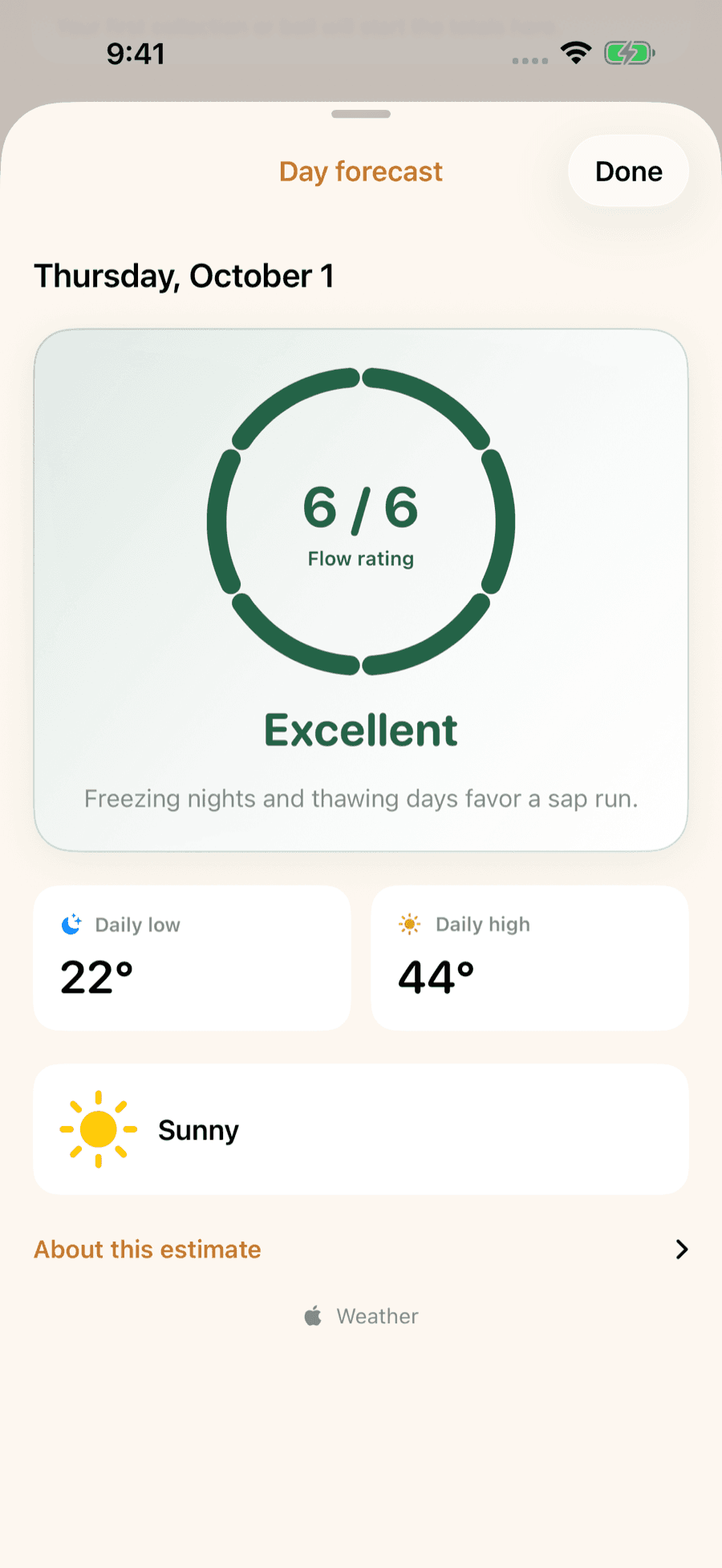
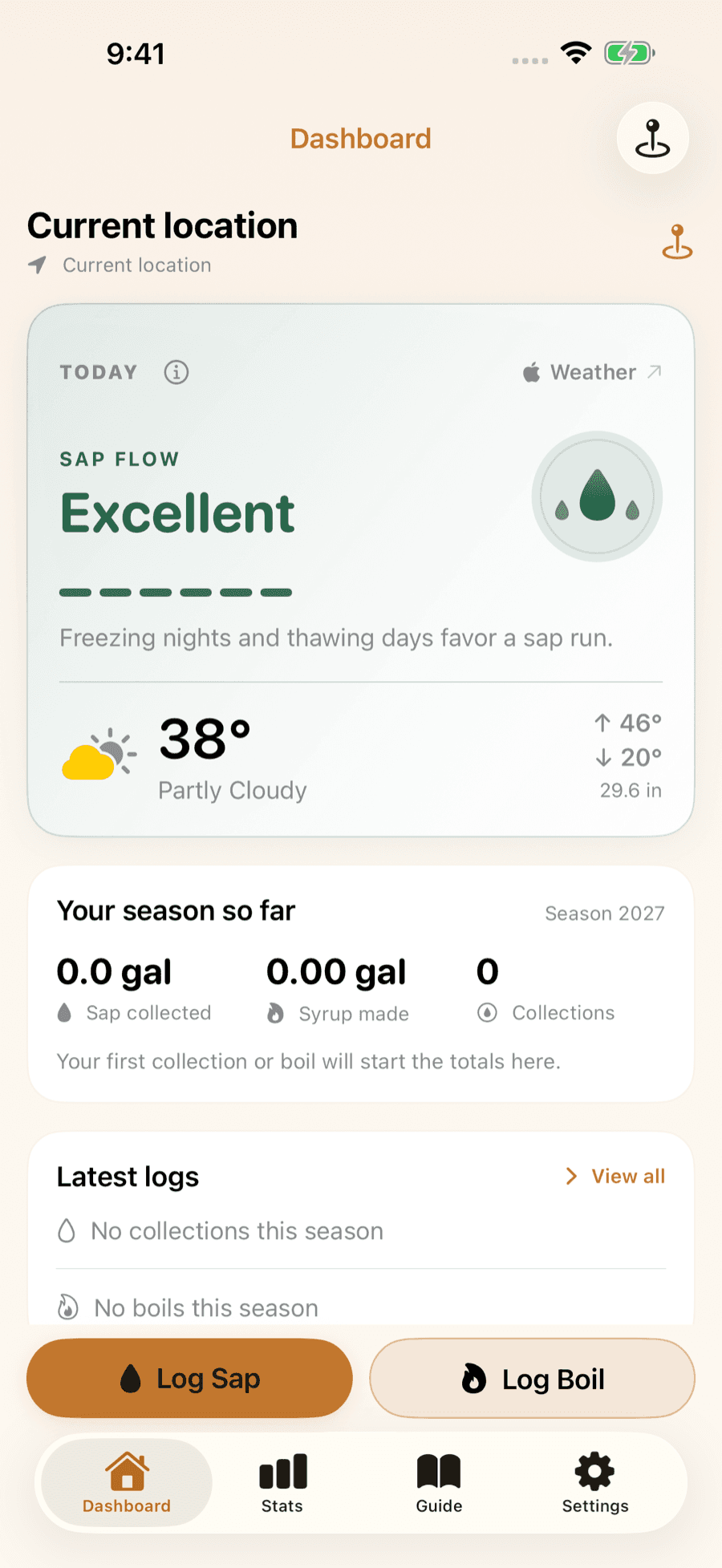
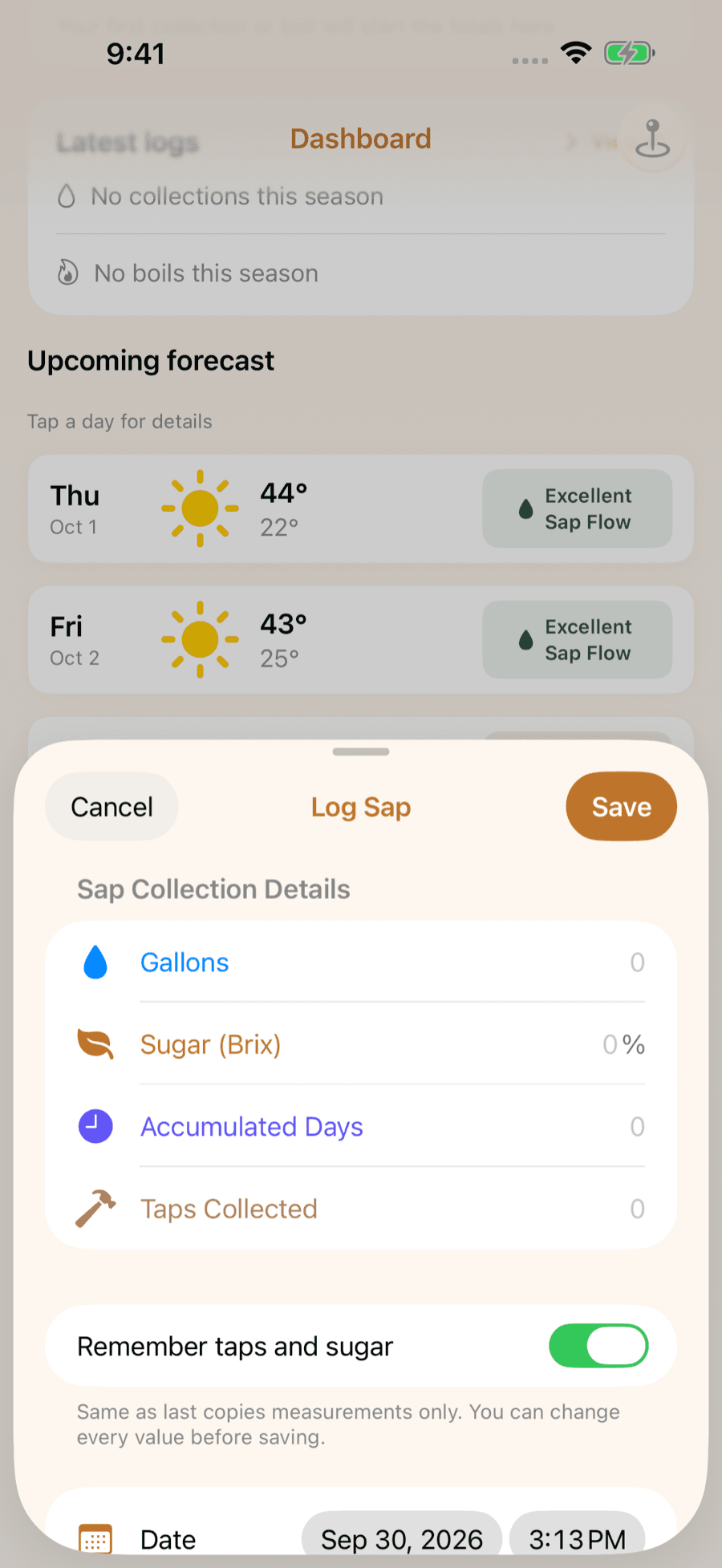
LuckySap turns the forecast for any spot into a day-by-day sap outlook and logs every collection and boil. Free on iPhone and Android.