The numbers
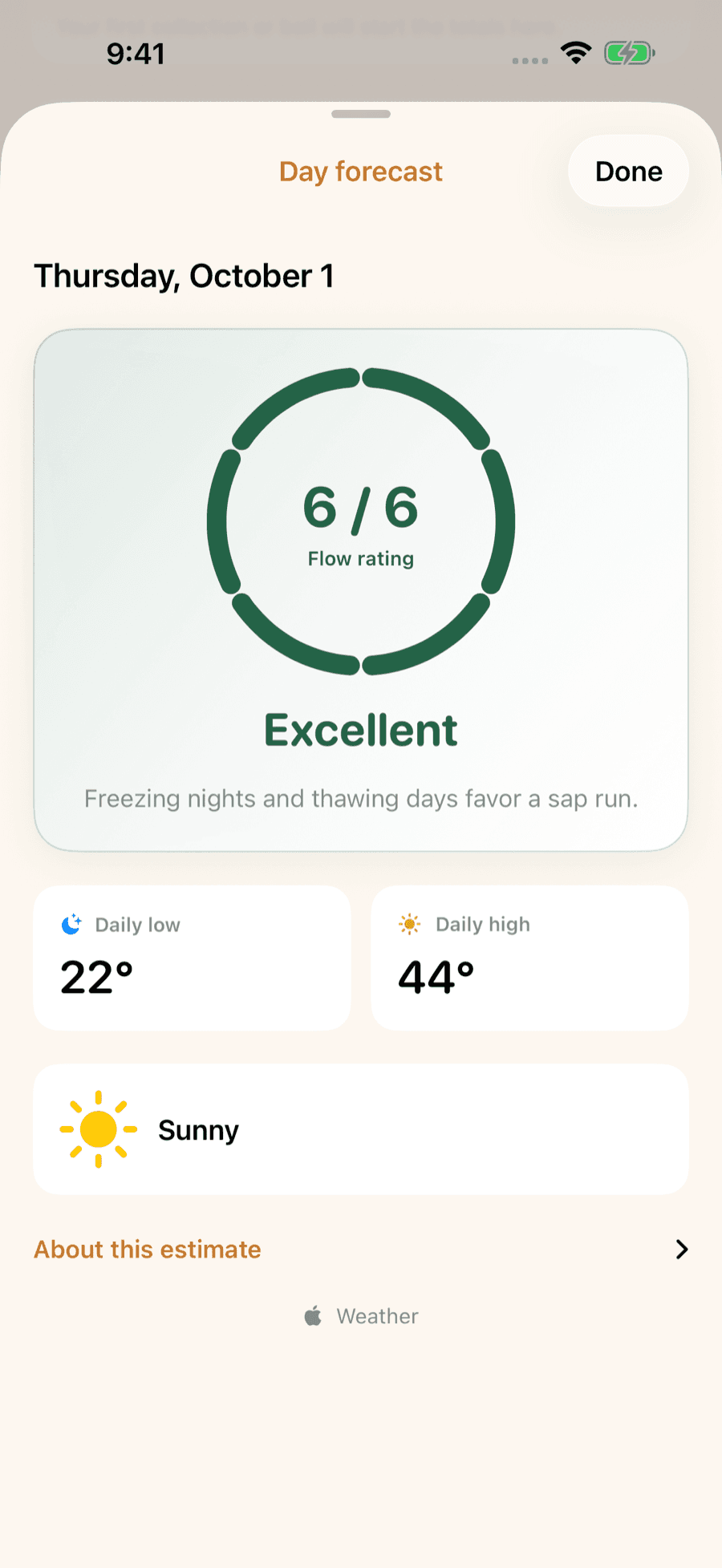
Sap runs on a temperature swing, not a temperature. It needs a night cold enough to freeze the wood, followed by a day warm enough to thaw it:
| What | Night | Day | Source |
|---|---|---|---|
| Research freeze-thaw day | below 30.2°F (−1 °C) | above 37.4°F (+3 °C) | de Lima Santos et al., 2025 |
| The classic sap day | in the 20s °F | in the 40s °F | UNH Extension |
| Extension rule of thumb | freezing | about 40°F or warmer | UMaine Extension |
How much does the margin matter? In that 2025 field study, runs of more than a litre per tap came on a real freeze-thaw day 94% of the time. Small runs were looser: about a third of them came on days that missed the thresholds.
Why the swing moves sap
Sap flow is driven by the wood crossing 32°F. As it freezes, ice forming in the wood creates suction that draws sap in, and the roots take up water if the soil isn't frozen. When the wood thaws, that flips to positive pressure, which the Producers Manual puts as high as about 40 psi near the base of the tree and highest at the start of the thaw. That pressure pushes sap out of your taphole.
On a sunny day, water evaporating from the canopy also pulls sap up and away from the taphole, which cuts the run short.
Why 32°F isn't quite enough
An air temperature only slightly below freezing may not freeze the branches. On calm nights the air a few feet off the ground is often several degrees colder than the canopy, and after a deep cold snap it can take a day or more above freezing before the wood at the taphole thaws. That's why the LuckySap outlook uses the research margin instead of a flat 32°F.
- Classic sap day
- Sap likely
- Maybe a light run
- Run tapering
- No refreeze forecast
How long a run lasts
Once it starts, a run can keep going for 30 to 72 hours if the tree doesn't refreeze, slowing the longer it goes. Only a real refreeze of the small branches brings the flow back to full strength. Sap can even run through the night when it stays above freezing.
A good run gives about 4 to 5 quarts per taphole, so check your buckets. On warm days, sap starts to spoil quickly; here's how long it keeps.
Pressure, snow and other lore
Barometric pressure: no peer-reviewed study we could find shows falling pressure drives runs, and no published sap-flow model uses it. Weather-scale pressure changes are tiny next to the pressure a thaw builds inside the trunk. Pressure does matter at the other end of the season, for your syrup's finishing temperature.
Snow: snow insulates the soil, and frozen soil keeps roots from taking up water during the freeze. But no study we found measures how snow changes daily flow or season length, so “deep snow keeps the season going” is lore, not research.
The short version
This week, live
Here's the rule applied to this week's forecast in St. Albans, in the heart of Vermont sugaring country:
Forecast for St. Albans
Updated Sep 30, 5:59 PM EDT
Off-season for now. Sap needs freezing nights, and none are in sight. Vermont's season usually opens around March 2, which is 153 days away.
No freeze-thaw days in the forecast
freeze thaw 32°F
- ThuOct 158° / 73°
0h below · 24h above
No refreeze forecast - FriOct 263° / 67°
0h below · 24h above
No refreeze forecast - SatOct 346° / 60°
0h below · 24h above
No refreeze forecast - SunOct 442° / 64°
0h below · 24h above
No refreeze forecast - MonOct 549° / 56°
0h below · 24h above
No refreeze forecast - TueOct 637° / 52°
0h below · 24h above
No refreeze forecast
Data: National Weather Service. Verdicts use freeze-thaw thresholds from maple field research; your woods may run a little differently.
Want it for your own trees? Open the sap forecast and use your location.