When to tap maple trees in Michigan
- Opens
- Mar 5
- median, USDA
- Closes
- Apr 7
- median, USDA
- Typical length
- 29days
- Seasons on record
- 12
- 2011–2022
County by county
When the sap runs across Michigan
Loading the map…
Typical opening date of the sap season, week by week across this state’s range
- Feb 16–22
- Feb 23–Mar 1
- Mar 2–8
- Mar 9–15
- Mar 16–25
- fewer than 5 maple farms
64 places with an atlas page. Typical season opening, earliest: Monroe County, MI, Feb 16; Lenawee County, MI, Feb 18; Macomb County, MI, Feb 18; latest: Schoolcraft County, MI, Mar 25; Alger County, MI, Mar 25; Mackinac County, MI, Mar 24. Most sap days a season: Oscoda County, MI, 49; Ogemaw County, MI, 47; Newaygo County, MI, 46. Maple taps in the 2022 Census of Agriculture, on a five-step scale fitted to Michigan: under 1,600, 1,600–4,200, 4,200–8,500, 8,500–13,000, 13,000+; the most: Menominee County, MI (45,900), Mackinac County, MI (40,791), Charlevoix County, MI (38,900), Cheboygan County, MI (35,531), Oscoda County, MI (29,640). Maple farms in the same census, in five steps: under 8, 8–11, 11–15, 15–20, 20+; the most: Leelanau County, MI (39), Kent County, MI (30), Lapeer County, MI (28). Syrup made, in US gallons: Charlevoix County, MI (19,405 gal), Grand Traverse County, MI (14,007 gal), Menominee County, MI (12,107 gal). Tappable maples (FIA estimates of sugar maples 10 in and up on forest land, US counties only): under 1.3 million, 1.3–3.1 million, 3.1–3.8 million, 3.8–8.2 million, 8.2 million+; the most: Iron County, MI (about 13 million ± 14%), Gogebic County, MI (about 13 million ± 12%), Baraga County, MI (about 11 million ± 17%). 29 counties' estimates are too uncertain to show (sampling error over 50%). 7 counties have none tallied on the inventory plots (not a zero). 3 places show an earlier census figure (dotted) because the latest was withheld; those figures don’t set the bins. Each shaded place links to its page; every state and province page lists its places in a table.
| Monroe | Feb 16 – Mar 22 | 33 | 495 |
|---|---|---|---|
| Lenawee | Feb 18 – Mar 24 | 42 | 408 |
| Macomb | Feb 18 – Mar 23 | 34 | 132 |
| St. Joseph | Feb 18 – Mar 22 | 40 | 3,248 |
| Van Buren | Feb 19 – Mar 26 | 44 | 1,107 (2017) |
| Washtenaw | Feb 19 – Mar 27 | 42 | 6,370 |
| Hillsdale | Feb 20 – Mar 26 | 39 | 2,572 |
| Barry | Feb 21 – Mar 28 | 43 | 11,594 |
| Jackson | Feb 21 – Mar 27 | 38 | 579 |
| Kalamazoo | Feb 21 – Mar 27 | 40 | 1,614 |
| Oakland | Feb 22 – Mar 27 | 35 | 1,127 |
| Calhoun | Feb 23 – Mar 28 | 38 | 1,612 |
| St. Clair | Feb 23 – Mar 27 | 31 | 173 |
| Shiawassee | Feb 23 – Mar 28 | 39 | 4,240 |
| Allegan | Feb 24 – Mar 29 | 42 | 1,057 |
| Clinton | Feb 24 – Mar 28 | 38 | 3,163 |
| Eaton | Feb 24 – Mar 28 | 38 | 18,705 |
| Genesee | Feb 24 – Mar 28 | 39 | 2,353 |
| Ingham | Feb 24 – Mar 28 | 36 | 6,355 |
| Lapeer | Feb 24 – Mar 28 | 40 | 9,173 |
| Saginaw | Feb 24 – Mar 30 | 37 | 3,160 |
| Ionia | Feb 25 – Mar 29 | 37 | 5,980 |
| Kent | Feb 26 – Mar 31 | 37 | 5,979 |
| Midland | Feb 27 – Mar 30 | 36 | 2,017 |
| Montcalm | Feb 27 – Apr 3 | 42 | 4,338 |
| Gratiot | Mar 1 – Apr 2 | 38 | 1,638 |
| Tuscola | Mar 1 – Apr 2 | 38 | 7,570 |
| Isabella | Mar 2 – Apr 2 | 37 | 10,370 |
| Newaygo | Mar 3 – Apr 7 | 46 | 3,134 |
| Oceana | Mar 3 – Apr 5 | 37 | 8,740 |
| Sanilac | Mar 3 – Apr 2 | 35 | 13,410 |
| Gladwin | Mar 5 – Apr 7 | 46 | 3,946 |
| Huron | Mar 5 – Apr 6 | 33 | 4,337 |
| Mason | Mar 6 – Apr 6 | 29 | 10,426 |
| Mecosta | Mar 6 – Apr 9 | 44 | 8,511 |
| Benzie | Mar 7 – Apr 9 | 36 | 5,201 |
| Iosco | Mar 8 – Apr 8 | 38 | 4,800 (2017) |
| Manistee | Mar 8 – Apr 10 | 32 | 12,037 |
| Grand Traverse | Mar 9 – Apr 12 | 34 | 26,288 |
| Osceola | Mar 9 – Apr 12 | 45 | 10,731 |
| Oscoda | Mar 9 – Apr 14 | 49 | 29,640 |
| Antrim | Mar 10 – Apr 13 | 40 | 17,134 |
| Clare | Mar 10 – Apr 13 | 45 | 8,587 |
| Ogemaw | Mar 10 – Apr 14 | 47 | 2,236 |
| Menominee | Mar 11 – Apr 12 | 31 | 45,900 |
| Wexford | Mar 11 – Apr 13 | 40 | 7,180 |
| Leelanau | Mar 12 – Apr 12 | 30 | 6,448 |
| Alcona | Mar 13 – Apr 13 | 36 | 3,800 |
| Charlevoix | Mar 13 – Apr 12 | 27 | 38,900 |
| Emmet | Mar 13 – Apr 14 | 31 | 11,905 |
| Kalkaska | Mar 13 – Apr 16 | 41 | 14,716 |
| Otsego | Mar 13 – Apr 14 | 36 | 9,235 |
| Presque Isle | Mar 15 – Apr 15 | 33 | 26,548 (2017) |
| Cheboygan | Mar 16 – Apr 18 | 34 | 35,531 |
| Delta | Mar 20 – Apr 21 | 34 | 6,840 |
| Gogebic | Mar 20 – Apr 23 | 35 | 625 |
| Baraga | Mar 21 – Apr 25 | 44 | 2,703 |
| Marquette | Mar 21 – Apr 21 | 23 | 1,200 |
| Houghton | Mar 23 – Apr 25 | 29 | 29,498 |
| Iron | Mar 23 – Apr 25 | 43 | 9,930 |
| Chippewa | Mar 24 – Apr 23 | 27 | 28,305 |
| Mackinac | Mar 24 – Apr 22 | 27 | 40,791 |
| Alger | Mar 25 – Apr 24 | 28 | 18,500 |
| Schoolcraft | Mar 25 – Apr 22 | 28 | 681 |
Taps with a year in brackets are that earlier census’s count, shown where the latest was withheld; they sort after the published counts.
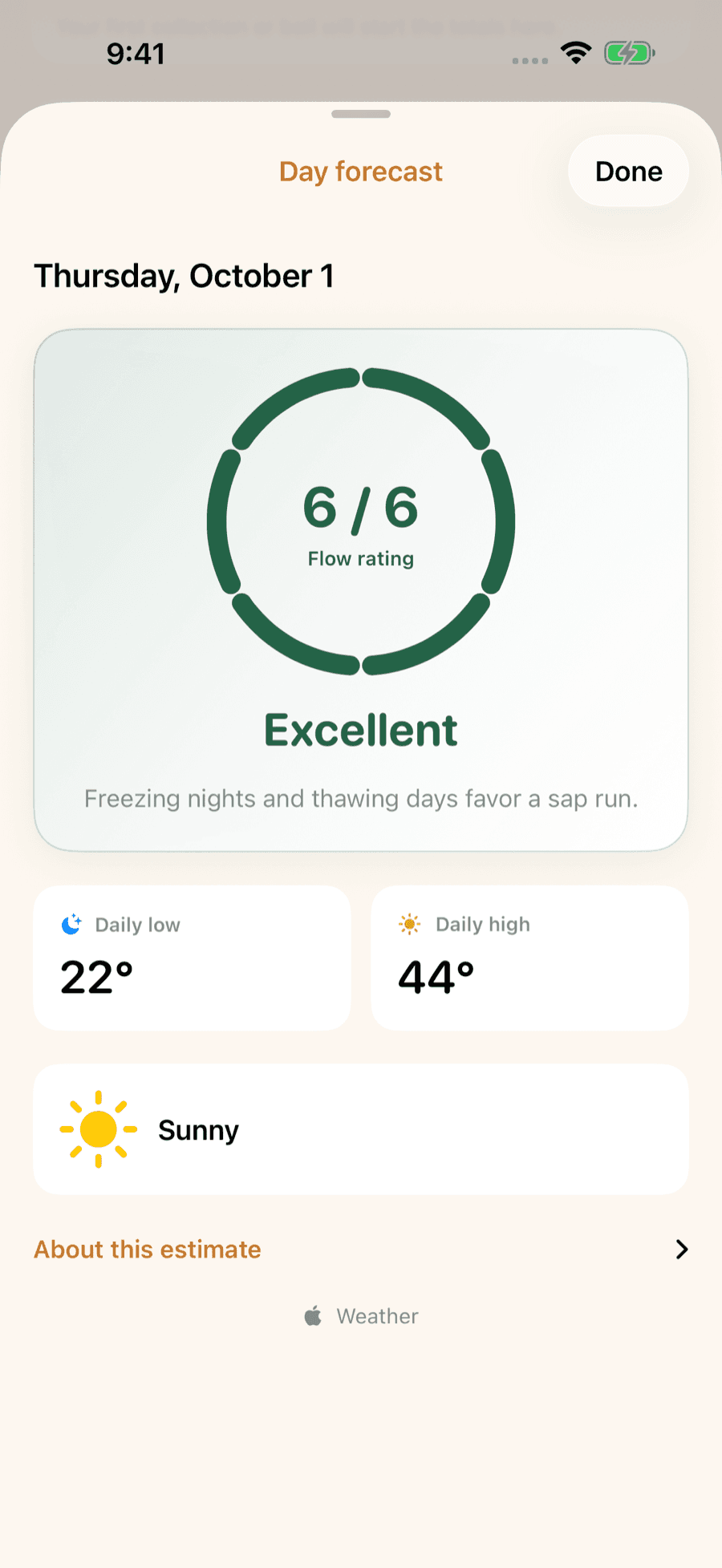
Sap-flow outlook right now
Full Michigan forecast →Forecast for Stephenson
Updated Nov 10, 7:07 AM EST
3 sap days in the next 6
freeze thaw 32°F
- WedNov 1135° / 46°
0h below · 24h above
No refreeze forecast - ThuNov 1234° / 39°
0h below · 21h above
No refreeze forecast - FriNov 1332° / 40°
4h below · 12h above
No refreeze forecast - SatNov 1424° / 42°
13h below · 10h above
Classic sap day - SunNov 1524° / 45°
12h below · 12h above
Classic sap day - MonNov 1627° / 48°Classic sap day
Data: National Weather Service. Verdicts use freeze-thaw thresholds from maple field research; your woods may run a little differently.
Season history
Michigan maple seasons, 2011–2022
| Year | Opened | Closed | Days |
|---|---|---|---|
| 2022 | Mar 9 | Apr 8 | 30 |
| 2021 | Mar 2 | Mar 28 | 26 |
| 2020 | Mar 1 | Mar 30 | 29 |
| 2019 | Mar 13 | Apr 7 | 25 |
| 2018 | Feb 28 | Apr 10 | 41 |
| 2017 | Feb 24 | Mar 28 | 32 |
| 2016 | Feb 28 | Mar 27 | 28 |
| 2015 | Mar 13 | Apr 8 | 26 |
| 2014 | Mar 21 | Apr 14 | 24 |
| 2013 | Mar 9 | Apr 10 | 32 |
| 2012 | Feb 26 | Mar 15 | 18 |
| 2011 | Mar 8 | Apr 6 | 29 |
Timing your taps
How to know it's time in Michigan
Sap runs on a temperature swing, not a date. A night below freezing loads the tree; a day above freezing pushes sap out of the taphole. Field research treats a low under about 30°F followed by a high over about 37°F as a real freeze-thaw day, and big runs almost always come on days like that.
So watch the 10-day forecast. When you see a string of nights in the 20s and afternoons in the 40s, get your taps in a day or two ahead. South-facing slopes warm first and usually run earlier.
Dates are USDA NASS approximate state averages. Michigan's production is spread across the Upper Peninsula and the northern Lower Peninsula; no single county has more than about 7% of the state's taps (2022 Census of Agriculture).
Michigan made 203,000 gallons of maple syrup in 2026, 3.5% of the US crop (USDA NASS). See every state’s crop.
Seasons are shifting. Cornell researchers found that start dates for tapping maples in the Northeast are about a week earlier than in 1970, and projected they could arrive about a month earlier by 2100 — e.g., around Feb 1 instead of Mar 1 in Montpelier, Vermont (Skinner, DeGaetano & Chabot, Climatic Change, 2010).
Where Michigan's sugaring happens
- StephensonMenominee County in the Upper Peninsula has the most taps in Michigan, 45,900 (2022 Census of Agriculture).
- Boyne CityCharlevoix County made the most syrup of any Michigan county with published figures, 19,405 gallons (2022 Census of Agriculture).
FAQ
Michigan tapping questions
- When is maple syrup season in Michigan?
- Usually from early March to early April, about 4 weeks. The exact start moves by weeks from year to year with the weather.
- When should I tap my trees in Michigan?
- Tap just before the first good run: when the forecast shows nights below freezing and days climbing to around 40°F. In a typical year that's around March 5. Tapholes dry up within 6 to 10 weeks, so tapping far too early can cost you the late runs.
- What's the earliest maple season has started in Michigan?
- In USDA records for 2011–2022, the earliest average opening was February 24 (2017) and the latest was March 21 (2014), a spread of 25 days.

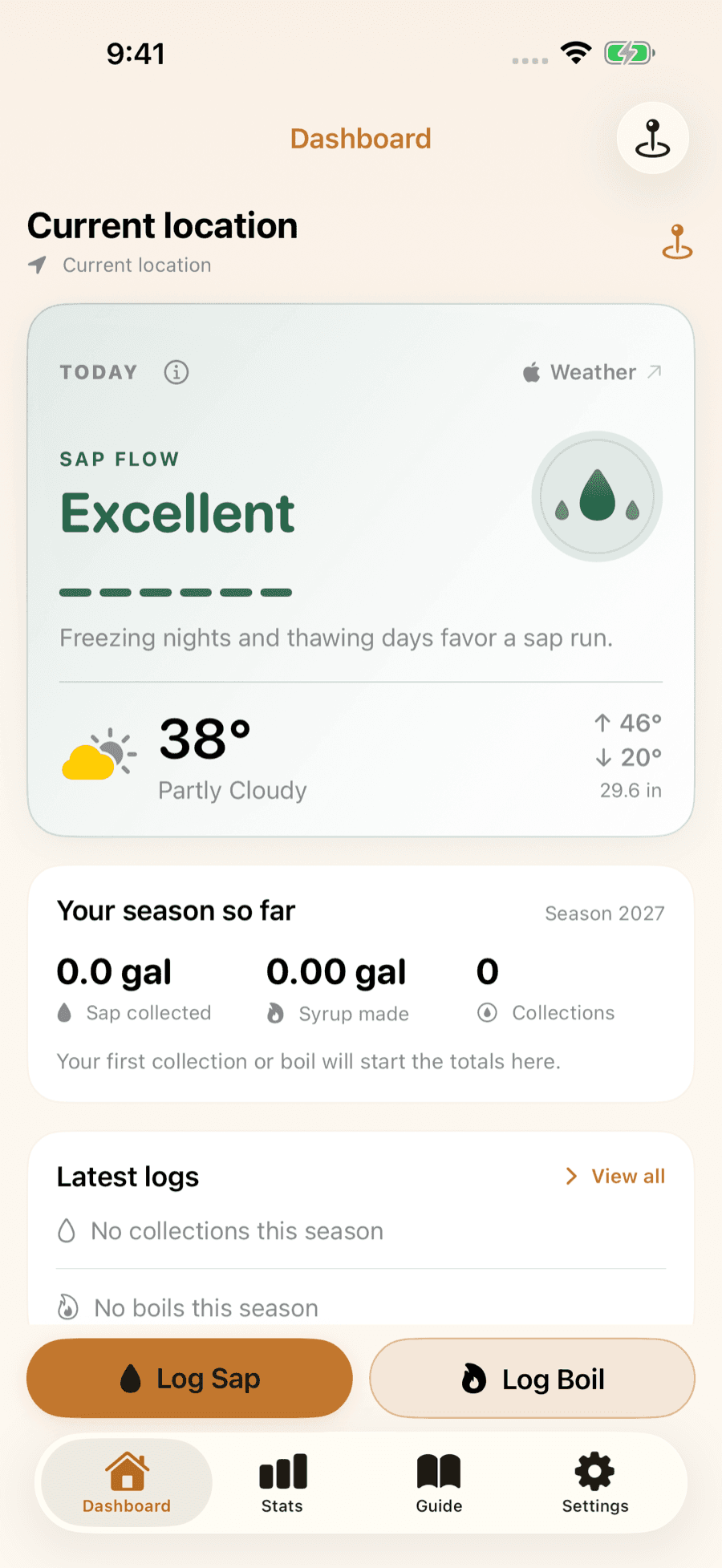
LuckySap · free on iPhone & Android
Get a heads-up when Michigan's sap will run
LuckySap checks the forecast for your trees and can ping you the night before a strong sap day, then keeps every collection and boil in one season log. Free on iPhone and Android.