When to tap maple trees in Illinois
- Opens
- —
- early January (south) to mid-February (central)
- Closes
- —
- late February (south) to mid-March (central)
County by county
When the sap runs across Illinois
Loading the map…
Typical opening date of the sap season, week by week across this state’s range
- Feb 14–15
- Feb 16–22
- Feb 23–26
- fewer than 5 maple farms
4 places with an atlas page. Typical season opening, earliest: Woodford County, IL, Feb 14; LaSalle County, IL, Feb 18; DeKalb County, IL, Feb 25; latest: Lake County, IL, Feb 26; DeKalb County, IL, Feb 25; LaSalle County, IL, Feb 18. Most sap days a season: Woodford County, IL, 43; LaSalle County, IL, 40; DeKalb County, IL, 36. Maple taps in the 2022 Census of Agriculture, on a five-step scale shared by both countries: under 1,000, 1,000–5,000, 5,000–20,000, 20,000–100,000, 100,000+; the most: Lake County, IL (107), LaSalle County, IL (95), Woodford County, IL (95), DeKalb County, IL (63). Maple farms in the same census, in five steps: under 10, 10–20, 20–50, 50–100, 100+; the most: Lake County, IL (8), Woodford County, IL (6), DeKalb County, IL (5). Syrup made, in US gallons: Lake County, IL (24 gal), DeKalb County, IL (22 gal), Woodford County, IL (18 gal). 3 counties' estimates are too uncertain to show (sampling error over 50%). 1 county has none tallied on the inventory plots (not a zero). Each shaded place links to its page; every state and province page lists its places in a table.
Sap-flow outlook right now
Full Illinois forecast →Forecast for Funks Grove
Updated Nov 10, 3:11 AM EST
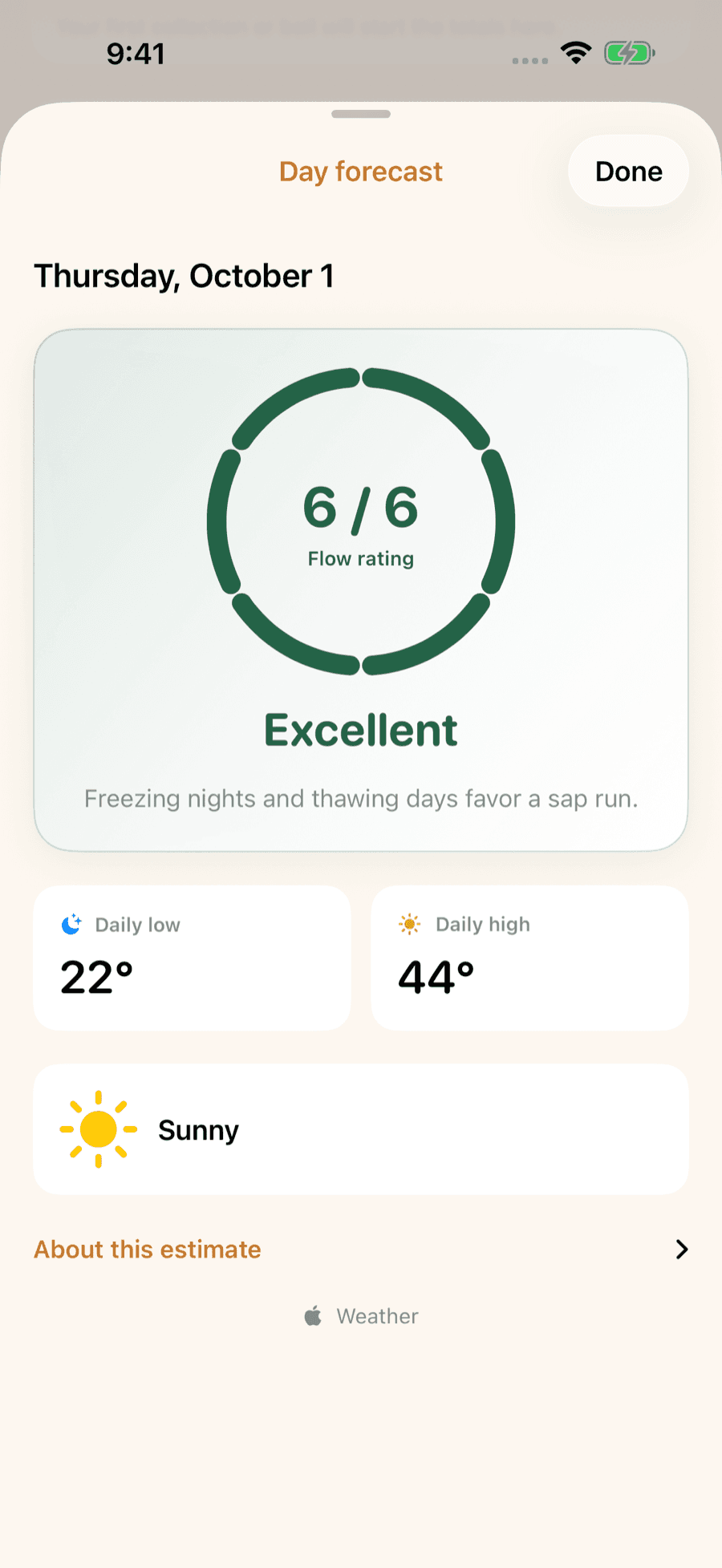
3 sap days in the next 7
freeze thaw 32°F
- TueNov 1046° / 66°No refreeze forecast
- WedNov 1142° / 62°
0h below · 24h above
No refreeze forecast - ThuNov 1237° / 46°
0h below · 24h above
No refreeze forecast - FriNov 1328° / 43°
10h below · 11h above
Classic sap day - SatNov 1423° / 46°
11h below · 12h above
Classic sap day - SunNov 1528° / 50°
7h below · 16h above
Sap likely - MonNov 1632° / 53°Run tapering
Data: National Weather Service. Verdicts use freeze-thaw thresholds from maple field research; your woods may run a little differently.
Timing your taps
How to know it's time in Illinois
Sap runs on a temperature swing, not a date. A night below freezing loads the tree; a day above freezing pushes sap out of the taphole. Field research treats a low under about 30°F followed by a high over about 37°F as a real freeze-thaw day, and big runs almost always come on days like that.
So watch the 10-day forecast. When you see a string of nights in the 20s and afternoons in the 40s, get your taps in a day or two ahead. South-facing slopes warm first and usually run earlier.
No NASS season data for Illinois. Illinois Extension: in southern Illinois the season runs roughly from the first week of January into the last week of February, and later the farther north you go. In central Illinois, Funks Grove historically ran mid-February to mid-March, but the season "seems to get earlier each year" and producers are starting to tap earlier, maybe in January (WGLT, 2023).
Seasons are shifting. Cornell researchers found that start dates for tapping maples in the Northeast are about a week earlier than in 1970, and projected they could arrive about a month earlier by 2100 — e.g., around Feb 1 instead of Mar 1 in Montpelier, Vermont (Skinner, DeGaetano & Chabot, Climatic Change, 2010).
Where Illinois' sugaring happens
- Funks GroveCentral Illinois reference point: Funks Grove in McLean County, a ~4,000-tree, 500-acre sugarbush that historically ran mid-February to mid-March (WGLT, 2023).
- SimpsonSouthern Illinois reference point: Illinois Extension's 100-tap sugarbush at the Dixon Springs Agricultural Center in Simpson.
FAQ
Illinois tapping questions
- When is maple syrup season in Illinois?
- Usually from early January (south) to mid-February (central) to late February (south) to mid-March (central). The exact start moves by weeks from year to year with the weather.
- When should I tap my trees in Illinois?
- Tap just before the first good run: when the forecast shows nights below freezing and days climbing to around 40°F. Tapholes dry up within 6 to 10 weeks, so tapping far too early can cost you the late runs.

LuckySap · free on iPhone & Android
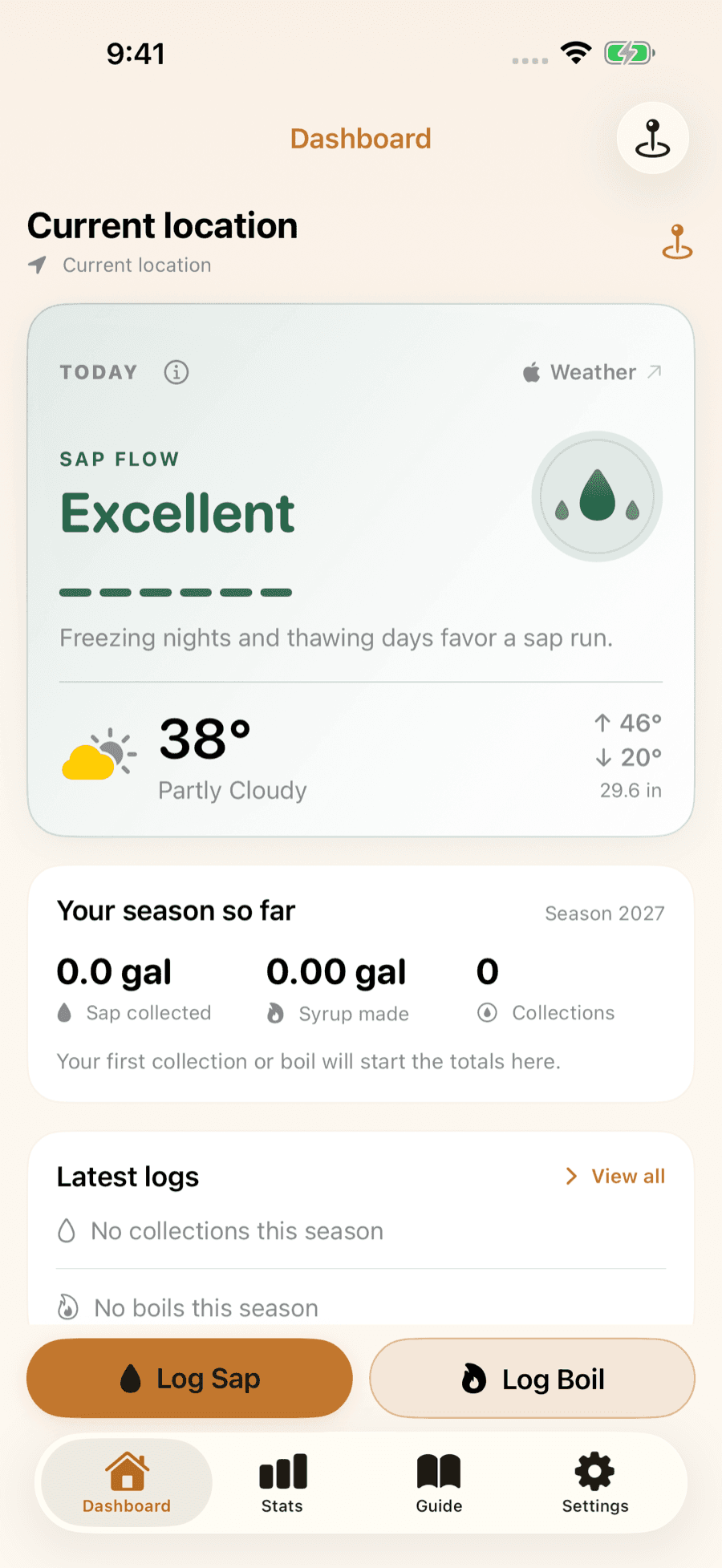
Get a heads-up when Illinois' sap will run
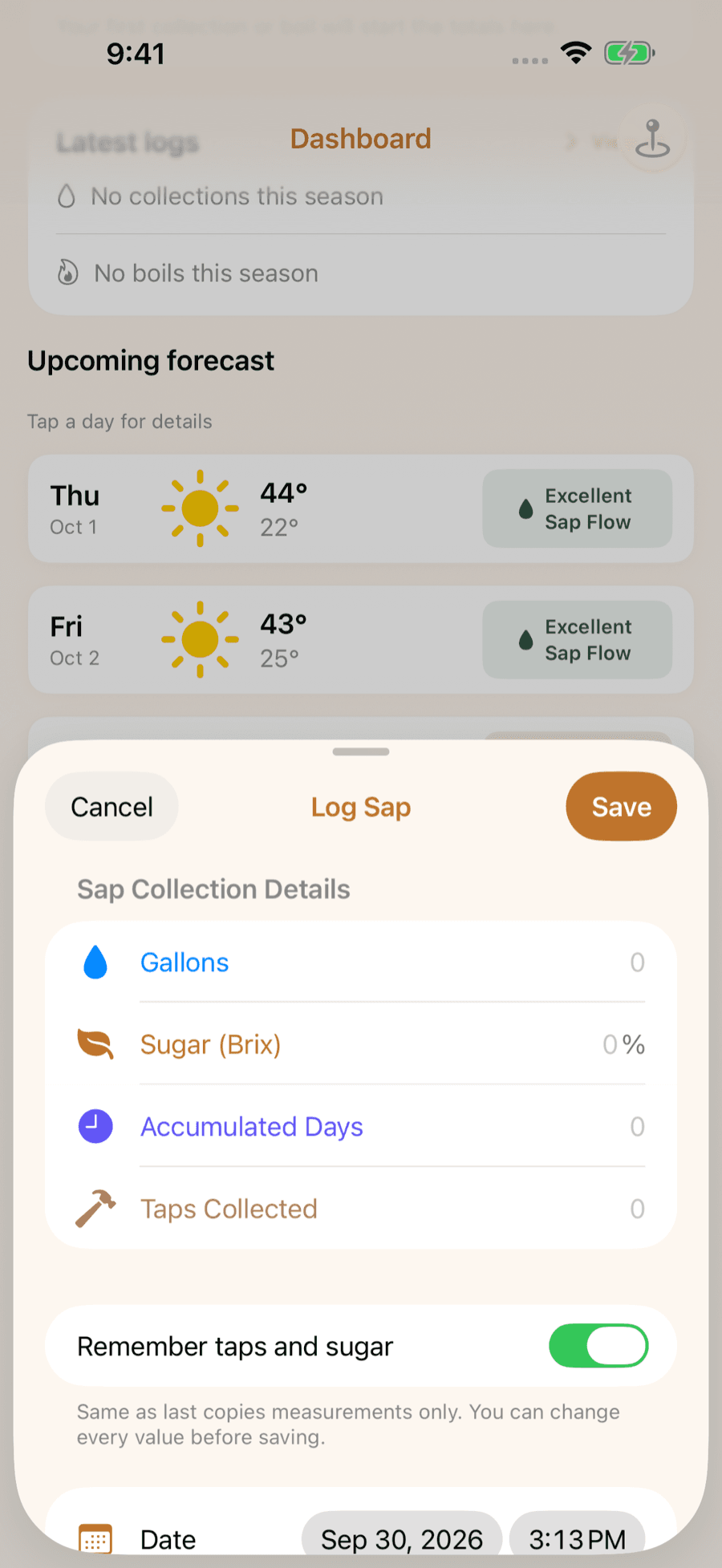
LuckySap checks the forecast for your trees and can ping you the night before a strong sap day, then keeps every collection and boil in one season log. Free on iPhone and Android.