Skip to content
LuckySap
Equipment guide · 20 categories · prices read 2026-10-05

Maple sugaring gear, by how many taps you'll run

Extension services publish the honest equipment lists (UMaine's bulletins for 1–50 and 50–500 taps, Cornell's beginner notebook); we turned them into three tiers with quantities per tap, then checked what's actually for sale against the criteria that matter. Read the disclosure before you buy: we haven't tested any of it.

How this section works, and how it's paid for

Gear pages contain affiliate links: if you buy through them we may earn a commission at no extra cost to you. Nobody on this site has tested these products; recommendations rest on manufacturer specifications, extension-service guidance, price and availability on the dates shown.

Three tiers

What you need, by tap count

Quantities come from extension rules of thumb; each line names its rule. Estimates are totals of real component prices on the date shown, excluding jars, fuel and anything you already own.

1-10 taps

First season

Tap a few yard trees, batch-boil outdoors in one pan, finish on a controlled burner by thermometer, filter through a cone or let settle, pack in canning jars.

~$230 to ~$560

  • 5/16 in tapping bit + cordless drill or hand brace15/16 in spout with a matching 5/16 in bit (19/64 in counts as 5/16) (UNH)
  • 5/16 in spouts1 per tap1 per taphole; buy a few spares (CORNELL-NB p.4)
  • Bucket + cover, or sap bag + holder, or drop tube to a food-grade pail1 per tap1 per taphole: bucket + cover, OR sap bag + holder, OR a drop tube to a ground pail (CORNELL-NB p.4)
  • Food-grade gathering pails (3-5 gal)22 food-grade pails, 3-5 gal each (one per hand) (NAMSPM2 p.92)
  • Sap storage (food-grade pails or a food-grade can)1-2 gal per tap (10-20 gal at 10 taps)Buckets: minimum 1 gal per tap; safest 2 gal per tap; 2-3 gal per tap covers two good days of flow (NAMSPM2 p.253, p.115)
  • Sap filter (coffee filter/cheesecloth or reusable)1Filter all sap before boiling; coffee filter, cheesecloth, or a reusable sap filter (CORNELL-NB p.76)
  • High-sided stainless pan or stock pot + outdoor heat source1Stainless steel, lead-free solder or welded; high sides (6-8 in minimum); keep sap about 1.5-2 in deep (UNH)
  • Thermometer readable above 219 F11; must read above 219 F: range to at least 225 F, graduations of 1/4 F or finer (NAMSPM); 'calibrated to at least 30 degrees F above the boiling point of water' (Cornell); 50-300 F (UNH) (NAMSPM2 p.148)
  • Syrup filter (wool/Orlon cone + paper prefilters) - or settle and decant1 + prefilters1 wool/Orlon (synthetic felt) filter plus paper prefilters; keep several clean filters and 2-3 prefilters stacked (UMN)
  • Canning jars or syrup bottlesabout 1 qt of capacity per tapContainers for about 1 qt of syrup per tap (canning jars are acceptable for home use); glass or food-grade plastic or metal (CORNELL-NB p.5)

Optional: Syrup hydrometer + cup (OSU lists it as optional for hobbyists); Defoamer

10-50 taps

Serious backyard

Enough sap that boiling time, not collection, is the constraint: a 2 ft-class flat or divided pan on a block arch, barrel or small steel arch (or several steam-table pans), proper storage, hydrometer finishing.

~$950 to ~$2,700

  • Everything in tier 1, scaled per tap-1 per taphole; buy a few spares (CORNELL-NB p.4)
  • Sap storage tank(s), food-grade, shaded2 gal per tap (20-100 gal)Buckets: minimum 1 gal per tap; safest 2 gal per tap; 2-3 gal per tap covers two good days of flow (NAMSPM2 p.253, p.115)
  • Pan/evaporator sized to finish a 1 gal/tap run in the hours availablegph = taps / boil hours(taps x gal of sap per tap in a good run) / hours you can boil; plan on 1 gal/tap per run (UNH, NAMSPM) and no more than a 10-hour day (UNH)
  • Finishing pot + controlled burner1Stainless steel, lead-free solder or welded; high sides (6-8 in minimum); keep sap about 1.5-2 in deep (UNH)
  • Syrup hydrometer (+ spare) and test cup2 + 1 cupOptional for a first season (thermometer finish), standard from then on: 1 hydrometer + 1 spare + 1 cup; cup nearly as long as the hydrometer and 1.5x as wide (OSU-F36)
  • Thermometer11; must read above 219 F: range to at least 225 F, graduations of 1/4 F or finer (NAMSPM); 'calibrated to at least 30 degrees F above the boiling point of water' (Cornell); 50-300 F (UNH) (NAMSPM2 p.148)
  • Cone filter + prefilters (several)1-2 felt + 3 or more prefilters1 wool/Orlon (synthetic felt) filter plus paper prefilters; keep several clean filters and 2-3 prefilters stacked (UMN)
  • Bottles/jugsabout 1 qt per tap (2.5-12.5 gal of syrup)Containers for about 1 qt of syrup per tap (canning jars are acceptable for home use); glass or food-grade plastic or metal (CORNELL-NB p.5)
  • Defoamer1 small bottleA drop or two at a time; commercial food-grade defoamer preferred over butter/oil (NAMSPM2 p.145)

Optional: Gravity 5/16 or 3/16 in tubing in place of buckets where there is slope; Small RO (Cornell's Childs halved boil time on 25 taps with a ~$360 water-purifier RO); Sap refractometer / sap hydrometer for the Rule of 86

50-200 taps

Small sugarhouse

Continuous-flow hobby evaporator (2x4 to 2x6 class) under cover, tubing on at least part of the bush, tank storage at 2+ gal/tap, hydrometer + refractometer, filtering and bottling as a station; syrup may be sold, so grading and food-grade/lead-free documentation start to matter.

~$4,500 to ~$10,000+

  • Tubing (5/16 or 3/16 in laterals, droplines, tees, end fittings, tubing tool) and/or buckets15 ft lateral per tap; 1 drop + tee per tap; 5-7 taps per lateralAbout 15 ft of 5/16 in tubing per tap for a woods installation; each lateral 5-7 taps and no longer than ~150 ft (PSU-AGALT (CORNELL-NB p.33))
  • Sap storage tank(s)2-3 gal per tap (100-600 gal)Buckets: minimum 1 gal per tap; safest 2 gal per tap; 2-3 gal per tap covers two good days of flow (NAMSPM2 p.253, p.115)
  • Continuous-flow evaporatorgph = taps / boil hours (e.g. 100 taps / 6 h = ~17 gph)(taps x gal of sap per tap in a good run) / hours you can boil; plan on 1 gal/tap per run (UNH, NAMSPM) and no more than a 10-hour day (UNH)
  • Hydrometer x2 + cup; thermometer; (syrup refractometer optional)-Optional for a first season (thermometer finish), standard from then on: 1 hydrometer + 1 spare + 1 cup; cup nearly as long as the hydrometer and 1.5x as wide (OSU-F36)
  • Filter tank with cone/flat filters, or small filter press-1 wool/Orlon (synthetic felt) filter plus paper prefilters; keep several clean filters and 2-3 prefilters stacked (UMN)
  • Bottling pot/canner able to hold 180-190 F; jugs/bottlesabout 1 qt per tap (12.5-50 gal of syrup)Containers for about 1 qt of syrup per tap (canning jars are acceptable for home use); glass or food-grade plastic or metal (CORNELL-NB p.5)
  • Grading kit (if selling)1
  • Defoamer, pan cleaner, brushes-A drop or two at a time; commercial food-grade defoamer preferred over butter/oil (NAMSPM2 p.145)

Optional: Small RO sized to the tap count; Sap pump/transfer

By category

Buying criteria and picks

Each page lists what matters (with the extension source), the products we found, their specs and dated prices, and a pick where the evidence supports one.

Where the money goes, in plain terms

Most maple equipment makers and dealers run no referral programs at all; of the ones we checked, only Smoky Lake Maple Products and ThermoWorks do, plus Amazon, where several hobby brands sell. When a link pays us a commission it is marked and it costs you nothing extra. Prices are single-day readings from the dealer's own page and will drift; the date is on every one. If a spec says “unknown”, the maker's page didn't state it and we didn't guess.

FAQ

Gear questions

Do you earn money from these links?
Gear pages contain affiliate links: if you buy through them we may earn a commission at no extra cost to you. Nobody on this site has tested these products; recommendations rest on manufacturer specifications, extension-service guidance, price and availability on the dates shown.
Why no 'best evaporator' ranking?
Because every evaporation rate on the market is the maker's own claim and nobody on this site has boiled on them side by side. Where the criteria that matter (stainless grade, lead-free welds, stated tap range, warranty, price per stated gallon per hour) point one way we say so; where they don't, we say there is no defensible pick.
What size spout should I buy?
5/16 inch, with a matching 5/16 inch bit. Current extension guidance (UMaine, UNH, Ohio State) has moved from the old 7/16 inch standard because the smaller hole heals faster; some starter kits still ship 7/16 inch hardware, and we flag them.

LuckySap · free on iPhone & Android

Gear up, then log every run

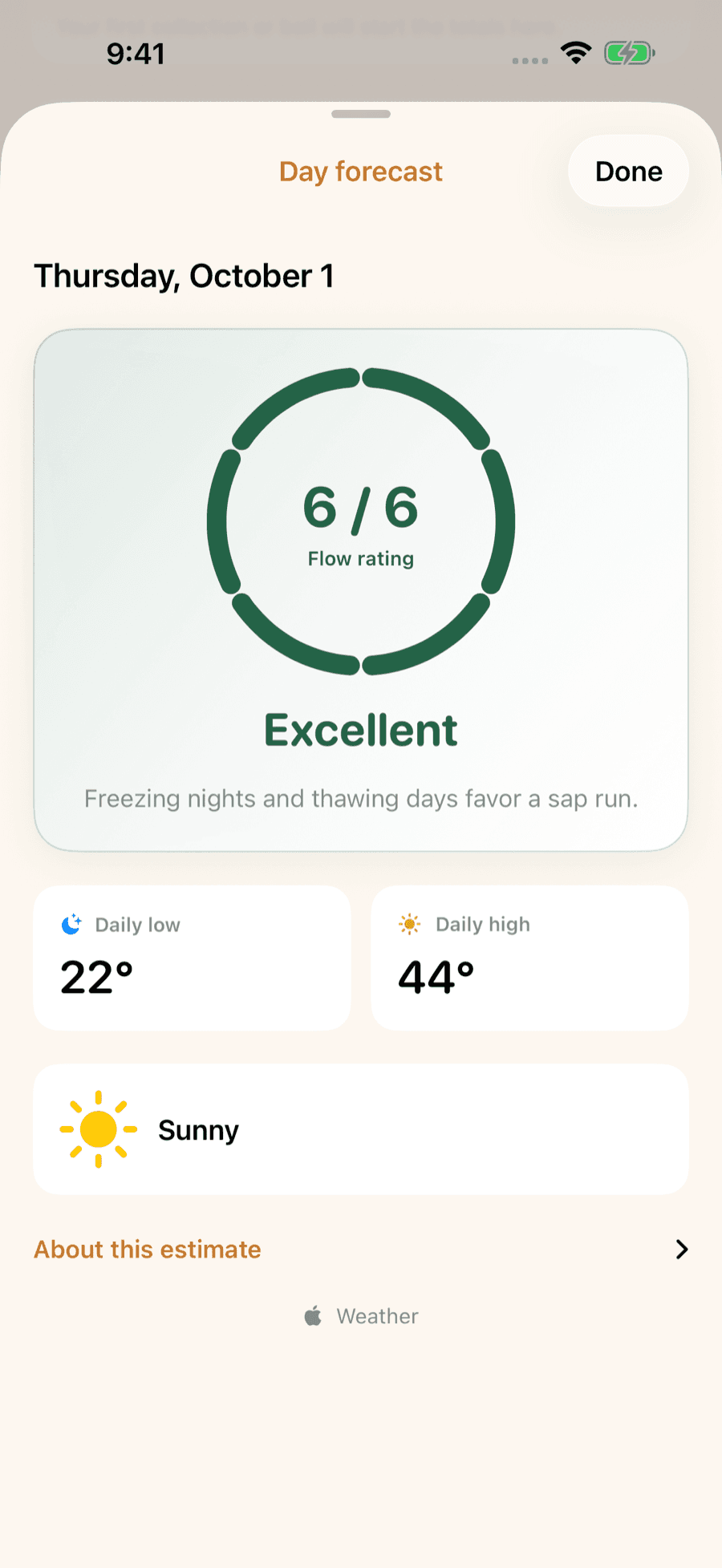
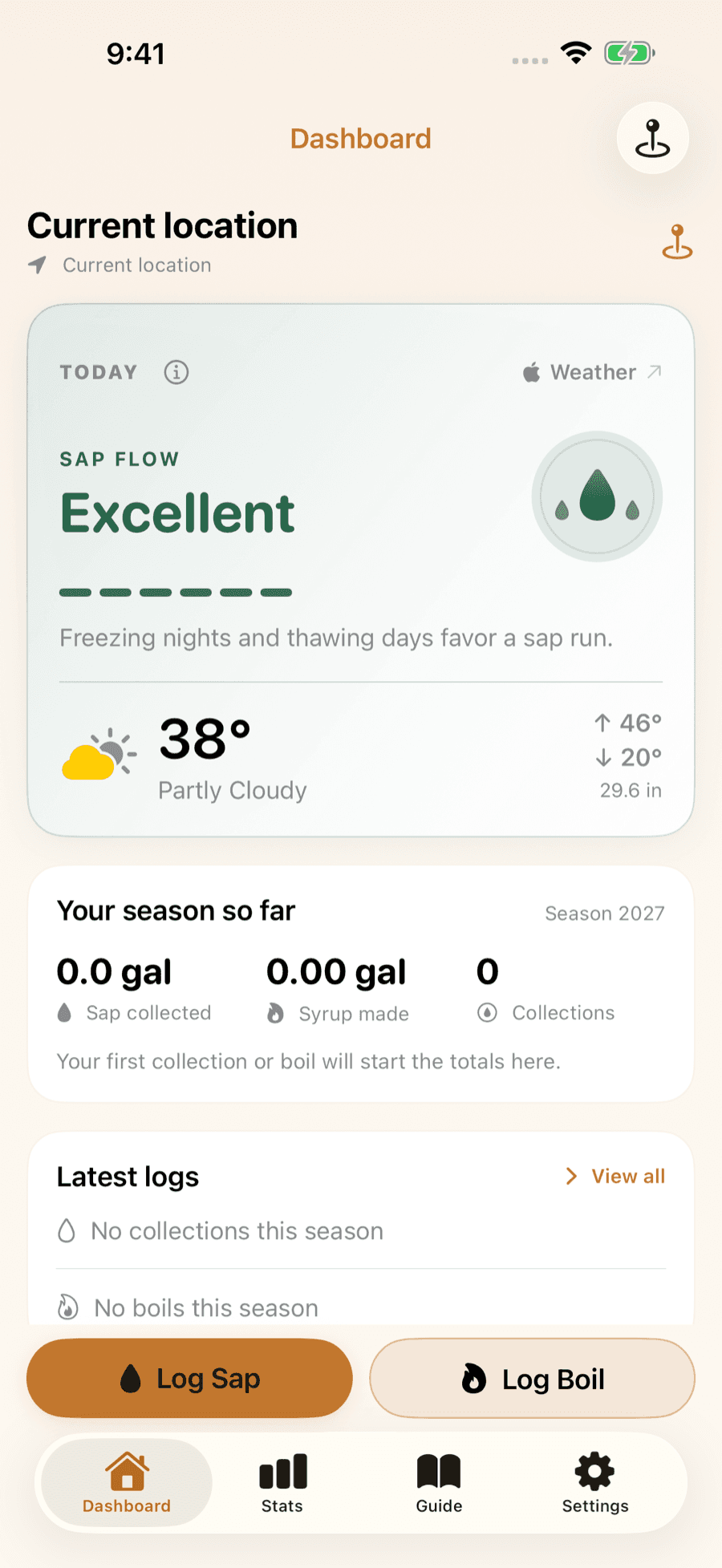
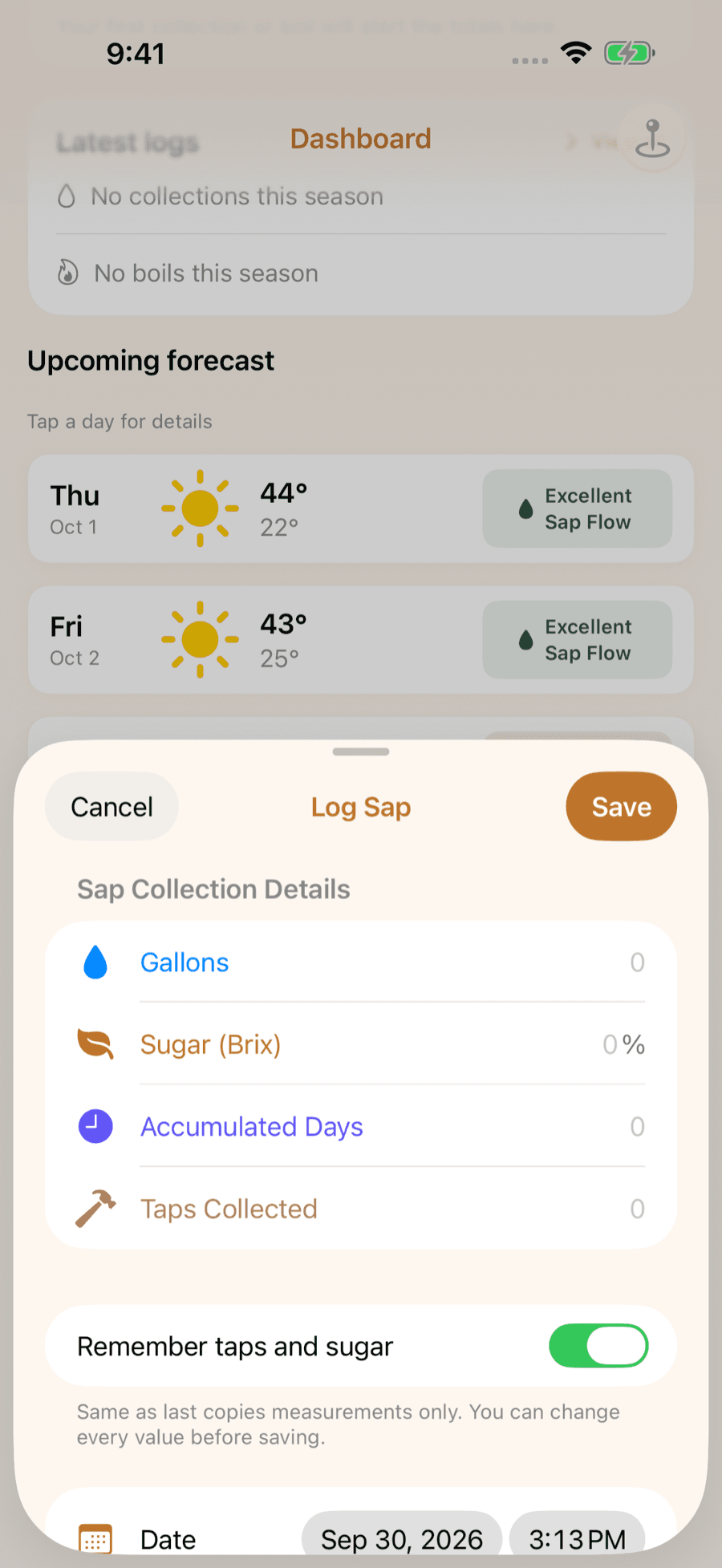
LuckySap keeps your collections and boils in one season log and gives you a day-by-day sap outlook. Free on iPhone and Android.

Download on the App StoreGet it on Google Play