Can you make maple syrup in South Dakota?
Local timing guidance
SDSU Extension (2019): 'Spiles should be installed in the trees before typical sap flow begins, that means by the end of February or early March for most people.' SDSU P-00326 (2025): once flow begins 'it may continue anywhere from a few days to a month'; season ends 'when the days and nights stay above freezing'.
Source: SDSU Extension 2019 and P-00326 2025
Trees
Tappable trees in South Dakota
| Species | Status | Where |
|---|---|---|
| Silver mapleAcer saccharinum | native | 'a very common tree in many communities in eastern South Dakota' and in shelterbelts; the US Forest Service range reaches 'southeastern South Dakota'Source: SDSU Extension 2019; US Forest Service range data |
| BoxelderAcer negundo | native | 'found growing across the state' — river bottoms and shelterbeltsSource: SDSU Extension 2019; US Forest Service range data |
| Sugar mapleAcer saccharum | native | Far northeast only ('Local populations occur in ... northeastern South Dakota'); 'listed as rare in South Dakota'; 'not common trees in our South Dakota forests or communities'Source: US Forest Service range data; SDSU Extension P-00326 |
| Freeman (red × silver) and Amur mapleAcer × freemanii; A. ginnala | planted | Yard and windbreak plantings; SDSU says both can be tappedSource: SDSU Extension 2019 |
| Rocky Mountain mapleAcer glabrum | native | Black Hills — small, rarely tappableSource: US Forest Service range data |
| Paper birchBetula papyrifera | native | Black Hills outliersSource: US Forest Service range data |
| Black walnutJuglans nigra | native | 'southeastern South Dakota' isolated populationsSource: US Forest Service range data |
USDA Forest Inventory · plots measured 2019–2025
How many tappable maples?
Sugar and red maples are too scarce on the Forest Service’s South Dakota plots for a reliable count, but it counts about 1.7 million boxelders 10 inches and up on South Dakota's forest land.
| Statewide | 10 in and up | 18 in and up |
|---|---|---|
| Statewide | ||
| Boxelders | 10 in and up about1.7 million ±37% sampling error (1.1–2.4 million) · tallied on 15 plots | 18 in and up about230,000 ±45% sampling error (130,000–330,000) · tallied on 5 plots |
- FIA counts trees on forest land only. Yard, street and farm trees are not counted, so true numbers are higher.
- Plots measured 2019–2025. FIA visits a different share of its plots each year, so a “current” estimate pools 7 years of visits.
- Species are listed only where the statewide sampling error is 50% or less. FIA measures bigtooth and Rocky Mountain maples at the root collar rather than at chest height, so they are not in these counts.
- Source: USDA Forest Service, Forest Inventory and Analysis (live trees on forest land, by species and trunk diameter at 4.5 ft). How FIA counts trees →
Who already does it
Sugaring in South Dakota, documented
SDSU Extension 'Harvesting Maple Syrup in South Dakota' (Graper & Schaefer, 2019): workshop tapping at McCrory Gardens (Brookings); 'just two large silver maples (18" diameter) will produce enough sap to make a gallon of syrup'; some boxelders give 'as much as five gallons of sap from one tap ... in one day'
SDSU Extension P-00326 'Tapping Maples for Sap' (Ball, Zhang, Trio, March 2025): ideal conditions 'cold nights (25-30 °F), sunny, warm days (above 40 °F)'; conditions 'may last anywhere from a few days to a month'; silver maple sap 'averages a little above 3%'; boxelder 'averages between 2% and 3%'
SDSU Extension / SD Dept. of Agriculture and Natural Resources
Cautions
What local sources warn about
- Wind: 'Since wind is almost a constant in South Dakota, after installing the spiles wait until the weather warms up to install the collection buckets so they do not blow away.'Source: SDSU Extension 2019
- Silver maple and boxelder 'leaf out before sugar maples', so the buddy/'butterscotch' off-flavour ends their season sooner.Source: SDSU Extension P-00326
- Sugar numbers in SDSU P-00326 (sugar maple 'about 4.5%', silver 'a little above 3%') are well above the Producers Manual/Cornell averages in our tree guide (2–2.5% sugar maple; silver usually lower) — treat SDSU's figures as local/optimistic and measure your own.Source: SDSU Extension P-00326
- Sap can spoil in warm sun; collect daily or more often.Source: SDSU Extension P-00326
Where to look
Likely sugaring country
Brookings
SDSU campus and McCrory Gardens tapping workshops; silver-maple town
Sioux Falls
Largest urban maple canopy in the state; southeastern river country where silver maple is native
Sisseton (Roberts County)
Northeastern corner where the US Forest Service places the state's only native sugar maple populations
FAQ
Sugaring in South Dakota: questions
- Can you tap maple trees in South Dakota?
- Yes, in parts of it. Yes in eastern South Dakota towns and shelterbelts with silver maple and boxelder (SDSU Extension publishes two how-to guides and runs tapping workshops); sugar maple is rare and 'listed as rare in South Dakota where it is at the western edge of its range', and the Plains freeze-thaw window can be 'a few days to a month'.
- When do you tap maple trees in South Dakota?
- SDSU Extension (2019): 'Spiles should be installed in the trees before typical sap flow begins, that means by the end of February or early March for most people.' SDSU P-00326 (2025): once flow begins 'it may continue anywhere from a few days to a month'; season ends 'when the days and nights stay above freezing'. (Source: SDSU Extension 2019 and P-00326 2025.)
- Which trees can you tap in South Dakota?
- Silver maple (Acer saccharinum, native): 'a very common tree in many communities in eastern South Dakota' and in shelterbelts; the US Forest Service range reaches 'southeastern South Dakota'. Boxelder (Acer negundo, native): 'found growing across the state' — river bottoms and shelterbelts. Sugar maple (Acer saccharum, native): Far northeast only ('Local populations occur in ... northeastern South Dakota'); 'listed as rare in South Dakota'; 'not common trees in our South Dakota forests or communities'. Freeman (red × silver) and Amur maple (Acer × freemanii; A. ginnala, planted): Yard and windbreak plantings; SDSU says both can be tapped. Rocky Mountain maple (Acer glabrum, native): Black Hills — small, rarely tappable. Paper birch (Betula papyrifera, native): Black Hills outliers. Black walnut (Juglans nigra, native): 'southeastern South Dakota' isolated populations.

LuckySap · free on iPhone & Android
Try a season where you are
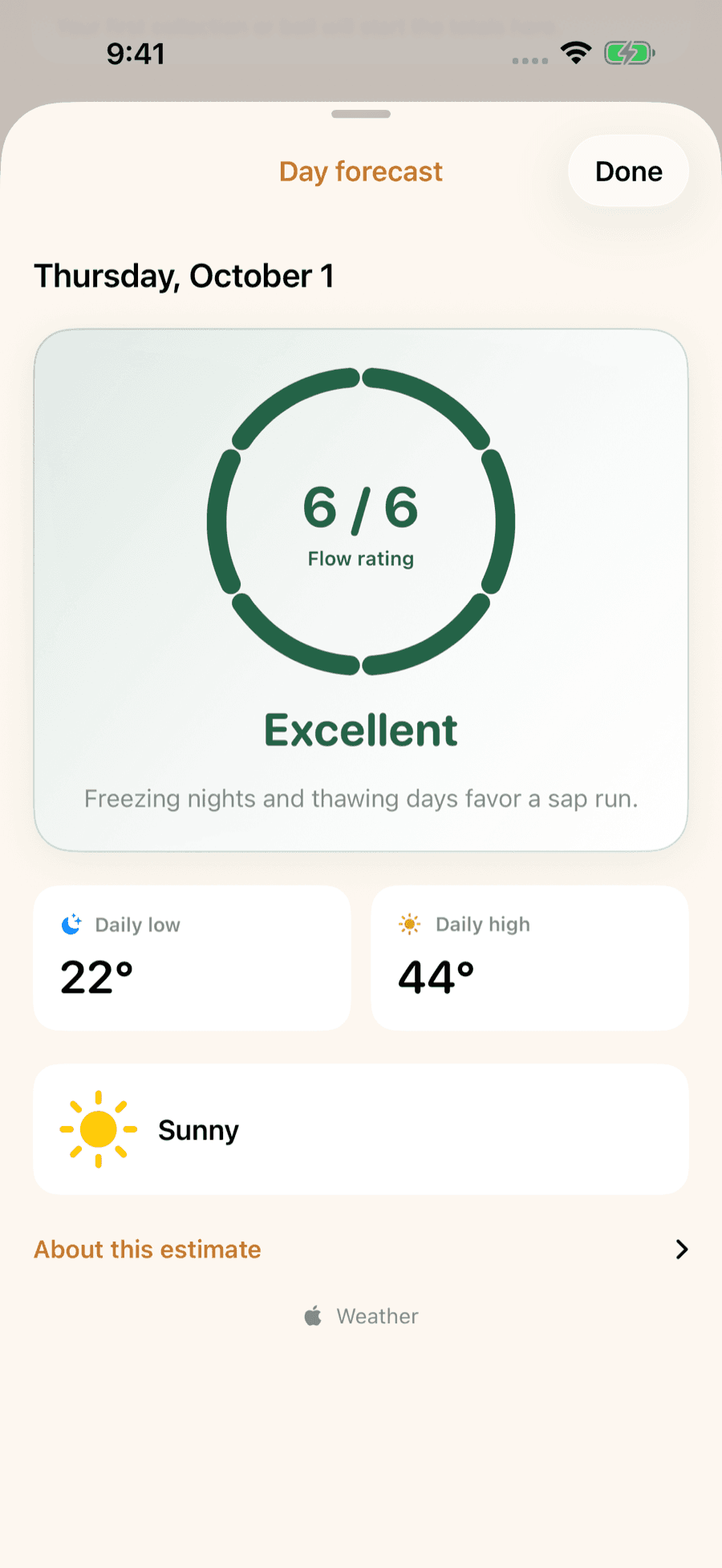
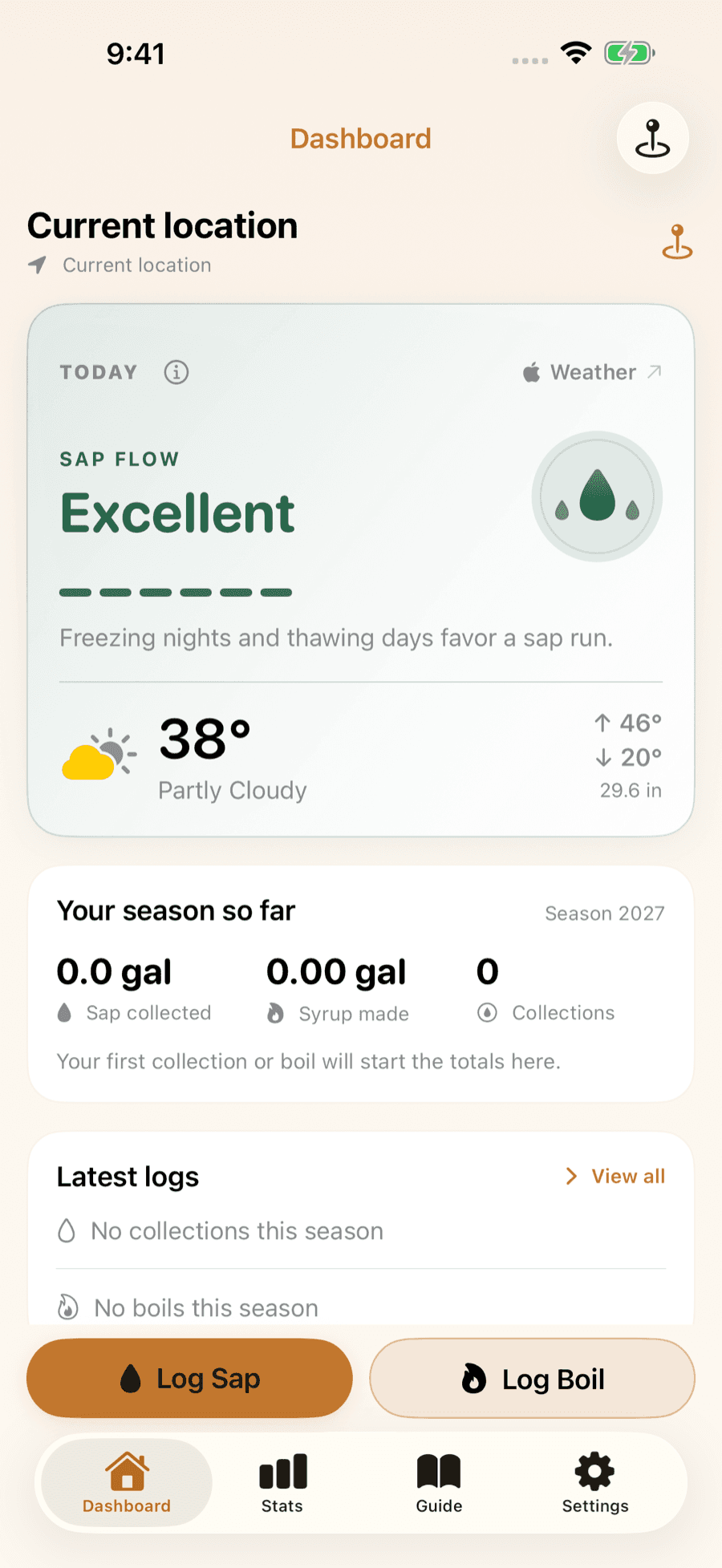
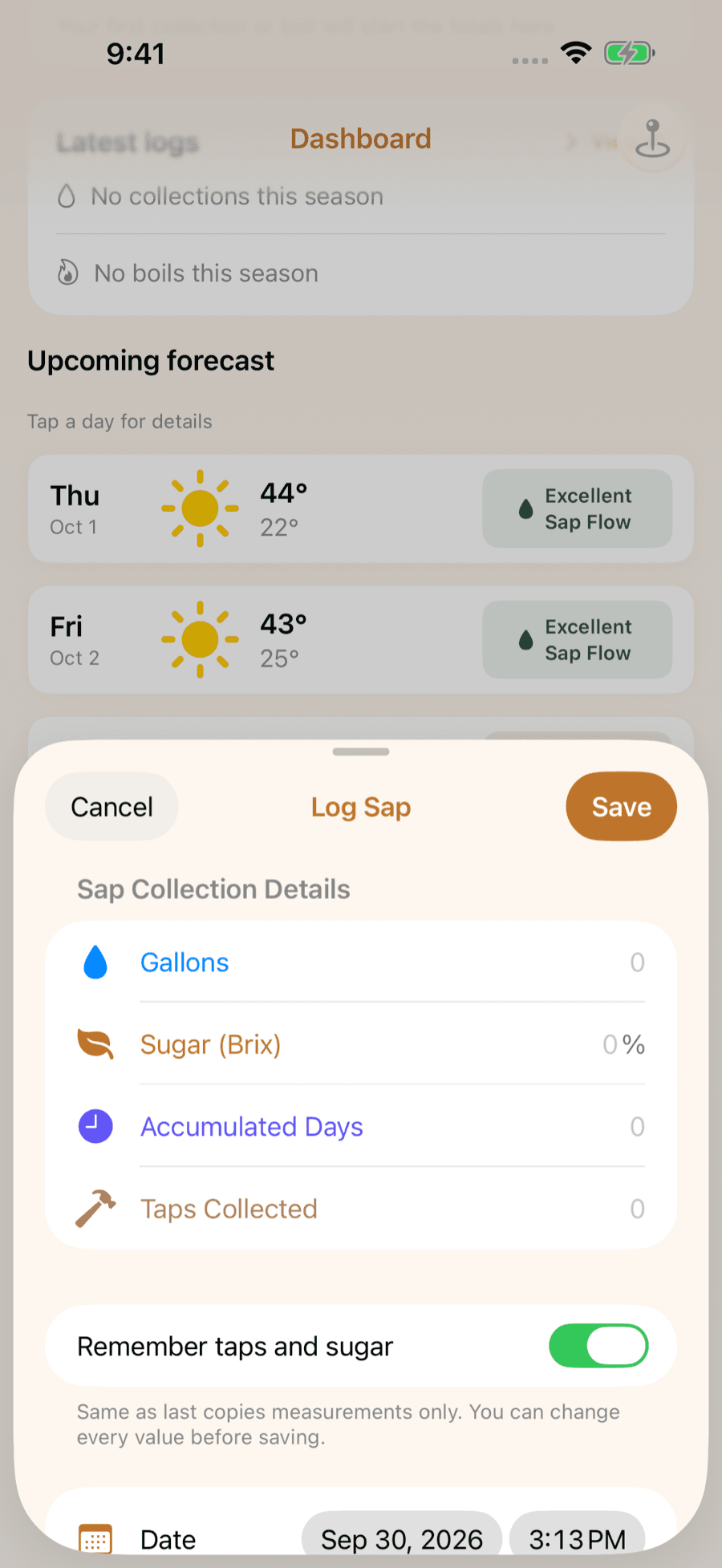
LuckySap turns the forecast for any spot into a day-by-day sap outlook and logs every collection and boil. Free on iPhone and Android.