Can you make maple syrup in Utah?
Local timing guidance
USU Forest Facts 043: freeze-thaw temperatures 'in Logan, Utah ... generally start occurring mid to late February'. Forest Facts 046: boxelder and Norway maples 'have been tapped in the late winter in Utah, generally in February'. Research trees in Cache Valley were tapped 1 March 2023 and ran to 10 April.
Source: Utah State University Forest Facts 043 and 046; ASHS 2025
Trees
Tappable trees in Utah
| Species | Status | Where |
|---|---|---|
| Bigtooth (canyon) mapleAcer grandidentatum | native | Wasatch, Uinta and plateau canyons — 'a small tree species native to Utah', commonly multi-stemmed with about 9 in trunks; 'a 7-inch diameter is acceptable for tapping'Source: Utah State University Forest Facts 046; US Forest Service range data |
| BoxelderAcer negundo | native | 'primarily found in natural mid-elevation canyons' and abundant statewideSource: Utah State University Forest Facts 043 |
| Norway mapleAcer platanoides | introduced | 'extensively planted in urban landscapes' — the Wasatch Front's commonest tappable street treeSource: Utah State University Forest Facts 043 |
| Rocky Mountain mapleAcer glabrum | native | Mountains statewide; 'Little is known about the specifics of tapping' itSource: Utah State University Forest Facts 046 |
| Tatarian and paperbark mapleAcer tataricum; A. griseum | introduced | Ornamentals listed as tappable by USUSource: Utah State University Forest Facts 046 |
USDA Forest Inventory · plots measured 2013–2022
How many tappable maples?
The Forest Service’s Utah plots tally too few maples 10 inches and up for a reliable count.
- FIA counts trees on forest land only. Yard, street and farm trees are not counted, so true numbers are higher.
- Plots measured 2013–2022. FIA visits a different share of its plots each year, so a “current” estimate pools 10 years of visits.
- Species are listed only where the statewide sampling error is 50% or less. FIA measures bigtooth and Rocky Mountain maples at the root collar rather than at chest height, so they are not in these counts.
- Source: USDA Forest Service, Forest Inventory and Analysis (live trees on forest land, by species and trunk diameter at 4.5 ft). How FIA counts trees →
Who already does it
Sugaring in Utah, documented
USU Forest Facts 043 'Producing Maple Syrup From Boxelder and Norway Maple Trees' — species ID, temperature trigger, tapping how-to, 'buddy' end-of-season signal
USU Forest Facts 046 'Alternative Tree Species for Utah Syrup Production': 'Bigtooth maples have been tapped successfully in Utah. The nonprofit ... "Bigtooth Maple Project and Syrup" in Woodland Hills, Utah, tapped over 900 trees in 2024 to make nearly 60 gallons of syrup'
USU Climate Center Maple Tree Tapping Project (USDA Acer grant): publications, workshop videos, Bigtooth Maple Festival 2023–2025, commercial products 'Bigtooth Maple Syrup Produced by: Woodland Hills Outdoors'
USU MS thesis (Mathews 2024): sap yield and sugar of boxelder and Norway maple at three Cache Valley sites (2022–23) and bigtooth maple at Woodland Hills (2023–24); 'Viability of a Maple Syrup Industry in Northern Utah'
Three-state boxelder trial: Logan/Providence/Smithfield trees tapped 1 Mar 2023, collected 2 Mar–10 Apr, 34.4 L per tree over 41 days
USU Extension Maple Syrup Festival / free tapping workshop at Woodland Hills Outdoors (Saturday, April 15)
Cautions
What local sources warn about
- Small trees, low volume: bigtooth maple is often a multi-stemmed 9-inch tree; USU's 2023 newsletter says expect '30-60 gallons of sap to make 1 gallon of syrup, depending on the initial sugar content'.Source: Utah State University Forest Facts 046; Utah State University newsletter 2023
- Public-land tapping usually needs a permit 'from the local management office'; tap only trees you own or have permission for.Source: Utah State University Forest Facts 043
- Season ends with bud swell — 'buddy' off-flavour — pull spouts then; sap 'turns cloudy' when spoiled.Source: Utah State University Forest Facts 043
- Boxelder syrup has a distinct flavour; don't mix with other maple sap.Source: our tree guide
Where to look
Likely sugaring country
Logan (Cache Valley)
USU research sites (Logan, Providence, Smithfield) and the mid/late-February trigger date quoted by USU
Woodland Hills (Utah County)
Bigtooth Maple Project — 900+ taps, festival, commercial bigtooth syrup
Salt Lake City
Largest Norway-maple street canopy and Wasatch canyon bigtooth stands
FAQ
Sugaring in Utah: questions
- Can you tap maple trees in Utah?
- Yes, in parts of it. Yes along the Wasatch Front and canyons: Utah State University leads a USDA-funded Intermountain West syrup program, publishes two Forest Facts on tapping boxelder, Norway and native bigtooth maple, and the Bigtooth Maple Project in Woodland Hills tapped over 900 trees for about 60 gallons in 2024 — but the natives are small, sap volumes are about half of eastern sugar maple, and the season is a few weeks from mid/late February.
- When do you tap maple trees in Utah?
- USU Forest Facts 043: freeze-thaw temperatures 'in Logan, Utah ... generally start occurring mid to late February'. Forest Facts 046: boxelder and Norway maples 'have been tapped in the late winter in Utah, generally in February'. Research trees in Cache Valley were tapped 1 March 2023 and ran to 10 April. (Source: Utah State University Forest Facts 043 and 046; ASHS 2025.)
- Which trees can you tap in Utah?
- Bigtooth (canyon) maple (Acer grandidentatum, native): Wasatch, Uinta and plateau canyons — 'a small tree species native to Utah', commonly multi-stemmed with about 9 in trunks; 'a 7-inch diameter is acceptable for tapping'. Boxelder (Acer negundo, native): 'primarily found in natural mid-elevation canyons' and abundant statewide. Norway maple (Acer platanoides, introduced): 'extensively planted in urban landscapes' — the Wasatch Front's commonest tappable street tree. Rocky Mountain maple (Acer glabrum, native): Mountains statewide; 'Little is known about the specifics of tapping' it. Tatarian and paperbark maple (Acer tataricum; A. griseum, introduced): Ornamentals listed as tappable by USU.

LuckySap · free on iPhone & Android
Try a season where you are
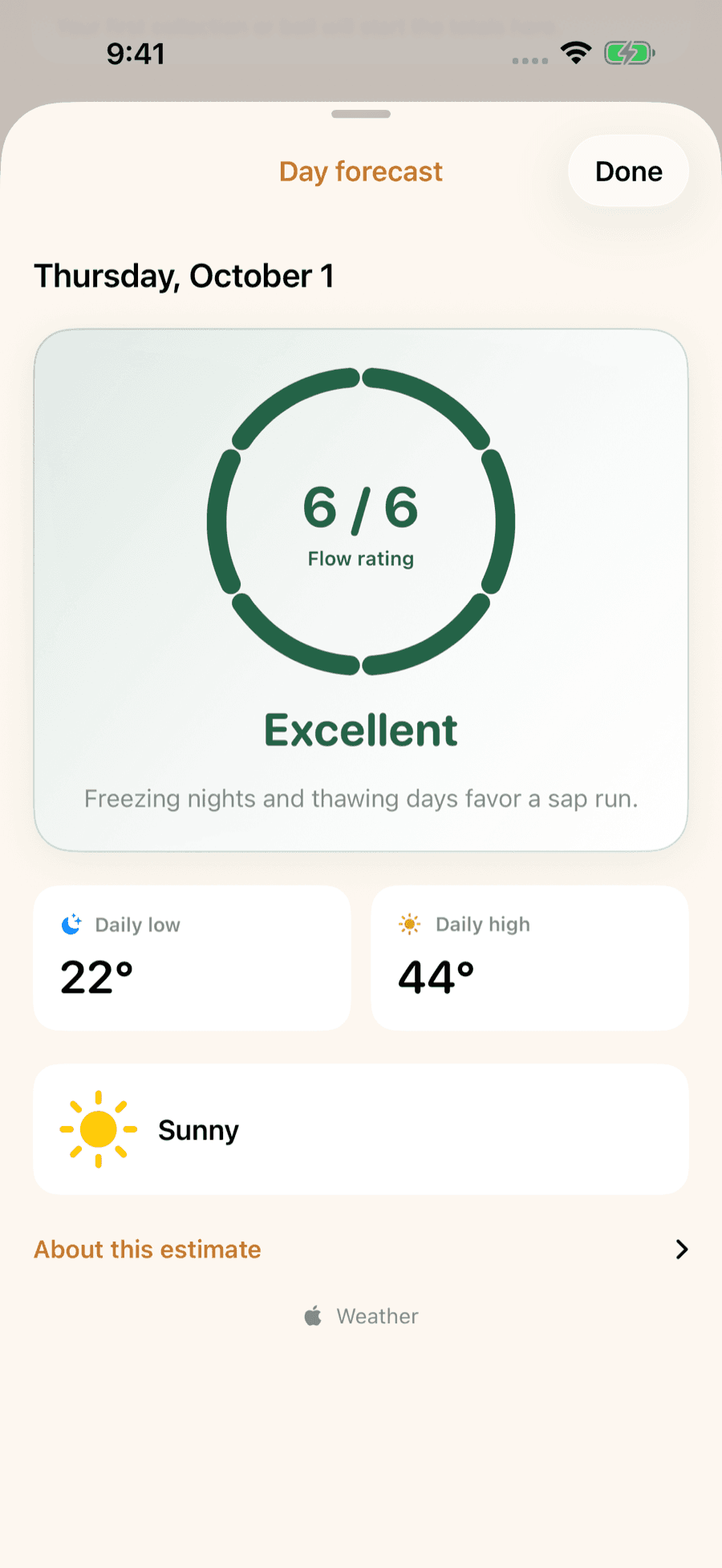
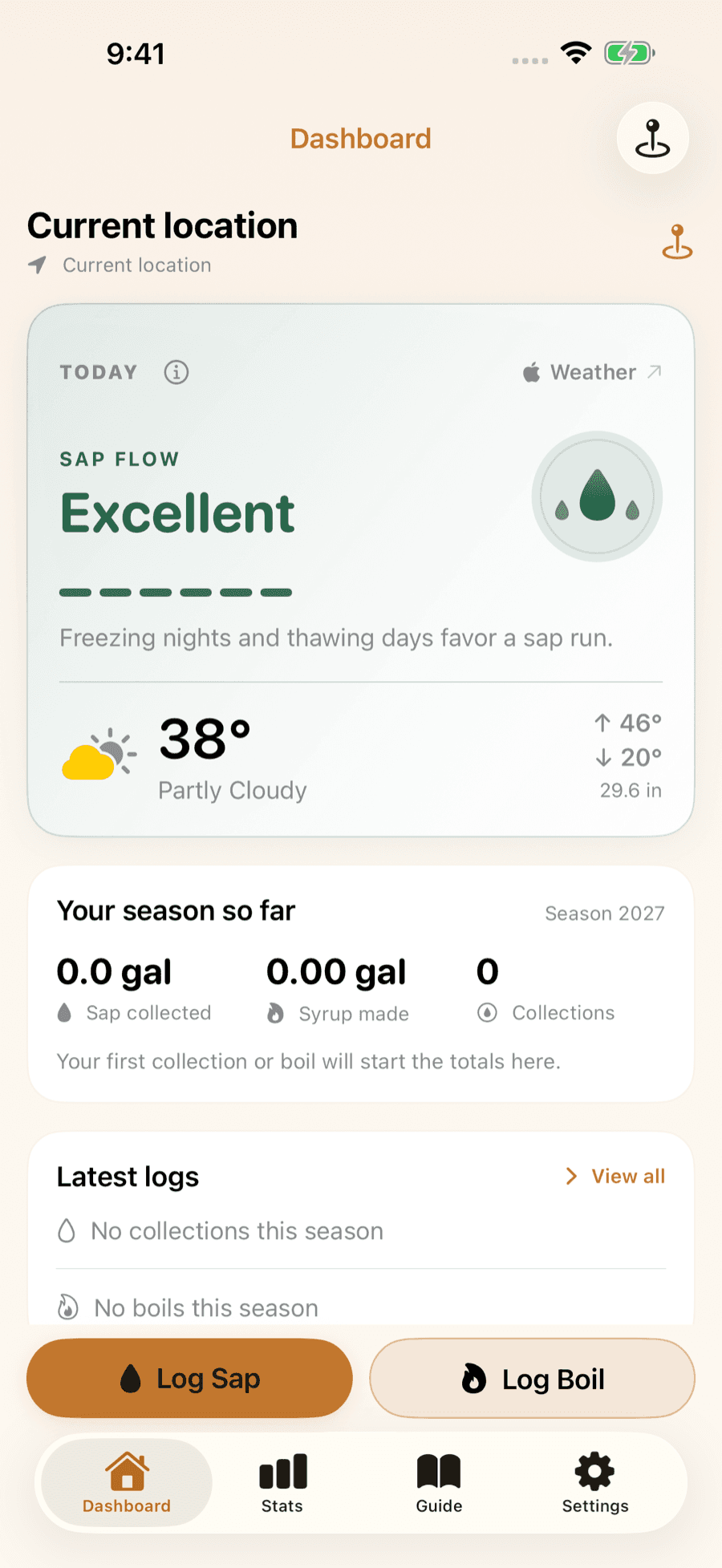
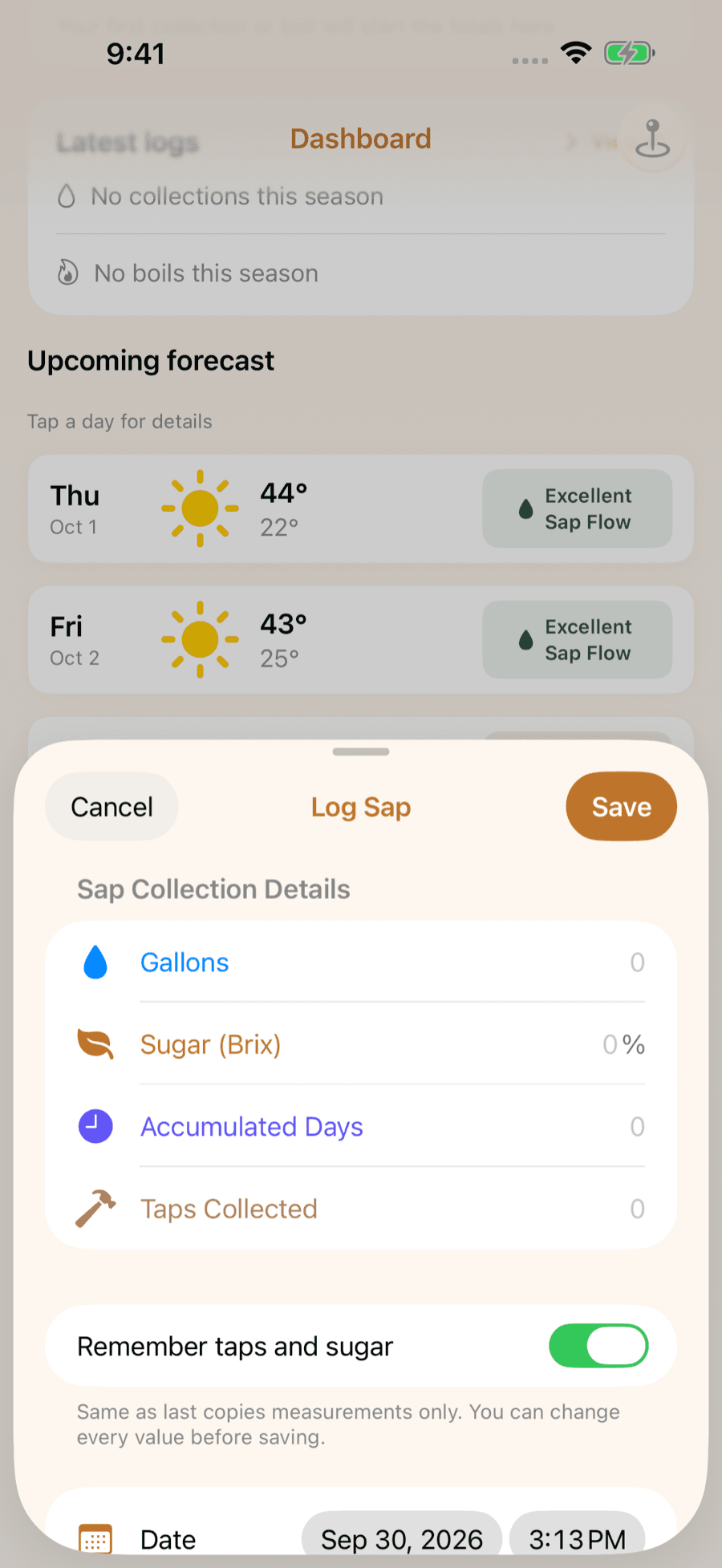
LuckySap turns the forecast for any spot into a day-by-day sap outlook and logs every collection and boil. Free on iPhone and Android.