Can you make maple syrup in Texas?
Local timing guidance
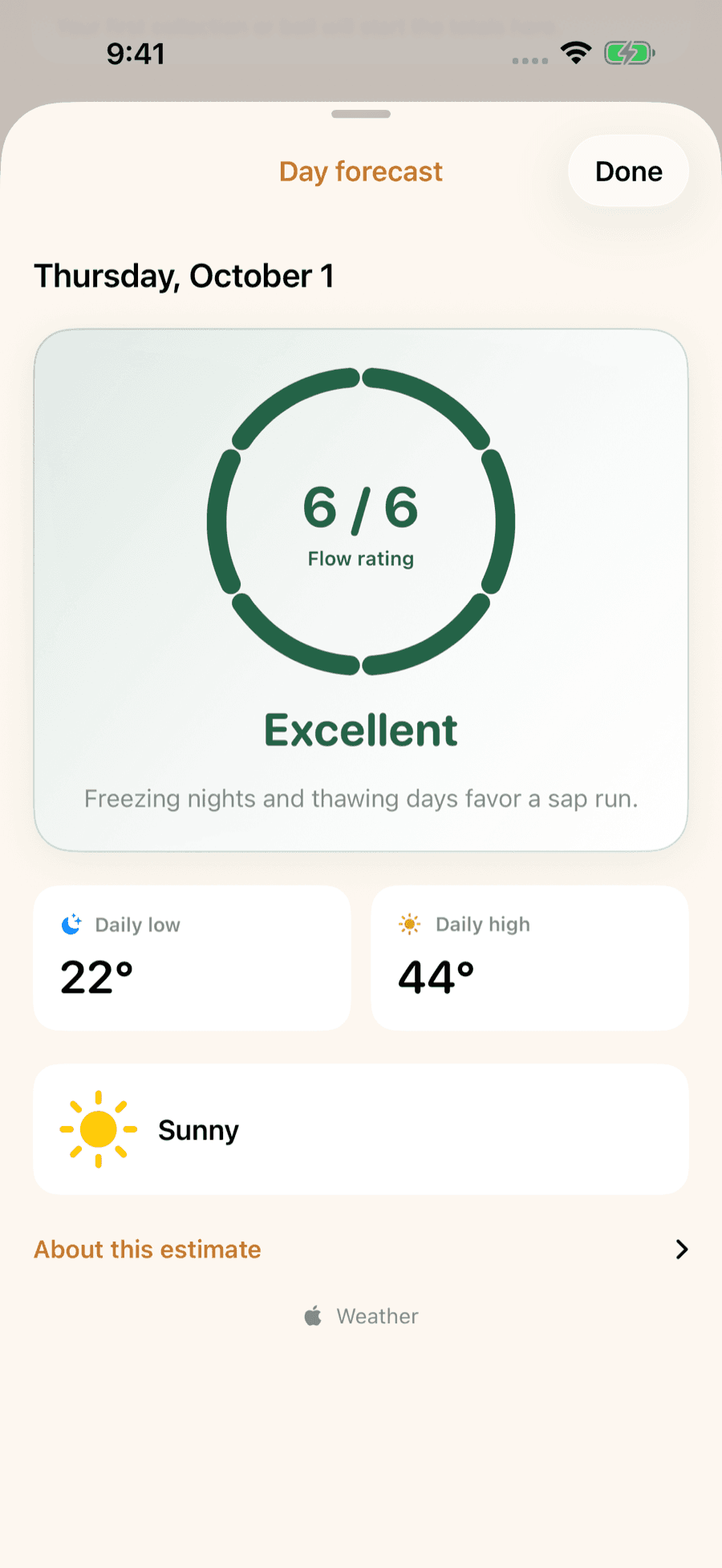
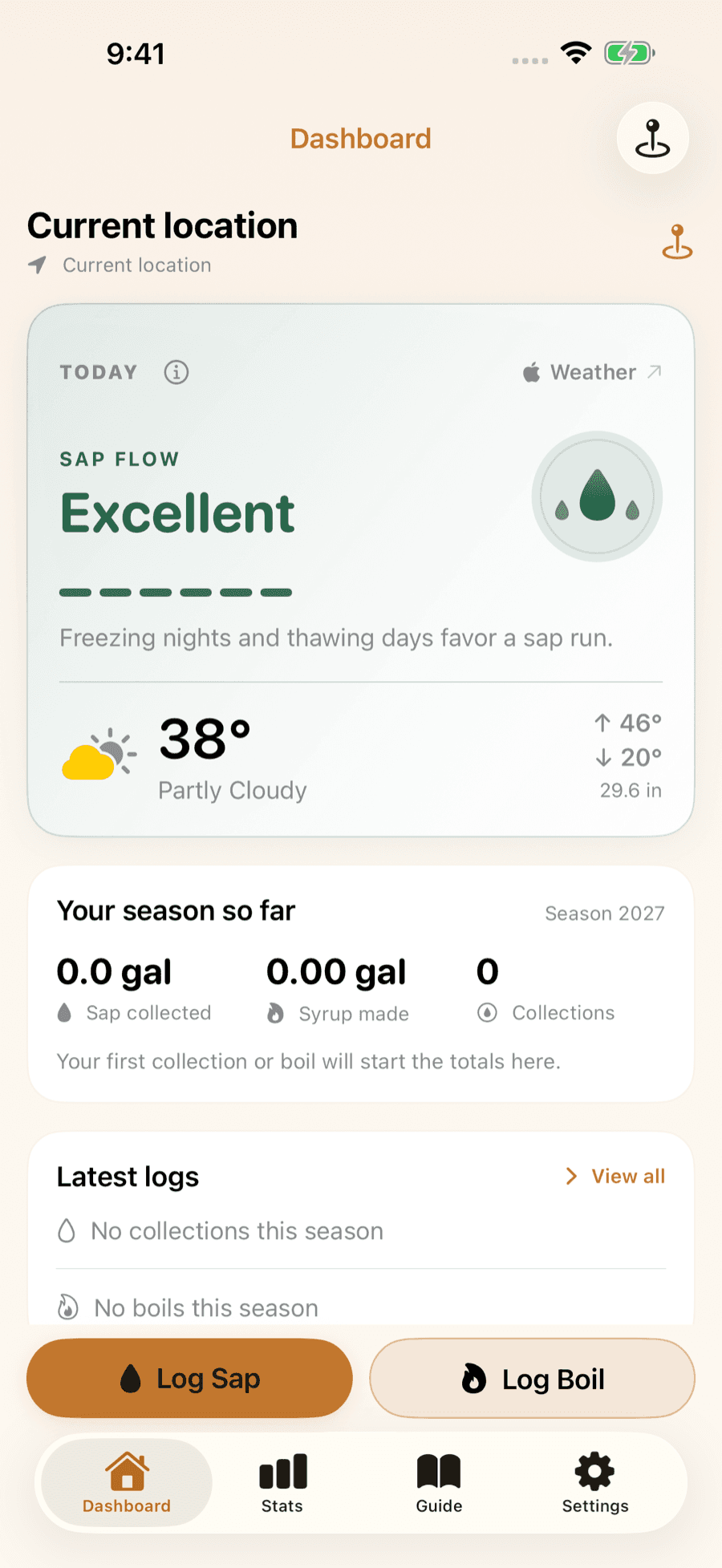
No local source gives tapping dates for Texas. The rule everywhere is the same: tap when the forecast shows freezing nights and days near 40 °F; our sap forecast works for any location.
Trees
Tappable trees in Texas
| Species | Status | Where |
|---|---|---|
| Bigtooth (Uvalde) mapleAcer grandidentatum | native | 'cool, moist, shaded canyons of the Sabinal and Frio rivers in Bandera, Real and Uvalde counties, and the mountains of West Texas'; also Cibolo Creek (Kendall Co.) and Fort Hood (Bell Co.)Source: Texas Parks & Wildlife magazine 2008; US Forest Service range data |
| Sugar mapleAcer saccharum | native | Far northeast only — the US Forest Service range ends 'into northeastern Texas'Source: US Forest Service range data |
| Red mapleAcer rubrum | native | East Texas pineywoods and bottomlands ('south through ... southern Texas')Source: US Forest Service range data |
| BoxelderAcer negundo | native | River bottoms statewide, especially East Texas; var. texanumSource: US Forest Service range data |
| Chalk mapleAcer leucoderme | native | East Texas (garden source) — no tapping recordSource: Epic Gardening 2023 |
| Black walnutJuglans nigra | native | 'isolated populations occur in eastern Texas'Source: US Forest Service range data |
USDA Forest Inventory · plots measured 2014–2023
How many tappable maples?
The Forest Service counts about 2.7 million red maples 10 inches and up on Texas' forest land.
| Statewide | 10 in and up | 18 in and up |
|---|---|---|
| Statewide | ||
| Red maples | 10 in and up about2.7 million ±15% sampling error (2.3–3.1 million) · tallied on 56 plots | 18 in and up Too few inventory plots for a reliable statewide estimate. |
| Boxelders | 10 in and up about1.6 million ±27% sampling error (1.2–2.0 million) · tallied on 20 plots | 18 in and up Too few inventory plots for a reliable statewide estimate. |
| Florida maples | 10 in and up about430,000 ±34% sampling error (280,000–570,000) · tallied on 9 plots | 18 in and up Too few inventory plots for a reliable statewide estimate. |
- FIA counts trees on forest land only. Yard, street and farm trees are not counted, so true numbers are higher.
- Plots measured 2014–2023. FIA visits a different share of its plots each year, so a “current” estimate pools 10 years of visits.
- Species are listed only where the statewide sampling error is 50% or less. FIA measures bigtooth and Rocky Mountain maples at the root collar rather than at chest height, so they are not in these counts.
- Source: USDA Forest Service, Forest Inventory and Analysis (live trees on forest land, by species and trunk diameter at 4.5 ft). How FIA counts trees →
Who already does it
Sugaring in Texas, documented
Bigtooth maple natural history — relict Ice Age stands at Lost Maples State Natural Area (Vanderpool) and West Texas mountains; 'a distant cousin of the eastern sugar maple, from which sweet syrup is derived'; no Texas tapping mentioned
Garden guide: Texas maples 'often do not produce sap like the trees up north' — a hobby-site generalisation, not research
Epic Gardening, Oct 2023Producer or news report
No Texas producer, festival, Texas A&M Forest Service or AgriLife sugaring guidance found
From our own searches
Cautions
What local sources warn about
- Bigtooth maple sap elsewhere (Utah/Idaho) has sugar comparable to sugar maple but about half the volume, from small multi-stemmed trees — and Texas stands are protected relicts in a state natural area and on private ranches.Source: Idaho Farm Bureau/UI 2022; Texas Parks & Wildlife 2008
- Texas is the extreme warm edge for sugar maple ('into northeastern Texas'); Appalachian warm-edge research found leaner sap (1.3–1.6 °Bx) and short windows — expect worse here.Source: US Forest Service range data; Peters et al. 2020 (different region)
- Boxelder 'is not tolerant of drought' and is confined to wetter East Texas.Source: Epic Gardening 2023
Where to look
Likely sugaring country
Vanderpool (Bandera County)
Lost Maples State Natural Area — the best-known bigtooth stand (protected; no tapping)
Texarkana (Bowie County)
Northeastern corner where sugar maple's range ends
Fort Davis (Jeff Davis County)
Trans-Pecos mountain canyons with bigtooth maple and the state's coldest nights
FAQ
Sugaring in Texas: questions
- Can you tap maple trees in Texas?
- Marginal. Marginal: Texas has relict bigtooth ('Uvalde') maples in Hill Country and Trans-Pecos canyons, sugar maple at its far southwestern limit in the northeast, and boxelder and red maple across East Texas — but winters rarely string together freeze-thaw days, no Texas producer or extension sugaring guidance was found, and Texas Parks & Wildlife treats bigtooth as a fall-colour relict, not a sap tree.
- Which trees can you tap in Texas?
- Bigtooth (Uvalde) maple (Acer grandidentatum, native): 'cool, moist, shaded canyons of the Sabinal and Frio rivers in Bandera, Real and Uvalde counties, and the mountains of West Texas'; also Cibolo Creek (Kendall Co.) and Fort Hood (Bell Co.). Sugar maple (Acer saccharum, native): Far northeast only — the US Forest Service range ends 'into northeastern Texas'. Red maple (Acer rubrum, native): East Texas pineywoods and bottomlands ('south through ... southern Texas'). Boxelder (Acer negundo, native): River bottoms statewide, especially East Texas; var. texanum. Chalk maple (Acer leucoderme, native): East Texas (garden source) — no tapping record. Black walnut (Juglans nigra, native): 'isolated populations occur in eastern Texas'.

LuckySap · free on iPhone & Android
Try a season where you are
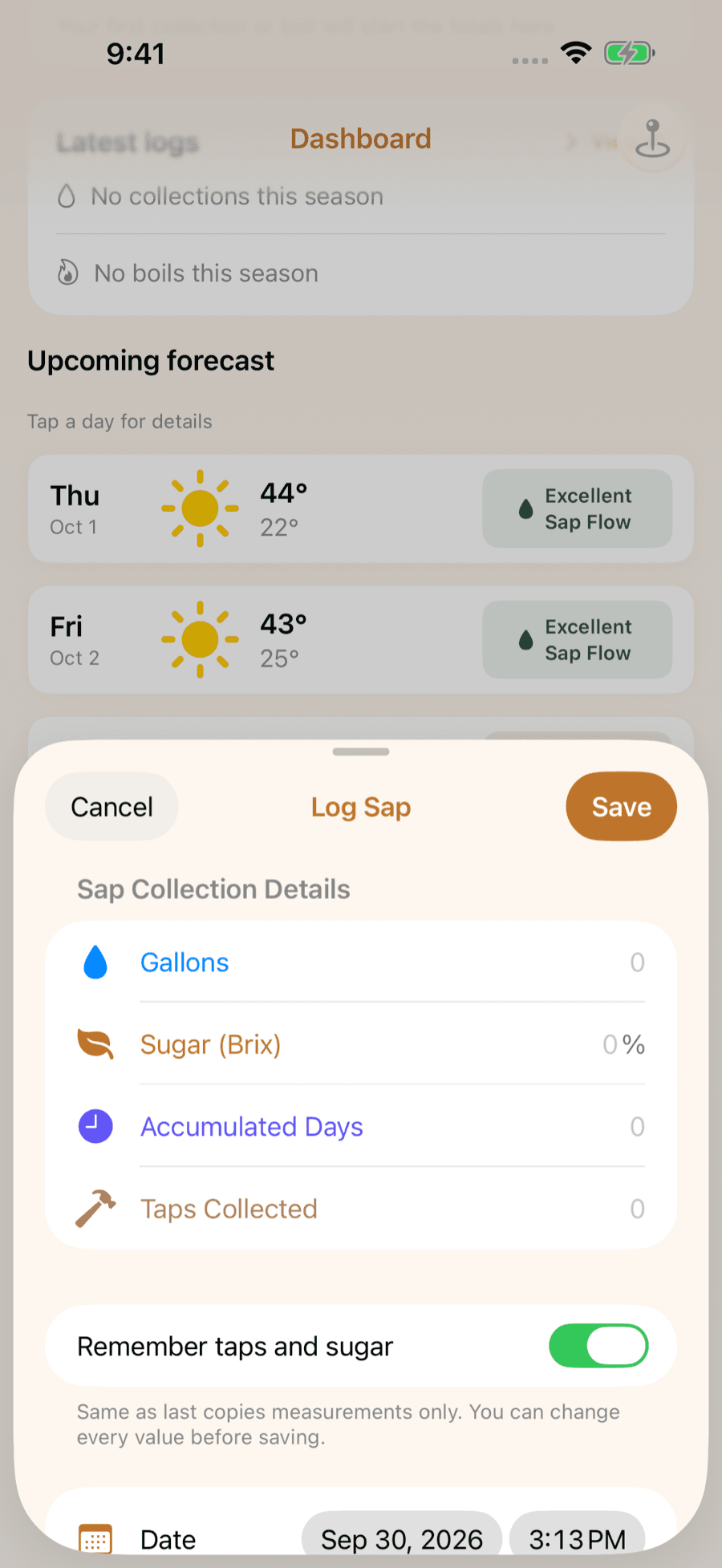
LuckySap turns the forecast for any spot into a day-by-day sap outlook and logs every collection and boil. Free on iPhone and Android.