Can you make maple syrup in Alaska?
Local timing guidance
UAF Extension (birch): 'Around mid-April, when the days warm and the ground begins to thaw, the sap begins to run. Daytime temperatures consistently above 50 °F mean that the sap will run soon.' Season '14 to 21 days', ending when leaves appear. Fairbanks can slip to late April in cold years. For maple: no local guidance (no tappable maple).
Source: University of Alaska Fairbanks Extension; University of Alaska Fairbanks news 2023
Trees
Tappable trees in Alaska
| Species | Status | Where |
|---|---|---|
| Paper / Alaska birchBetula papyrifera (incl. var. kenaica, B. neoalaskana) | native | Interior and Southcentral boreal forest — Fairbanks, Mat-Su, Kenai; the US Forest Service range 'to northwestern Alaska'Source: US Forest Service range data; University of Alaska Fairbanks Extension |
| Douglas / Rocky Mountain mapleAcer glabrum var. douglasii | native | Southeast Alaska panhandle — a shrub/small tree, not a practical sap treeSource: US Forest Service range data |
| Bigleaf mapleAcer macrophyllum | native | 'Some authors place bigleaf maple's distribution as far north as the Alaska panhandle' — doubtful/marginalSource: US Forest Service range data |
USDA Forest Inventory · plots measured 2015–2022
How many tappable maples?
The Forest Service’s coastal Alaska plots tally too few maples 10 inches and up for a reliable count.
- FIA counts trees on forest land only. Yard, street and farm trees are not counted, so true numbers are higher.
- Plots measured 2015–2022. FIA visits a different share of its plots each year, so a “current” estimate pools 8 years of visits.
- Species are listed only where the statewide sampling error is 50% or less. FIA measures bigtooth and Rocky Mountain maples at the root collar rather than at chest height, so they are not in these counts.
- Source: USDA Forest Service, Forest Inventory and Analysis (live trees on forest land, by species and trunk diameter at 4.5 ft). How FIA counts trees →
Who already does it
Sugaring in Alaska, documented
UAF Cooperative Extension 'Tapping Birch Trees' (Cascio & Barber): 'Around mid-April, when the days warm and the ground begins to thaw, the sap begins to run'; 'The sap typically runs from 14 to 21 days'; 'a sugar content of 0.8 to 1.5 percent'; 'It takes 110 or more gallons of sap to make 1 gallon of syrup'
University of Alaska Fairbanks Cooperative Extension Service
Kahiltna Birchworks (Talkeetna), founded 1990, now run by Hammers Family Birch (2023): 'a harvest that lasts only a few weeks'; sap 'carries roughly 1% sugar, so it takes at least 110 gallons to make a single gallon'
Kahiltna Birchworks (producer site)Producer or news report
Mat-Su birch industry: 'In three weeks, we have to make all the syrup we need for the entire year' (Dulce Ben-East); 'Late April is the season of first-run sap'
Anchorage Daily News, 28 Apr 2010Producer or news report
UAF OneTree Alaska (Jan Dawe) tracks temperatures from 1 March to forecast the Interior sap run; in the cold April of 2023 'the birch sap isn't likely to start running until late in April' (Fairbanks)
Cautions
What local sources warn about
- Birch is a root-pressure flow, not freeze-thaw: it starts as 'the ground begins to thaw' and 'Sap seems to run best when snow is still on the ground'.Source: University of Alaska Fairbanks Extension
- Very lean sap (0.8–1.5%) — 110+ gallons per gallon; sap spoils fast ('kept below 41 °F ... for no more than six days'); birch syrup scorches easily.Source: University of Alaska Fairbanks Extension
- Timing is unforgiving: 'Tapping too early results in the tree sealing over the tap hole ... tapping too late misses the first days of sweet, clear sap.'Source: University of Alaska Fairbanks news 2023
- Tap only birches 'eight inches in diameter or larger' and never trees exposed to pesticides or petroleum.Source: University of Alaska Fairbanks Extension
Where to look
Likely sugaring country
Talkeetna (Mat-Su)
Kahiltna Birchworks, the world's largest birch-syrup producer
Fairbanks
UAF Extension and OneTree Alaska sap-run forecasting; Interior season (mid–late April)
Wasilla / Palmer (Mat-Su)
Historic processing base of the Mat-Su birch industry
FAQ
Sugaring in Alaska: questions
- Can you tap maple trees in Alaska?
- No. No for maple — Alaska has no native tappable maple (only shrubby Douglas maple in the southeast and a few planted yard maples) — but yes for birch: Alaska is home to the world's largest birch-syrup producer (Kahiltna Birchworks, Talkeetna), UAF Extension publishes tapping guidance, and the Interior and Mat-Su run a 2–3-week sap season from about mid-April.
- When do you tap maple trees in Alaska?
- UAF Extension (birch): 'Around mid-April, when the days warm and the ground begins to thaw, the sap begins to run. Daytime temperatures consistently above 50 °F mean that the sap will run soon.' Season '14 to 21 days', ending when leaves appear. Fairbanks can slip to late April in cold years. For maple: no local guidance (no tappable maple). (Source: University of Alaska Fairbanks Extension; University of Alaska Fairbanks news 2023.)
- Which trees can you tap in Alaska?
- Paper / Alaska birch (Betula papyrifera (incl. var. kenaica, B. neoalaskana), native): Interior and Southcentral boreal forest — Fairbanks, Mat-Su, Kenai; the US Forest Service range 'to northwestern Alaska'. Douglas / Rocky Mountain maple (Acer glabrum var. douglasii, native): Southeast Alaska panhandle — a shrub/small tree, not a practical sap tree. Bigleaf maple (Acer macrophyllum, native): 'Some authors place bigleaf maple's distribution as far north as the Alaska panhandle' — doubtful/marginal.

LuckySap · free on iPhone & Android
Try a season where you are
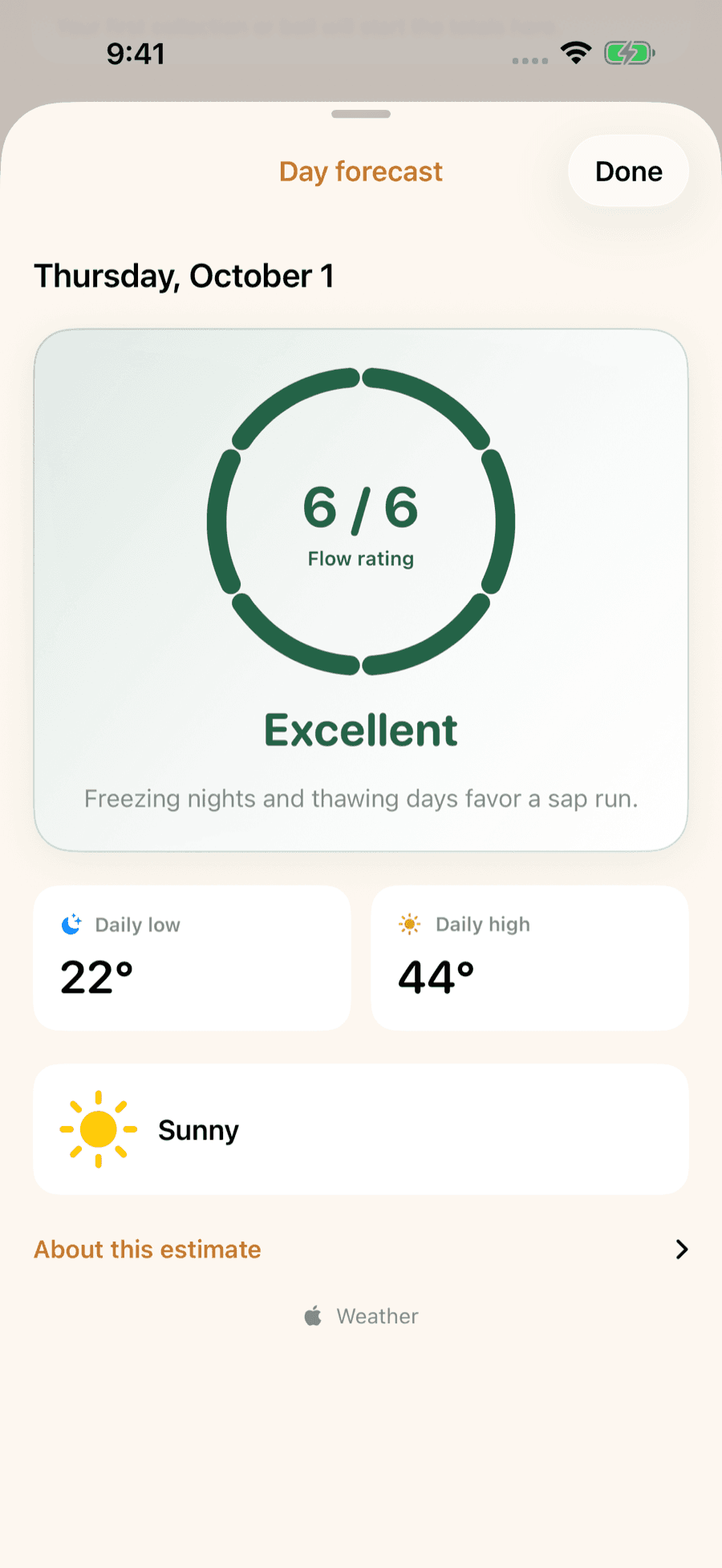
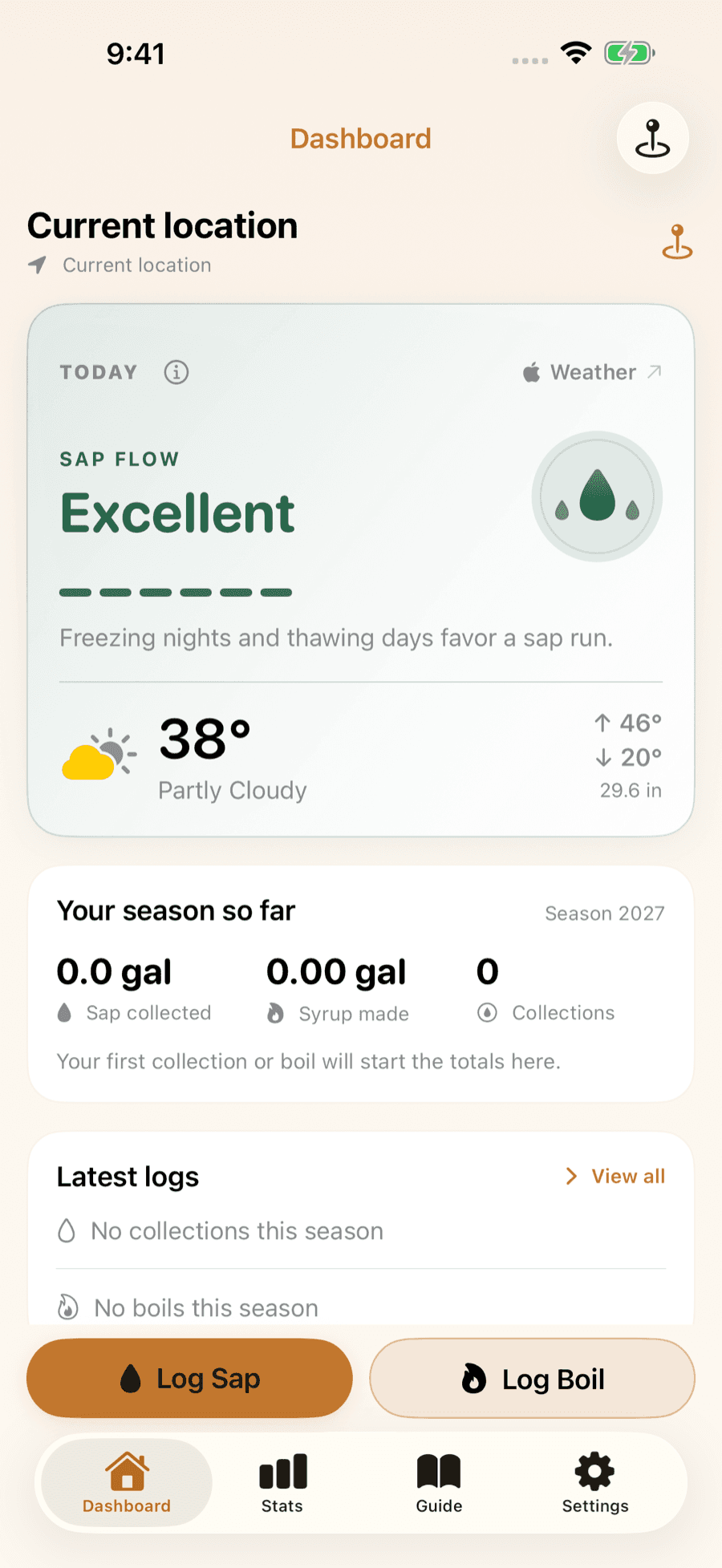
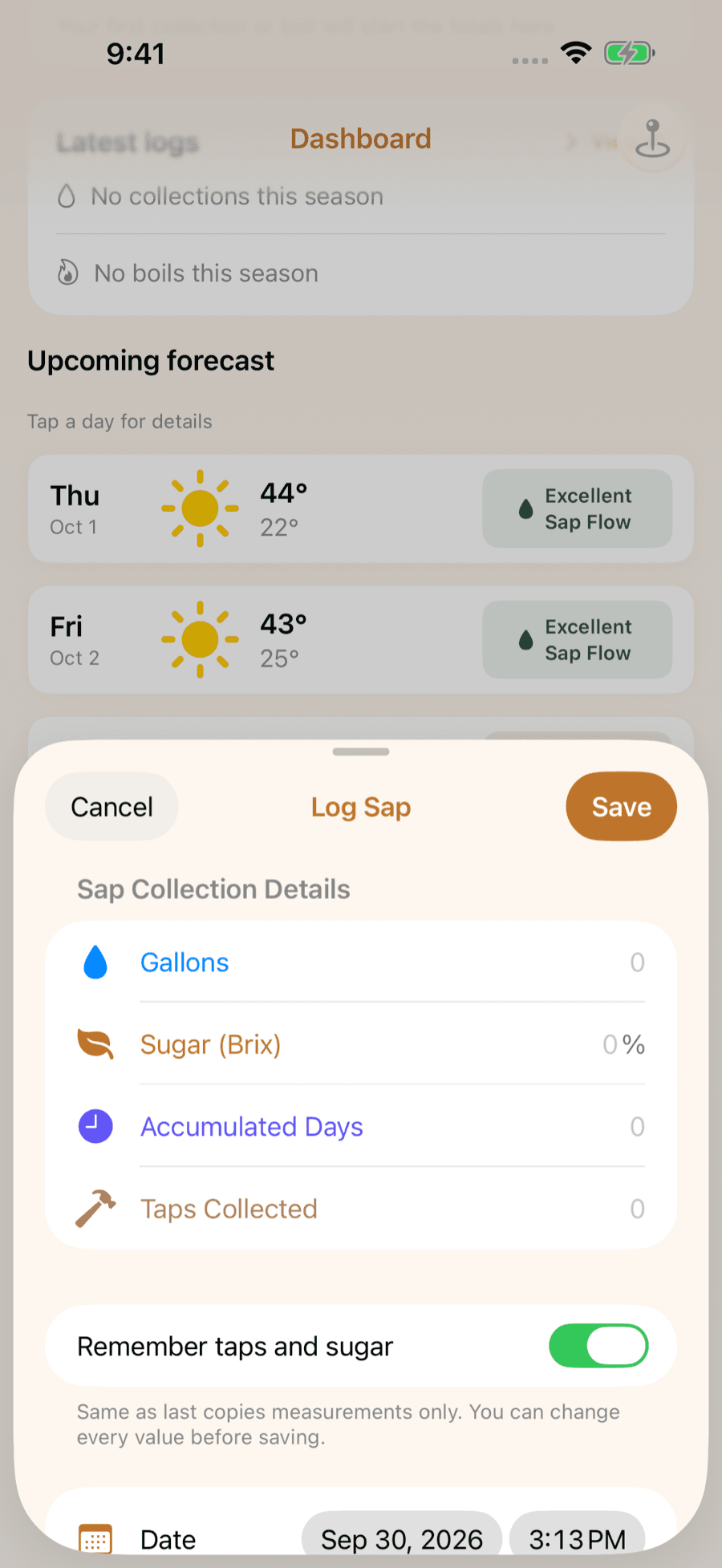
LuckySap turns the forecast for any spot into a day-by-day sap outlook and logs every collection and boil. Free on iPhone and Android.