Can you make maple syrup in North Dakota?
Local timing guidance
North Dakota Forest Service column: boxelder sap starts 'normally early March in the southern half of the state to middle or late March in the northern half'; in the Turtle Mountains the author has started 'from March 1st one year to March 25th the next'; a prolonged winter can push flow 'even into April'. NDSU: 'It's a very narrow window.'
Source: Minot Daily News / ND Forest Service 2023 (PRACTITIONER); NDSU Extension (VERIFIED)
Trees
Tappable trees in North Dakota
| Species | Status | Where |
|---|---|---|
| BoxelderAcer negundo | native | 'found in river bottoms, ravines and hillsides' statewide and 'commonly found planted in towns, parks, windbreaks'; hardiness zone 2NDSU Extension boxelder page (VERIFIED); Minot Daily News 2023 (PRACTITIONER) |
| Silver mapleAcer saccharinum | native | Red River valley (FEIS lists ND); widely planted in townsUSFS FEIS (ND in STATES list) |
| Sugar mapleAcer saccharum | planted | Not native (ND absent from FEIS list); planted as a yard treeUSFS FEIS |
| Paper birchBetula papyrifera | native | Turtle Mountains, Pembina Hills and 'Great Plains of ... North Dakota' outliers; 'birch-cicles' noted by NDSUUSFS FEIS; NDSU Dakota Gardener (VERIFIED) |
Who already does it
Sugaring in North Dakota, documented
NDSU Extension forester Joe Zeleznik: 'In North Dakota, I've met quite a few people who make maple syrup from boxelder trees'; 'The ratio of sap to syrup is about 45 to 1'; 'Staff at Fort Stevenson State Park have been making maple syrup every spring for several years' (Maple Sugaring Day, 9 Apr 2022)
NDSU Extension, Dakota Gardener column · VERIFIED
'FOR THE TREES: Sweet syrup to ring in spring' — Turtle Mountain tapper (ten boxelders, 12–20 in DBH) describes boxelder syrup as 'a lighter color and ... a hint of butterscotch'
Minot Daily News (North Dakota Forest Service column), 15 Apr 2023 · PRACTITIONER
NDSU Extension boxelder tree profile (Zeleznik): habitat, zone 2, 'Also called Manitoba maple or ash-leaved maple'
NDSU Extension · VERIFIED
Cautions
What local sources warn about
- Narrow, late window: 'If it's too warm at night or too cold during the day, the sap just won't flow.' (NDSU Extension (VERIFIED))
- Get permission before tapping public trees — 'Different park districts or towns may or may not allow tapping.' (ND Forest Service column (PRACTITIONER))
- Boxelder is easily confused with green ash, balsam poplar or Siberian elm in winter — identify by opposite buds and persistent samaras. (ND Forest Service column (PRACTITIONER))
- Boxelder sap is leaner (NDSU: lower than sugar maple's 2–6%), so plan on ~45:1 or more. (NDSU Extension (VERIFIED))
Where to look
Likely sugaring country
Garrison (Fort Stevenson State Park)
Annual Maple Sugaring Day; state-park boxelder tapping
Bottineau (Turtle Mountains)
Documented hobby tapping; northern start dates (1–25 March)
Fargo
Red River valley with the state's native silver maple and NDSU Extension
Minor place. The ND Forest Service 'Sweet syrup' page on ag.ndsu.edu returned a news index, so the Minot Daily News syndication was used.
FAQ
Sugaring in North Dakota: questions
- Can you tap maple trees in North Dakota?
- Yes, in parts of it. Yes with boxelder: NDSU's extension forester says 'quite a few people' make syrup from boxelder, a state park holds an annual Maple Sugaring Day, and the native boxelder lines every river bottom and shelterbelt — but there is no native sugar maple, the window is 'very narrow', and it opens in March, weeks later than the East.
- When do you tap maple trees in North Dakota?
- North Dakota Forest Service column: boxelder sap starts 'normally early March in the southern half of the state to middle or late March in the northern half'; in the Turtle Mountains the author has started 'from March 1st one year to March 25th the next'; a prolonged winter can push flow 'even into April'. NDSU: 'It's a very narrow window.' (Minot Daily News / ND Forest Service 2023 (PRACTITIONER); NDSU Extension (VERIFIED))
- Which trees can you tap in North Dakota?
- Boxelder (Acer negundo, native): 'found in river bottoms, ravines and hillsides' statewide and 'commonly found planted in towns, parks, windbreaks'; hardiness zone 2 Silver maple (Acer saccharinum, native): Red River valley (FEIS lists ND); widely planted in towns Sugar maple (Acer saccharum, planted): Not native (ND absent from FEIS list); planted as a yard tree Paper birch (Betula papyrifera, native): Turtle Mountains, Pembina Hills and 'Great Plains of ... North Dakota' outliers; 'birch-cicles' noted by NDSU

LuckySap · free on iPhone & Android
Try a season where you are
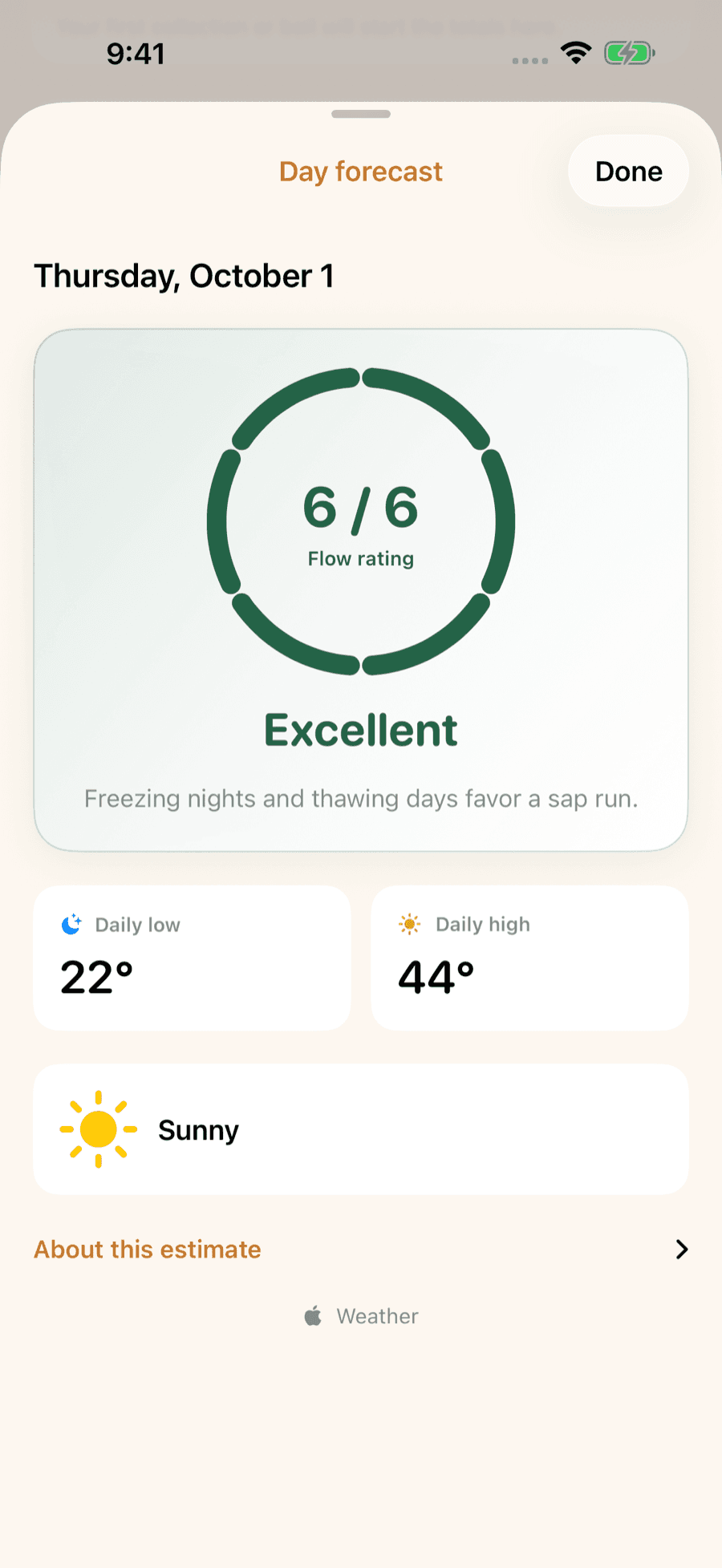
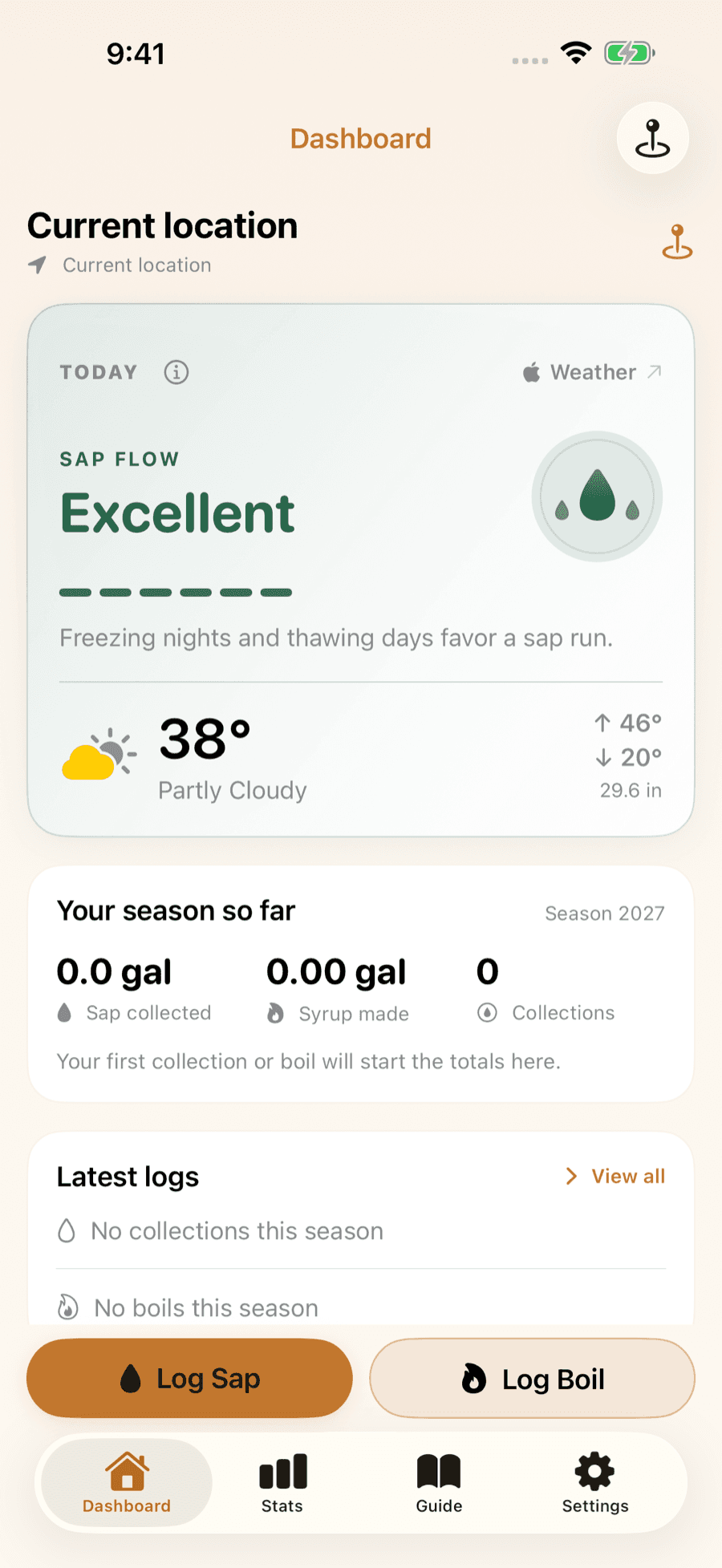
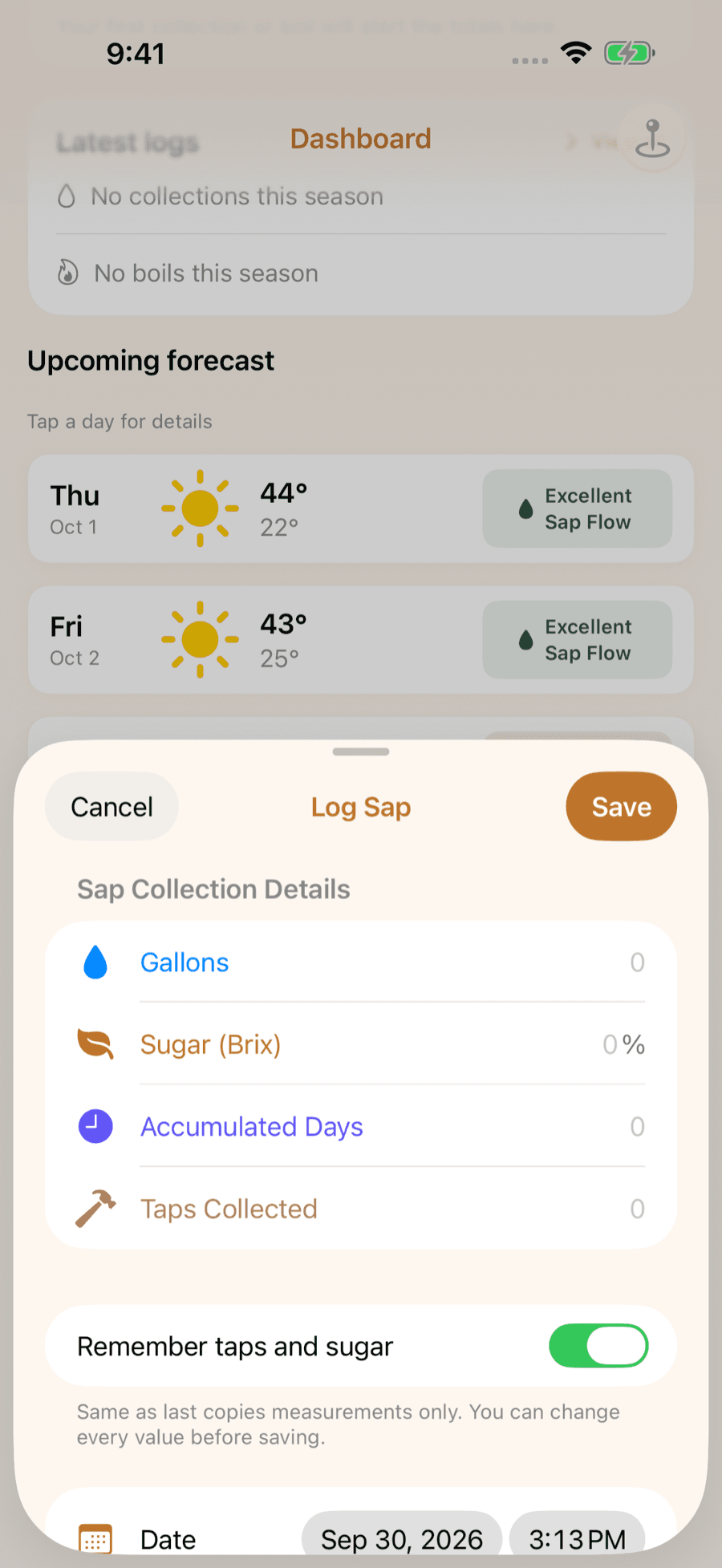
LuckySap turns the forecast for any spot into a day-by-day sap outlook and logs every collection and boil. Free on iPhone and Android.