When to tap maple trees in Nova Scotia
- Opens
- Mar 15
- weather estimate
- Closes
- Apr 17
- weather estimate
Division by division
When the sap runs across Nova Scotia
Loading the map…
Typical opening date of the sap season, week by week across this province’s range
- Mar 9–15
- Mar 16–19
- fewer than 5 maple farms
7 places with an atlas page. Typical season opening, earliest: Lunenburg, NS, Mar 9; Annapolis, NS, Mar 11; Kings, NS, Mar 13; latest: Cumberland, NS, Mar 19; Pictou, NS, Mar 18; Colchester, NS, Mar 17. Most sap days a season: Colchester, NS, 44; Lunenburg, NS, 44; Hants, NS, 43. Maple taps in the 2021 Census of Agriculture, on a five-step scale shared by both countries: under 1,000, 1,000–5,000, 5,000–20,000, 20,000–100,000, 100,000+; the most: Cumberland, NS (257,477), Kings, NS (61,068). Maple farms in the same census, in five steps: under 10, 10–20, 20–50, 50–100, 100+; the most: Cumberland, NS (31), Kings, NS (18), Colchester, NS (16). Canadian divisions have no official count. 5 places show an earlier census figure (dotted) because the latest was withheld; those figures don’t set the bins. Each shaded place links to its page; every state and province page lists its places in a table.
| Lunenburg | Mar 9 – Apr 10 | 44 | 4,926 (2016) |
|---|---|---|---|
| Annapolis | Mar 11 – Apr 12 | 41 | 10,838 (2016) |
| Kings | Mar 13 – Apr 16 | 42 | 61,068 |
| Hants | Mar 14 – Apr 16 | 43 | 818 (2016) |
| Colchester | Mar 17 – Apr 19 | 44 | 23,499 (2016) |
| Pictou | Mar 18 – Apr 19 | 38 | 5,441 (2016) |
| Cumberland | Mar 19 – Apr 20 | 38 | 257,477 |
Taps with a year in brackets are that earlier census’s count, shown where the latest was withheld; they sort after the published counts.
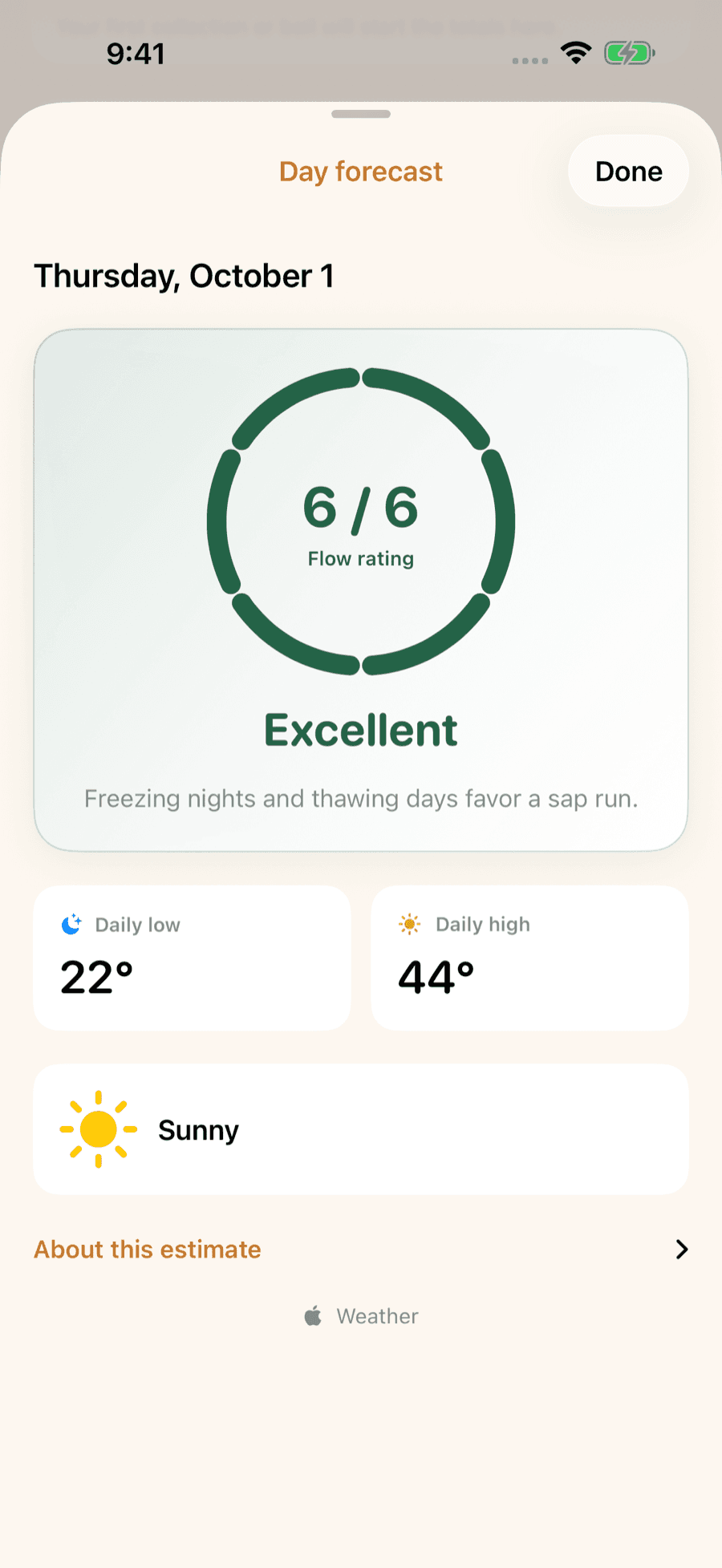
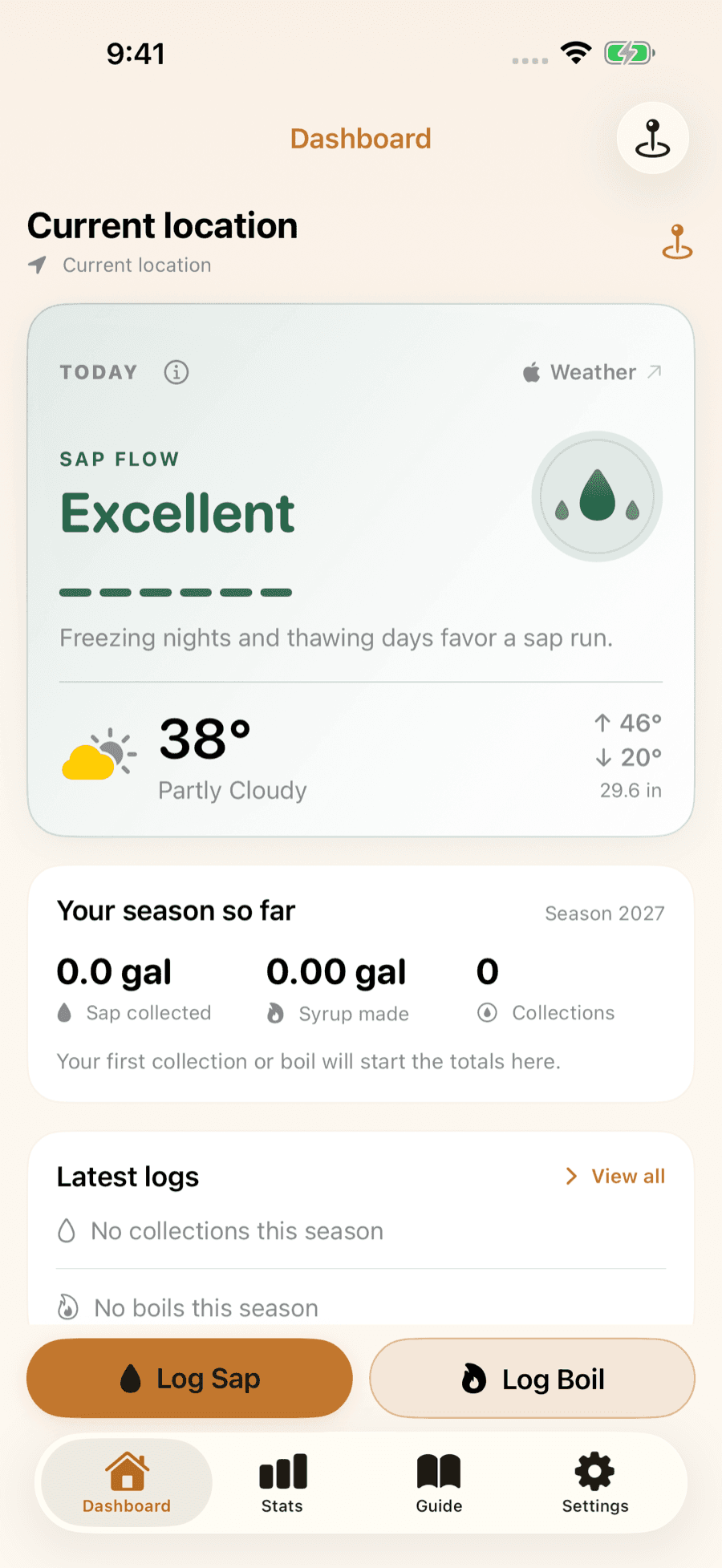
Sap-flow outlook right now
Full Nova Scotia forecast →Forecast for Earltown
Updated Nov 8, 3:00 PM EST
Off-season
Nova Scotia's opening window starts in about 112 days
Typically March.
What to do now
- 1
Hold the drill
Fall sap is low in sugar, and a November hole on buckets is spent by January.
- 2
Find and mark your trees
Easiest while the leaves are on. Tapping starts at 12 inches across, about 38 inches around.
- 3
Gather your gear
A drill with a clean 5/16-inch bit, one spout per taphole, covered food-grade buckets.
Show this week’s forecast anywayHide the forecast
Only marginal days ahead
freeze thaw 0 °C
- MonNov 94° / 8°No refreeze forecast
- TueNov 103° / 6°No refreeze forecast
- WedNov 110° / 6°No refreeze forecast
- ThuNov 12-1° / 6°Maybe a light run
- FriNov 131° / 5°No refreeze forecast
- SatNov 143° / 5°No refreeze forecast
Data: Environment and Climate Change Canada. Verdicts use freeze-thaw thresholds from maple field research; your woods may run a little differently.
Weather estimate
Estimated from 35 seasons of weather
No official season record exists for Nova Scotia. Our weather signal, weighted by farms across its 7 atlas divisions, puts the typical opening around Mar 15 and the closing around Apr 17. It's an estimate from daily temperatures (Daymet, 1991–2025), not a producer survey.
- Opens
- Mar 15
- weather estimate
- Closes
- Apr 17
- weather estimate
- Earliest opening
- Feb 27
- 2000
- Latest opening
- Apr 2
- 2015
Timing your taps
How to know it's time in Nova Scotia
Sap runs on a temperature swing, not a date. A night below freezing loads the tree; a day above freezing pushes sap out of the taphole. Field research treats a low under about 30°F followed by a high over about 37°F as a real freeze-thaw day, and big runs almost always come on days like that.
So watch the 10-day forecast. When you see a string of nights in the 20s and afternoons in the 40s, get your taps in a day or two ahead. South-facing slopes warm first and usually run earlier.
No multi-year published dates were found. The Maple Producers Association of Nova Scotia says tapping season lasts about four to six weeks between March and April; Taste of Nova Scotia describes maple season as March to late April. Mild winters can bring February flows (e.g., 2016).
Seasons are shifting. In Québec, the sap season is projected to start and end 9–13 days earlier by 2046–2065 and 15–19 days earlier by 2081–2100 than in 1971–2000; season onset advances about four days for each degree Celsius of warming (Houle et al., PLoS ONE, 2015).
Where Nova Scotia's sugaring happens
- EarltownNorthern Nova Scotia's Colchester–Cumberland area is where the maple association's president describes the province's producers; Earltown's Maple Mist Farm taps about 8,000 trees (CBC, 2016).
FAQ
Nova Scotia tapping questions
- When is maple syrup season in Nova Scotia?
- Usually from March to late April. The exact start moves by weeks from year to year with the weather.
- When should I tap my trees in Nova Scotia?
- Tap just before the first good run: when the forecast shows nights below freezing and days climbing to around 40°F. Tapholes dry up within 6 to 10 weeks, so tapping far too early can cost you the late runs.
Nova Scotia
More for Nova Scotia sugarmakers
Nearby
When to tap in other provinces

LuckySap · free on iPhone & Android
Get a heads-up when Nova Scotia's sap will run
LuckySap checks the forecast for your trees and can ping you the night before a strong sap day, then keeps every collection and boil in one season log. Free on iPhone and Android.