What a few taps will make
The planning number is about a quart of syrup per bucket tap in an average season, from roughly 10 gallons of sap. Good years can give up to about half again as much, and open-grown trees with big crowns can do even better.
| Bucket taps | Sap (season) | Storage to have | Syrup (average year) |
|---|---|---|---|
| 4 | ≈ 40 gal | ≈ 8 gal | ≈ 1 gal |
| 8 | ≈ 80 gal | ≈ 16 gal | ≈ 2 gal |
| 12 | ≈ 120 gal | ≈ 24 gal | ≈ 3 gal |
| 20 | ≈ 200 gal | ≈ 40 gal | ≈ 5 gal |
Numbers for your own taps and collection method are in the yield estimator.
Fall: find your trees
Sugar and black maples are the best, red maples are a solid second, and several other trees can be tapped. Mark yours while the leaves are still on, and measure them: current guidance starts tapping at 12 inches across (about 38 inches around the trunk at chest height). Here's which trees you can tap, and how to tell them apart in winter.
Winter: gather your gear
- A drill and a clean 5/16-inch bit, and one spout per taphole.
- Covered, food-grade buckets or bags for each tap.
- Food-grade storage for about 2 gallons of sap per tap, kept in the shade.
- A filter for sap, and a way to boil it down.
- A good thermometer, plus a syrup hydrometer and test cup (or a syrup refractometer).
Skip old metal gear
Adding it up? The cost calculator spreads your gear over the seasons you'll use it.
Late winter: tap
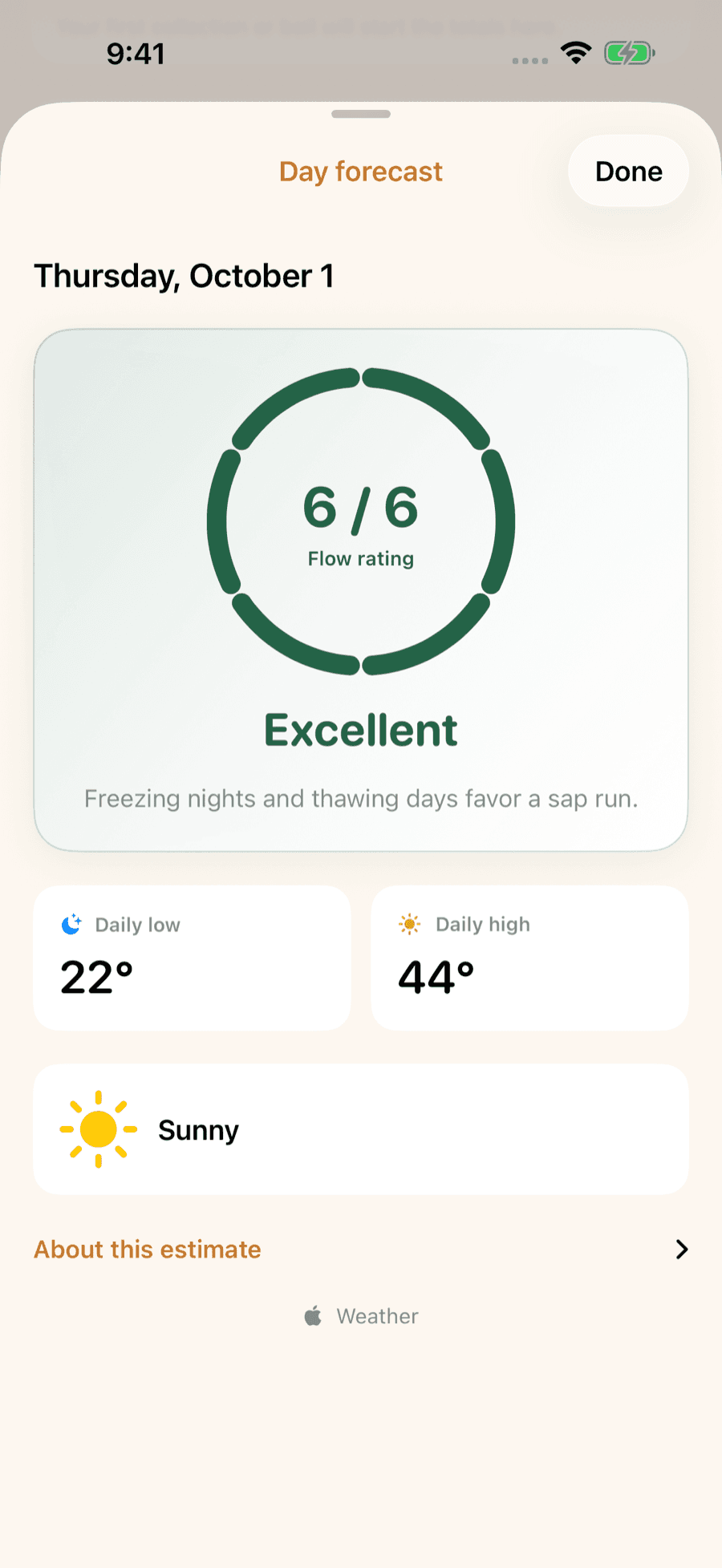
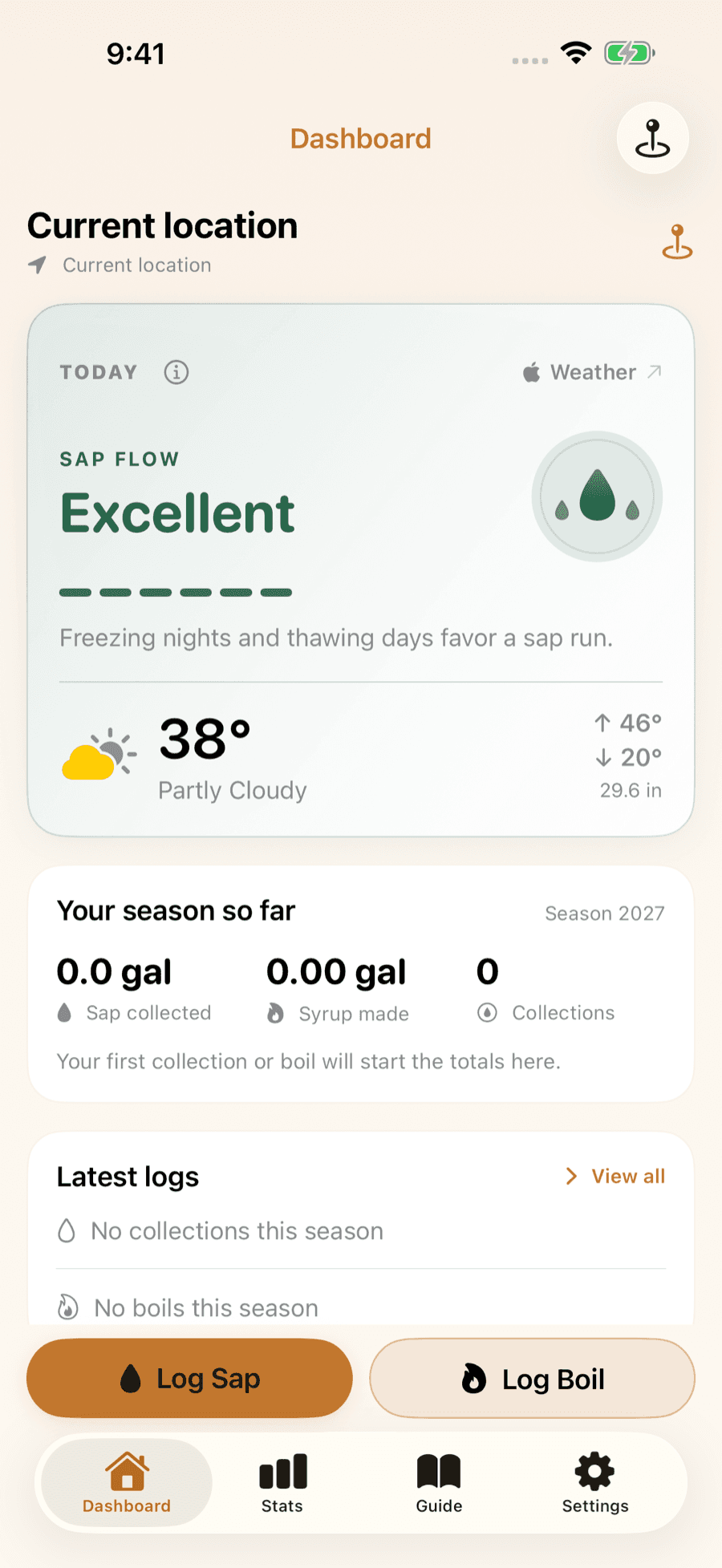
Watch your state's typical season dates and the sap forecast. When a string of freezing nights and days near 40°F shows up, tap a day or two ahead. Tapholes dry up in 6 to 10 weeks, so going much earlier can cost you the late runs.
- 1
One tap per tree
Most backyard trees get one tap. Only big, healthy, fast-growing trees over 18 inches get a second. - 2
5/16-inch hole, about 1.5 inches deep
Angled slightly up, in fresh wood away from old holes. - 3
Tap the spout in gently
Stop at the dull thud, and hang a covered bucket.
The full walkthrough is in how to tap a maple tree.
The season: collect and store
A good run can give 4 to 5 quarts per tap, so check buckets daily when the sap is running. Keep collected sap below 40°F, boil it the same day once it reaches the mid-40s, and boil right away above 50°F. Dump any sap that turns cloudy, yellow or sour. More in how long sap can sit.
Boil, finish and bottle
At 2% sugar it takes about 43 gallons of sap to make one gallon of syrup, which means roughly 42 of every 43 gallons you collect leave as steam. Plan your fuel and your day around that; the sap-to-syrup calculator runs it for your batch.
- 1
Finish at water's boiling point + 7.1°F
That's 66 °Brix, the standard density. Measure water's boiling point the same day with the same thermometer; the finishing calculator does the math. - 2
Check density
Confirm with a hydrometer or refractometer. Thin syrup can spoil; syrup that's too thick can crystallize. The hydrometer calculator corrects for temperature. - 3
Filter and hot-pack
Bottle at 180°F or hotter in clean containers, and don't reheat it much past 200°F, which darkens it and drops sediment. Sealed, hot-packed syrup keeps on the shelf; refrigerate it once opened.
Spring: pull taps and look back
When buds swell and the nights stop freezing, the season is over. Pull spouts gently and don't plug the holes; the full checklist is in when to pull taps. Then write down what you made, because next year's plan starts with this year's numbers.