Freeze, then thaw
What sap flow needs
Maple sap runs on a swing, not a season. When the wood freezes, pressure inside the tree goes negative and it pulls water up from the roots (if the soil is not frozen). When the wood thaws, pressure flips positive, as high as about 40 psi near the base and highest at the start of the thaw, and sap is pushed out of any hole in the trunk. Without another freeze the pressure drains away within 30 to 72 hours and the run stops.
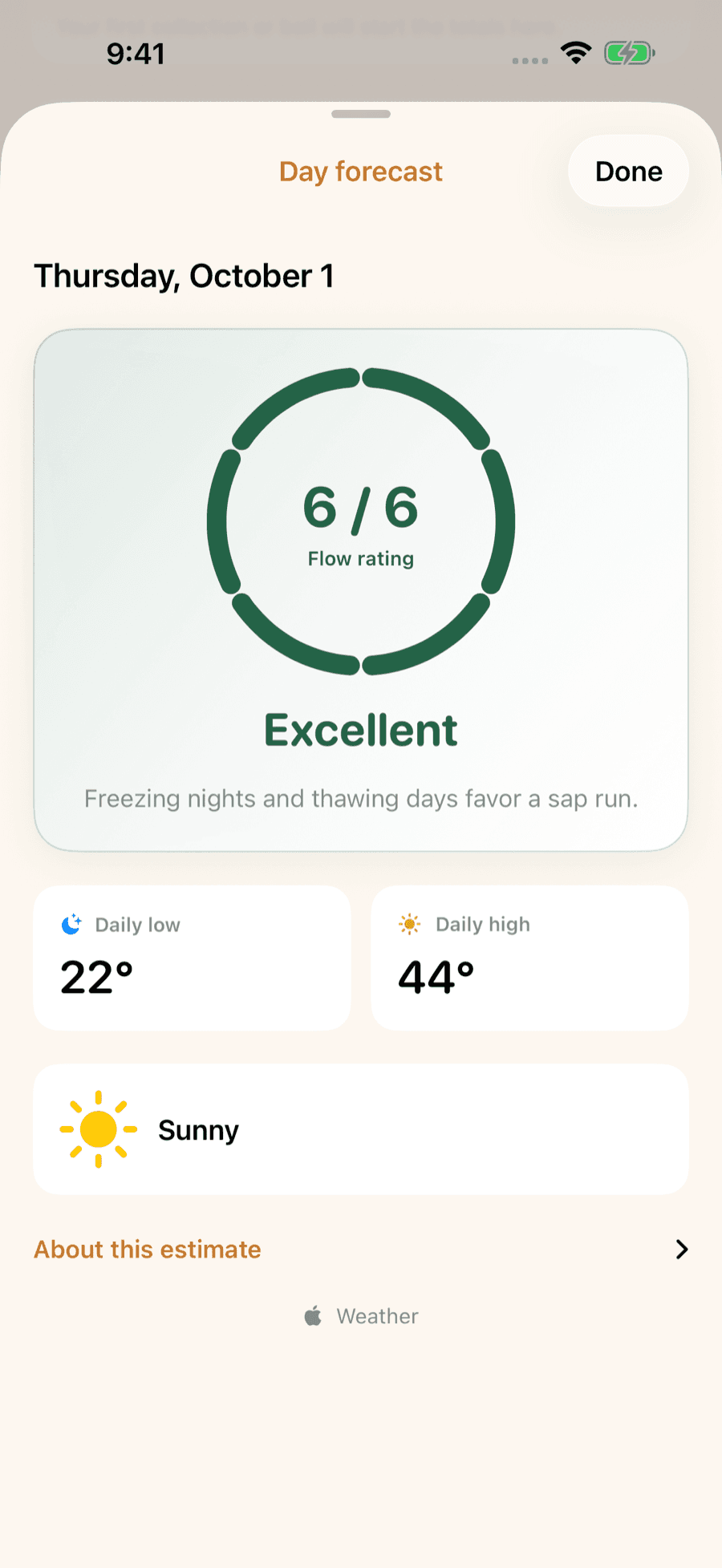
The research threshold for a freeze-thaw day, from a Quebec study published in 2025, is a night below 30.2°F and a day above 37.4°F; 94% of the big-flow days (over a liter per tap) had one. Extension puts it as nights in the 20s and days in the 40s. Early in the season or after deep cold it can take a day or more above freezing before the wood at the taphole thaws. The mechanism is explained in what temperature makes sap run, and the sap forecast counts the qualifying days ahead.
October, November
Why fall tapping fails
Freeze-thaw nights happen in autumn too, so sap can move. Three things make a fall hole a bad trade. First, the sugar: the Producers Manual describes sap sugar rising rapidly at the start of the spring season and then declining slowly, with fall sap well below the spring peak, and in Cornell's walnut trials fall sap ran under 1% against 2 to 3.5% in spring. Second, the clock: a taphole starts closing the day you drill it (next section), so a November hole on buckets is spent by January. Third, the rules: Canada's organic standard (CAN/CGSB-32.310-2020) states plainly that “fall syrup production is prohibited.”
The one winter maple
4 to 8 weeks on buckets
A taphole has a lifespan
“Taphole drying” is not drying. Flow stops because the tree plugs the vessels around the wound, and microbes carried in on the spout speed that up. The 2022 Producers Manual expects a taphole to stay productive for about 4 to 8 weeks with buckets or bags, while a sanitary vacuum tubing system “can remain reasonably productive for 3 to 4 months.” Cornell's beginner notebook puts it at 6 to 10 weeks. Warm spells with wood above about 55°F end flows fast.
So tapping too early costs you the late runs. The penalty is smaller than folklore says, though. UVM's Tim Wilmot found January tapping “doesn't diminish your eventual sap yield” in cool seasons; early holes underperformed only after repeated spells above 50°F, when microbial growth plugged them. Tapping too late has a cost too: USDA's state tables record earliest openings of January 1 in New York, Vermont and Ohio in several recent years, and a producer survey cited in the climate research found about a third of producers had missed the first run.
If a hole does quit, do not re-drill or ream it, and do not add a second hole beside it. The Manual says a second taphole even right above the first makes a full second stain column, and reamed holes produce wounds “sometimes double or more” the size.
The calendar moves with latitude
December in Missouri, March in Quebec
“Is December too early?” has a different answer in every state. Here are the typical openings the sources give, south to north. Your county's own dates and production history are in the county maple atlas, and typical state dates in when to tap.
| Region | Typical opening | Source |
|---|---|---|
| Missouri | Late December | MU Extension (2024): season late Dec to early Mar; early sap (late Dec to early Feb) often sweetest |
| Kentucky | Late December or early January | Kentucky Department of Agriculture (2026) |
| Southern Illinois | First week of January | Illinois Extension (2025); last runs late February, later farther north |
| West Virginia | Feb 4 | USDA NASS average opening, median of 2016–18 |
| Ohio | Feb 15 | USDA NASS, median 2015–18 (range Feb 11 to Mar 7) |
| Pennsylvania · New York | Feb 21 · Feb 25 | USDA NASS, medians 2015–22 |
| Vermont · Maine | Feb 28 · Mar 3 | USDA NASS, medians 2015–22 (Vermont ranged Feb 23 to Mar 22) |
| Minnesota · Wisconsin | Mar 6 · Mar 10 | USDA NASS medians |
| Quebec | Mar 6 to Mar 24 | Regional mean start, 1999–2011 (Houle and colleagues, 2015) |
| Pacific Northwest (bigleaf maple) | December | WSU: Dec to Feb; Oregon State (2025): after leaf fall and the first hard freeze |
Two cautions. Within one state the average opening swings 3 to 4 weeks from year to year, so a date is a starting guess, not a rule. And the calendar is drifting: in a 2019 survey of 354 producers, 59% said their season already starts earlier, and Quebec's data put the onset about 4 days earlier per degree Celsius of warming. The sources also disagree about early-season sap: Missouri's extension says its late-December-to-early-February sap is the sweetest at 2 to 5%, while Cornell says very early flows in the Northeast tend to be lower in sugar. Both may be right for their regions.
Hold the drill if
Signs you are too early
- 1
The forecast has no freeze-thaw pattern in it
No nights below about 30°F followed by days above about 37°F in the week ahead means no run to catch. Cornell's rule: tap when the forecast shows a couple of days in the mid to high 30s. The forecast page marks those days for you. - 2
The wood is frozen hard
Drilling frozen wood invites splits, and driving a spout into a frozen tree can kill cambium around the hole. After deep cold it can take a day or more above freezing before the wood at the taphole thaws. - 3
A long warm spell is coming
Repeated days above 50°F are what shortened the life of early holes in UVM's work, by letting microbes plug them. An early hole plus a warm week is the worst combination. - 4
Your usual season is still two months away and you are on buckets
With a 4 to 8 week taphole life on buckets, a hole drilled two months before your county's typical opening will be fading when the real runs arrive. Sanitary vacuum tubing, at 3 to 4 months, has more room for an early start.
When those signs clear, tap when the forecast shows a couple of days in the mid to high 30s (Cornell's rule), starting with trees on south-facing slopes, which warm and run first. The drilling steps are in how to tap a maple tree.