Selling maple syrup in Iowa
Last checked
October 5, 2026
Some points to confirm with the agency
Licenses & registration
We found no Iowa statute, rule or agency page that singles out maple syrup (honey has its own exemption; maple doesn't). Three general routes apply. (1) Cottage food: food that isn't time/temperature-controlled, produced at a private residence and sold and delivered by the producer directly to the consumer, is "exempt from all licensing, permitting, inspection, packaging, and labeling laws of the state" apart from the cottage food label (Iowa Code § 137F.20). There's no sales cap in the statute. (2) Home food processing establishment (HFPE) license: $50 a year from the Department of Inspections, Appeals, and Licensing (DIAL), for a business on the premises of a residence with gross annual sales under $50,000; it allows sale "or resale", so you can sell through other businesses (Iowa Code §§ 137D.1, 137D.2). Apply at least 30 days before operating; the person in charge must complete approved food safety training first. (3) Food processing plant license: required for a commercial operation that makes or packs food and doesn't sell directly to consumers; the annual fee runs from $75 (under $50,000 in sales) to $500 (Iowa Code §§ 137F.4, 137F.6).
Official pageIowa Department of Inspections, Appeals, and Licensing (DIAL), Food & Consumer Safety — nothing to file for cottage food; HFPE or food processing plant license if you sell for resaleWhere you can make it
Yes — both small-producer routes are built around the home. Cottage food must be "produced at a private residence" and gets no state inspection. A licensed HFPE is a business "on the premises of a residence" and is inspected periodically, with DIAL inspecting only the areas related to preparing food for sale; its rules require cleanable surfaces, hot and cold potable water under pressure, a sink in each processing area, pets kept out of food preparation areas, and food-contact surfaces made of safe materials (481 IAC 34.3). Neither the statutes nor DIAL's pages say whether an outdoor evaporator or a separate sugarhouse on your home property counts as produced "at a private residence" — ask DIAL (515-725-5342).
Grade & density
Golden
75% or more
Amber
50–74.9%
Dark
25–49.9%
Very Dark
under 25%
We found no Iowa maple grading law or density range: "maple" doesn't appear in Iowa Code chapters 137D, 137F, 189, 190 or 191 or in DIAL's food rules (481 IAC chapters 30, 31 and 34). Grading therefore follows the voluntary USDA standards. Iowa's rules do adopt the federal standards of identity for sweeteners and table syrups (21 CFR Part 168) for licensed home food processing establishments and food processing plants, so licensed syrup must meet the federal maple syrup standard — at least 66% soluble solids (see the national notes) — and an HFPE must be able to document that on request (481 IAC 34.6(6); 481 IAC 31.2(4)).
What goes on the label
- Cottage food: information identifying the name and address, phone number or email address of the person preparing the food
- The common name of the food ("maple syrup")
- The ingredients in descending order of predominance
- Cottage food: the statement "This product was produced at a residential property that is exempt from state licensing and inspection."
- An allergen statement if the food contains a major allergen (plain syrup doesn't)
- HFPE license instead: the name of the home food processing establishment, the common name, ingredients, the net quantity of contents, and the statement "This product was produced at a home food processing establishment."
- Licensed food processing plant: product name, ingredients, name and address of the manufacturer, packer or distributor, net weight or volume, and allergen information (DIAL)
Where you can sell
Cottage food may be sold to the consumer "in person, remotely, by telephone, by internet, or by an agent of the producer" and delivered directly, by mail or by an agent — so farm-gate, roadside, farmers market and online sales to consumers are all covered. DIAL lists cottage foods among products that can be sold at a farmers market without a farmers market license, and says the only food establishment where cottage foods can be sold is a temporary one run by the producer. Cottage food can't go to stores or restaurants for resale; that takes an HFPE license (which requires distribution records for anything sold for resale) or a food processing plant license. The statute warns that meeting the cottage food exemption "does not represent compliance with federal law" — see the national notes before shipping out of state.
Food-safety requirements
Cottage food: no state inspection, but DIAL says that when it isn't obvious whether a food needs temperature control, the producer must be able to document that it doesn't. HFPE licensees: periodic inspection; water from a private (non-public) system tested at least annually for nitrates and coliforms, with operations stopping if a test fails; food-contact surfaces made of safe materials; standardized recipes and batch records kept (481 IAC 34.3, 34.9). We found no Iowa maple-specific equipment, lead or bottling-temperature rule.
Across the US
There's no federal license to sell maple syrup in the US — whether you need a license, where you can boil and where you can sell are decided by your state. Federal rules still set the floor for every jar: the FDA defines what "maple syrup" is and what a food label must say, and USDA publishes grade standards that are voluntary at the federal level.
- FDA standard of identity: "maple syrup" (or "maple sirup") is made by concentrating and heat-treating maple sap and must contain at least 66% soluble solids by weight (21 CFR 168.140).
- Every packaged food label needs the product's name on the front panel (21 CFR 101.3), the net quantity of contents in fluid measure (21 CFR 101.7), and the name and place of business of the maker, packer or distributor, including city, state and ZIP code (21 CFR 101.5).
- Nutrition Facts panels are often not required for small producers: direct-to-consumer sellers with $50,000 or less a year in food sales to consumers (or $500,000 or less in total sales to consumers) are exempt if the label makes no nutrition claims (21 CFR 101.9(j)(1)). A separate low-volume exemption covers firms with fewer than 100 full-time-equivalent employees selling fewer than 100,000 units, and firms under 10 employees selling under 10,000 units don't have to file a notice (21 CFR 101.9(j)(18)).
- USDA's grade standards (2015) are voluntary at the federal level: Grade A comes in four color/taste classes — Golden (Delicate), Amber (Rich), Dark (Robust) and Very Dark (Strong) — at 66–68.9% solids (°Brix). Processing Grade must be packed in containers of 5 gallons or larger and can't go into retail-size containers. Some states make grade labeling mandatory under state law (in this guide: Maine, New Hampshire, New York, Vermont, and Wisconsin for licensed processors), while others leave it voluntary — see your state's page.
- FDA facility registration: FDA treats boiling sap into syrup as "manufacturing/processing", so a dedicated sugarhouse generally has to register with FDA unless an exemption applies — for example, it's a retail food establishment, meaning its direct-to-consumer food sales are worth more than its sales to all other buyers (sales at roadside stands, farmers markets, CSAs, fairs and by mail or online from a farm or farm-operated business all count as direct), or the syrup is made in your home or in an outbuilding that's still used the way a normal home building would be (FDA facility-registration Q&A, 7th ed., 2018).
- Licenses, home-kitchen rules and sugarhouse inspections are state matters, and federal rules apply on top of them — USDA's grade standards say they don't excuse failure to comply with state law. Rules move: Illinois, for example, requires a state permit for every wholesale food operation from July 1, 2026 (see the Illinois page).
Elsewhere
Other states & provinces
- Maine
- Michigan
- Minnesota
- New Hampshire
- New York
- Ohio
- Ontario
- Pennsylvania
- Vermont
- Wisconsin
- Connecticut
- Illinois
- Indiana
- Kentucky
- Massachusetts
- Missouri
- West Virginia
- New Brunswick
- Nova Scotia
- Quebec
Getting ready for the season? When to tap in Iowa

LuckySap · free on iPhone & Android
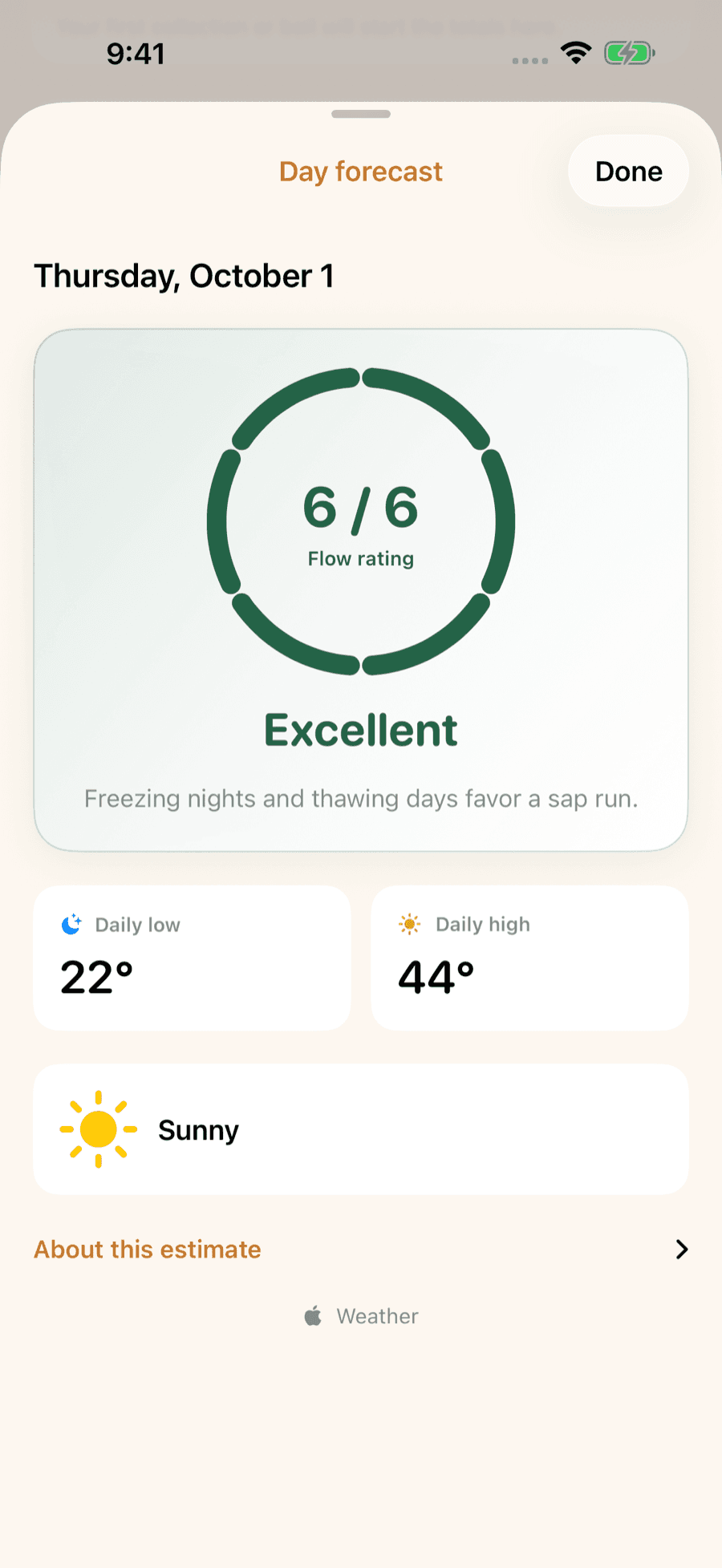
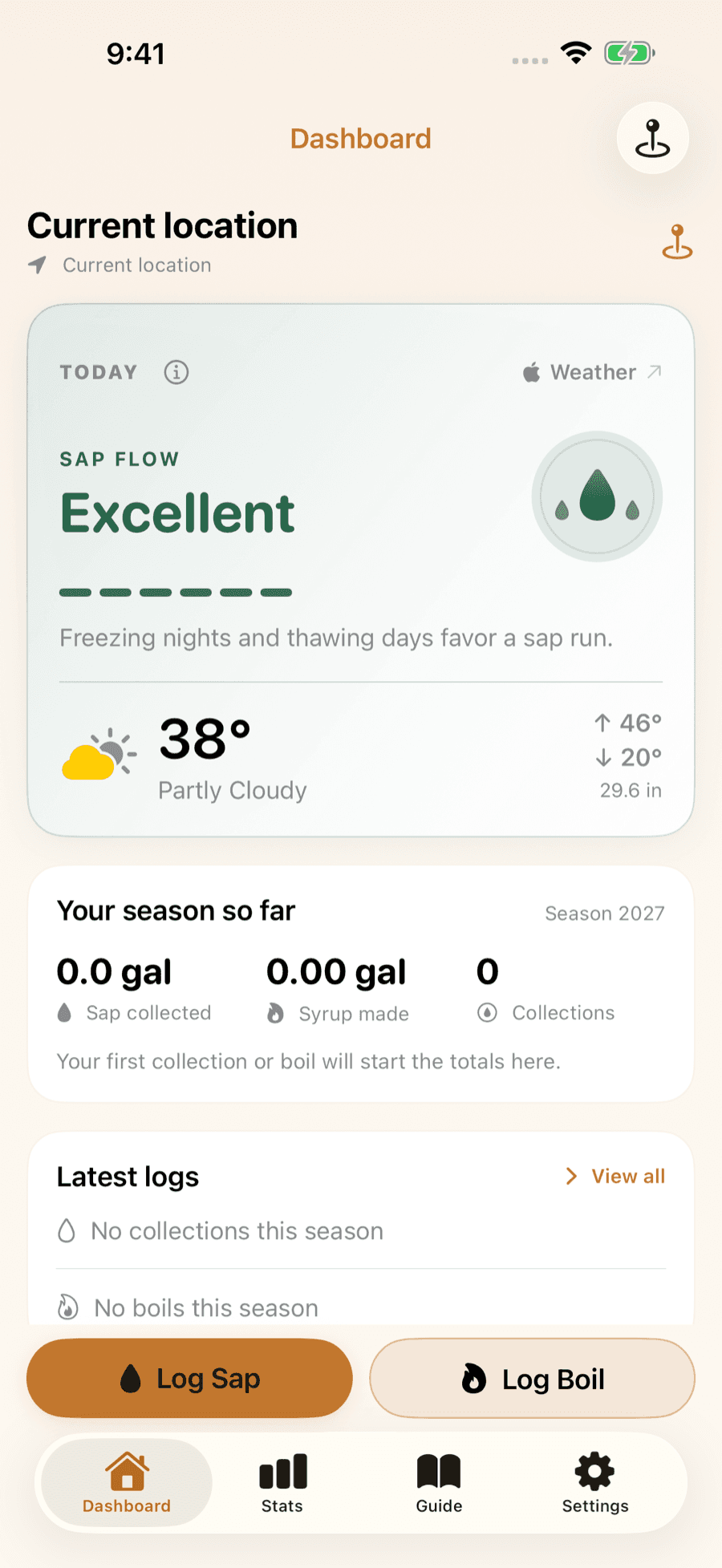
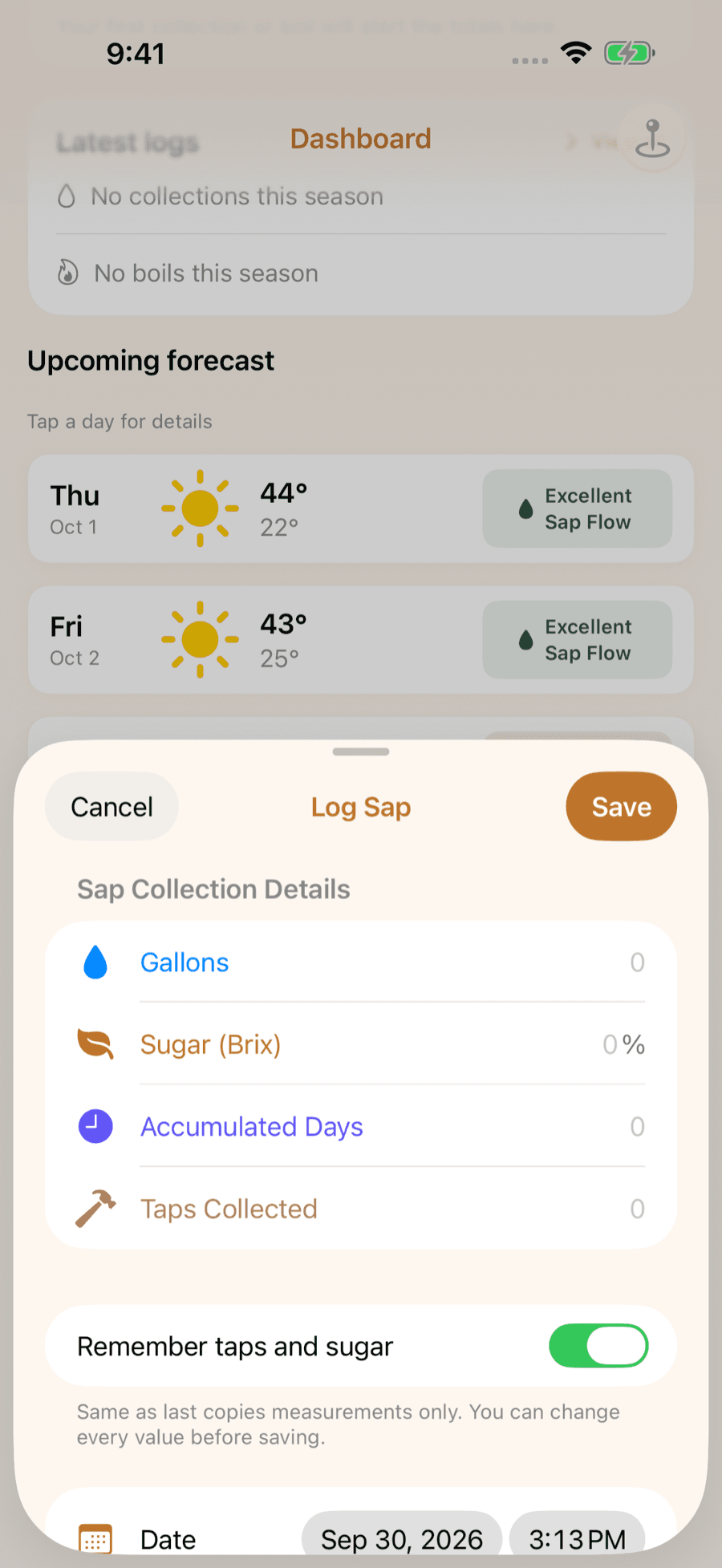
Know your numbers before you price
LuckySap logs every collection and boil (sap in, syrup out, hours on the evaporator) so you know what each gallon really took. Free on iPhone and Android.